


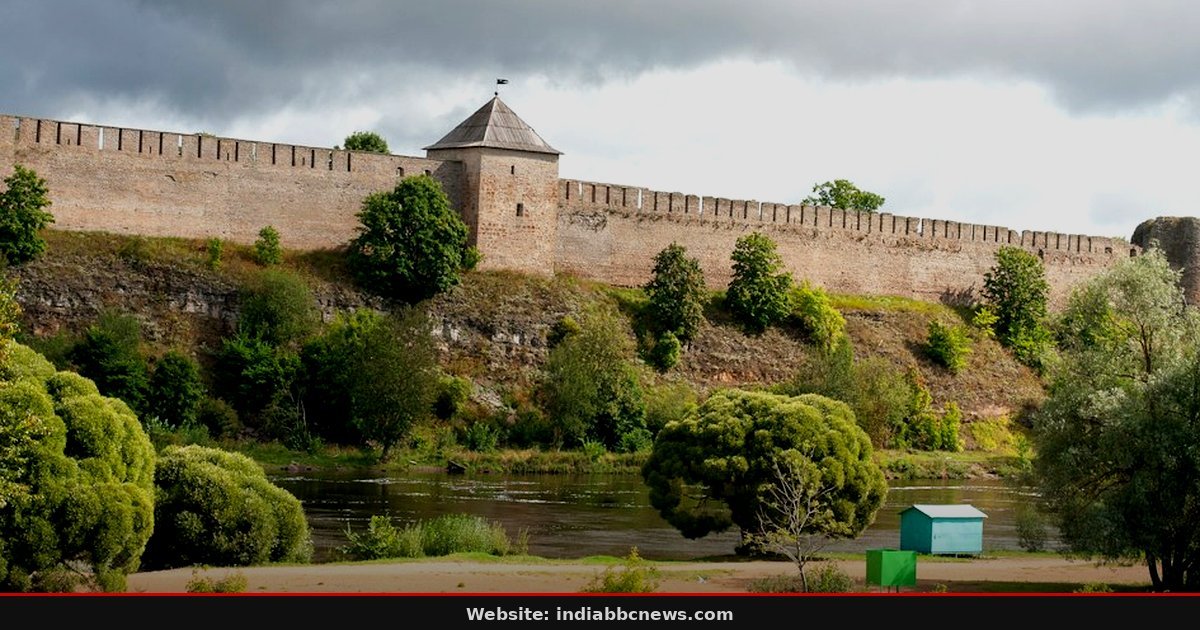
500 people. That is the number crossing the Friendship Bridge in Narva right now. It used to be 25,000. The line stretches casually down the cold pavement, a mix of suitcases, winter coats, and old photographs, while the water of the Narva River laps against the stone walls below.
On December 1, that line will vanish. Estonia is closing its land border with Russia for at least six months. It is a hard, jagged line in the sand. It is also the first time an EU member state has fully shut down a land crossing with Moscow since the 1990s.
We are not talking about a symbolic gesture. This is a physical wall going up in the blink of an eye.
The Cold Reality at Narva
The air here bites. It is late November and the temperature has dropped well below freezing, making the breath of every commuter visible in the grey light. Border guard Eerik Purgel stands near the checkpoint, his face set in a mask of professional exhaustion. He tells reporters that the attack on the drone company Threod Systems near Tallinn was the final spark, but the fuse had been burning for months.
“We understand who the neighbour is,” he said, his voice flat and devoid of emotion. “We have been preparing for whatever provocation might be happening next.” The bridge, named for friendship, feels less like a connection and more like a noose tightening.
For the residents of Narva, this feels like an amputation. The city is 95% Russian-speaking, a fact that complicates the narrative of pure national unity. Many families have roots on both sides of the river, making the closure not just a political statement but a personal exile. One woman dragging a large wheeled suitcase told me she plans to buy her groceries in Ivangorod before the deadline, a trip that used to take 20 minutes and will now require a two-day detour through Finland or Lithuania.
“My mother is on that side,” she said, refusing to give her name. “What is my mother supposed to do? Fly to St Petersburg? It’s too expensive for her.” The economic logic of the border is simple: proximity equals trade, but proximity also equals vulnerability.
Tallinn’s “Frog in Boiling Water” Strategy
Foreign Minister Margus Tsahkna has been loud about this. He uses the metaphor of a frog being boiled in water, slowly turning up the heat. “Russia has pushed all the limits,” he said in a statement released to the press last week. The rhetoric is sharp, cutting through the usual diplomatic fog that often clouds Baltic security discussions.
Tsahkna points to the recent expulsion of a Russian official in Denmark over an alleged plot to assassinate a Ukrainian-American rapper. “They are waging the full package of attacks against Europe,” he warned. It’s a direct call for unity, but one that feels like a plea to brothers who don’t want to hear the alarm bell.
But the decision isn’t just about drones or assassinations. It’s about control. Estonia accuses Russian secret services of crossing the river to recruit agents and test the responsiveness of its border forces. At the end of last year, Estonian authorities caught three Russian border guards on a hovercraft illegally crossing into their territory.
That incident didn’t make the global headlines, but it rattled the local police force for weeks. “These are not isolated incidents,” Tsahkna said, clarifying the timeline for journalists. “This is a pattern. And we are done reacting.
We are acting.” The shift from defense to offense is subtle but significant in the context of European security doctrine. Why should a reader in Mumbai or Delhi care about a bridge in Estonia? Because the supply chains that keep Indian tech and defense industries running are shifting. Estonia is a hub for digital infrastructure and cybersecurity, sectors where Indian startups and firms are increasingly active. If Baltic borders harden, the flow of data and personnel across the European Union may face new regulatory friction.
What This Means for India
Indian companies operating in the EU, particularly in fintech and secure communications, need to watch this space closely. The closure signals a fragmentation of the European single market regarding security-sensitive goods and services. This isn’t just a border; it’s a node in a larger network.
Additionally, Indians abroad in the Baltic states face a logistical quagmire. There are thousands of Indian students and IT professionals in Riga, Tallinn, and Vilnius. While direct travel between Estonia and Russia is rare for them, the psychological and regulatory climate is changing. Border closures often lead to stricter visa scrutiny for third-country nationals, including Indians, in anticipation of potential risks.
The Indian Embassy in Tallinn has advised its citizens to keep their travel documents updated and to avoid unnecessary travel to border zones. It is a subtle warning, but it reflects a broader anxiety about how geopolitical spats between Western powers can ripple out to affect global citizens. The India angle is not about politics; it’s about access, mobility, and the quiet tightening of screws on international movement.
The Iron Curtain Returns, But Different
Moscow is furious. The Russian Foreign Ministry called the move a “hostile act” that brings the situation to the brink of open war. They accused Estonia of tacitly allowing Ukraine to use its airspace for drone strikes, a claim Tallinn denies outright. The language is sharp, echoing the rhetoric of the Cold War, but the context is entirely different.
This isn’t an ideological divide between capitalism and communism. It’s a security conflict between a revisionist power and its neighbors. The “Iron Curtain” of the 1980s was a fixed wall of ideology. This border closure is a fluid, tactical measure, designed to be reversible but psychologically permanent.
It’s a way to signal that Europe is no longer an open door. Historically, border closures have been rare in post-Cold War Europe. The fall of the Berlin Wall in 1989 was supposed to be a one-way street. But 1989 is coming undone. The closing of the Finnish border in 2023 was the first test, driven by a surge of migrants.
Estonia’s move goes further, targeting not just people but the very concept of open borders. It suggests that the Schengen Area, the freedom of movement that defines modern Europe, is becoming a liability. The question is no longer if other countries will follow, but when. The next domino could be Poland, or maybe Sweden.
The geopolitical map is being redrawn in real-time, and the ink is drying fast. On the bridge, business is business. A group of men from Ivangorod are buying last-minute gifts for Christmas, knowing they won’t be able to return to Estonia for months. They are not political actors. They are just people trying to navigate a changing world.
Life Goes On, But Differently
One of them, a mechanic in his 40s, told me he worries about his daughter’s education in Narva. “She goes to school here,” he said. “If the border stays closed, how does she get there? It’s not just about freedom.
It’s about a child’s backpack.” The human cost is often ignored in these grand strategic narratives. It’s easy to talk about national security. It’s harder to explain to a father why his routine is being ripped apart by a decision made in Tallinn or Moscow.
And yet, the city of Narva is not empty. It is still a place of work, of life, of daily struggle. The fortresses on either side of the river have watched centuries of conflict. They have seen empires rise and fall.
They know that borders are temporary, but the need for security is eternal. The people of Narva are not unique in their plight. They are just the latest test case for a Europe that is awake to a threat it spent 30 years ignoring. The bridge will close.
The river will keep flowing. But the relationship between these two lands will never be the same. It’s a harder sell than it sounds, but it’s the only option left.
Frequently Asked Questions
Why is Estonia closing its border with Russia?
Estonia is closing the border due to increased Russian aggression, including sabotage and espionage. The government cites a suspected arson attack on a drone company as the trigger for the decision. They want to send a clear message of unity with Europe and stop what they view as dangerous provocations.
What is the impact on daily life in Narva?
Residents with family ties across the border face separation and travel difficulties. The number of daily crossings has dropped from 25,000 pre-pandemic to just 500 now. Local businesses reliant on cross-border trade are struggling to adapt to the new reality.
Will other European countries follow Estonia’s lead?
It is possible, but no other EU country has announced a full closure yet. Finland closed its border in 2023, but Estonia is the first to halt all road crossings. The decision could influence neighbors like Latvia and Lithuania, who are currently monitoring the situation closely.
Is this move considered illegal under EU law?
No, it is within Estonia’s sovereign rights to manage its borders. However, it raises questions about the integrity of the Schengen Area. The EU is currently discussing how to handle such unilateral security measures without breaking the broader framework of free movement.
Source: The Independent World
Source: The Independent World

