

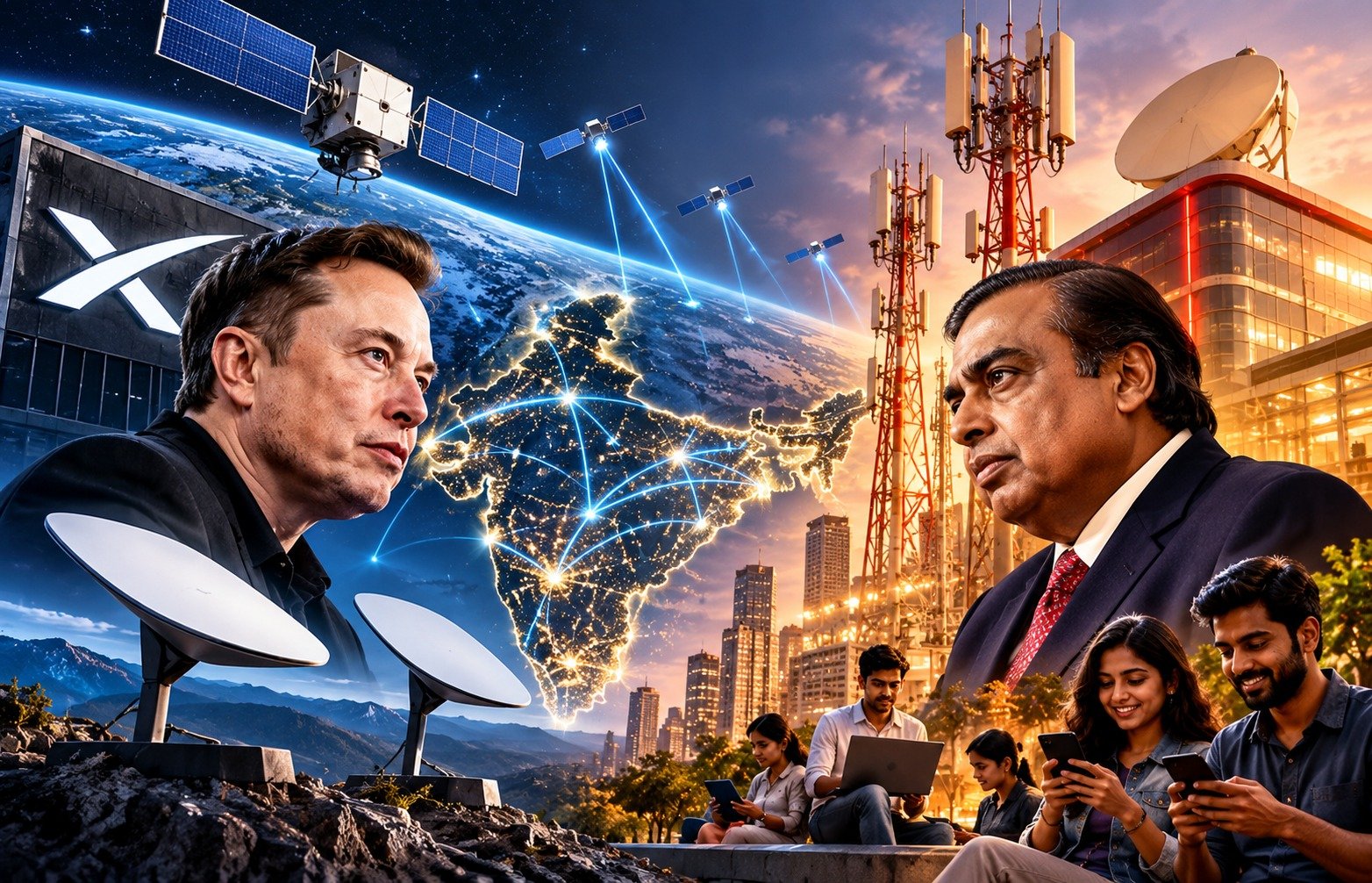
Starlink has not yet begun commercial satellite internet service in India. That delay became a public dispute this week after Elon Musk accused unnamed business interests of blocking the company. India’s Ministry of Communications rejected the charge and said the rules apply equally to licensed satellite operators. The public record cited so far does not establish that Reliance Jio or its chairman caused Starlink’s delay.
Here is what is confirmed, what remains disputed and what Indian customers still need to wait for.
What did Musk say, and how did India respond?
On October 7, Musk said Starlink was being held back by powerful interests. He did not present evidence in that post identifying a company responsible. The next day, the Communications Ministry described India’s satellite authorisation framework as fair and non-discriminatory. Its statement said security assessments were under way for all three licensed operators: Starlink, Jio Satellite Communications and OneWeb India.
That is the government’s position; Musk’s allegation is his own. Neither statement independently settles why Starlink’s final approvals are taking time. The dispute also does not establish that Jio, Reliance Industries or Mukesh Ambani interfered with the process. The Indian Express report on the government’s response has further detail.
Why a licence does not mean Starlink can launch
A satellite communications licence is one step in a longer approval process. The Department of Telecommunications’ January 2026 parliamentary reply confirms that Starlink, Jio Satellite Communications and OneWeb India received authorisation for GMPCS satellite services. It does not announce a commercial launch date or consumer plans.
Before customers can subscribe, operators still have to meet applicable security and technical requirements and obtain the permissions needed to use spectrum. The Ministry said in October that security assessments were ongoing. So a licence is meaningful progress, but it should not be described as proof that service is ready to start.
How Jio fits into the story
Jio is both a major mobile and fibre provider and one of the companies authorised to pursue satellite communications. Starlink’s network uses SpaceX satellites; Jio’s satellite business is a separate part of its wider connectivity plans. The two services could compete for some customers, especially where fixed networks are difficult to build, but they are not yet comparable consumer offers in India.
There is no confirmed Indian launch date, retail price or service package in the government reply or the Ministry’s October statement. Until operators publish those details, claims that one service will be cheaper, faster or better for Indian homes are speculation.
What customers should watch next
The next useful updates will be completion of security assessments, spectrum permissions and an official service launch. Once plans are announced, customers can compare equipment cost, monthly fees, data rules, coverage and support with the broadband they already use.
Satellite broadband may add an option for places where fibre or mobile coverage is limited. It is not automatically a replacement for those networks: availability, capacity, equipment and affordability will determine where it makes sense. For now, the clear story is that three operators have licences, final checks remain, and the claim that rivals are blocking Starlink is disputed.
Sources
- Press Information Bureau: Department of Telecommunications parliamentary reply, January 29, 2026
- The Indian Express: Centre rejects Musk’s claim that oligarchs are blocking Starlink’s India launch, October 8, 2026
- Business Standard: Government response on Starlink’s pending security assessment, October 8, 2026