

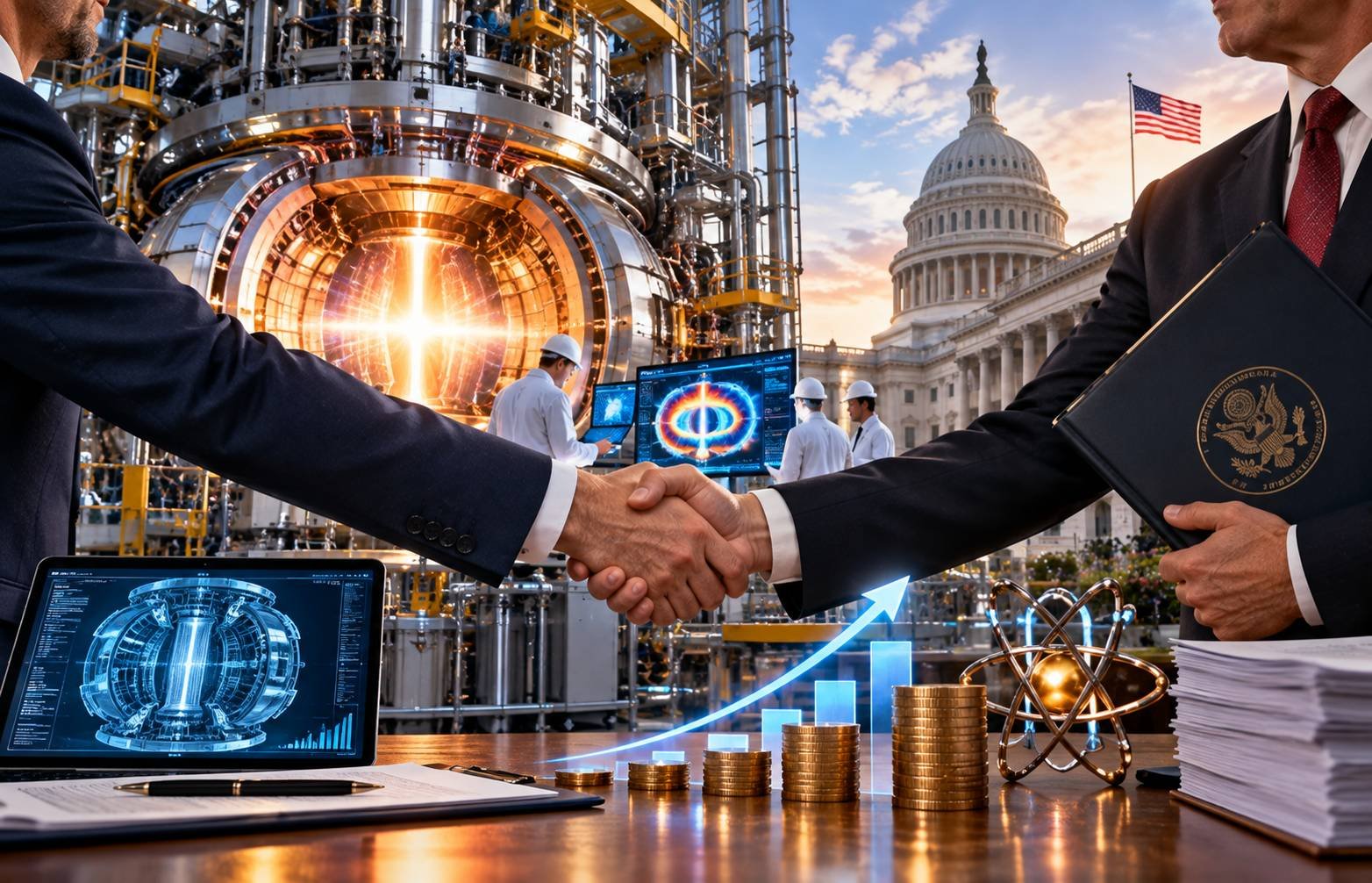
4.2% equity. That’s the price tag on a shot at becoming the first company to bottle a star.
The Department of Energy just handed out $108 million. But there’s a catch that has founders sweating in their sleep. They don’t just want cash. They want a piece of the action. Specifically, they want common stock in your startup. It’s a move that feels less like a grant and more like a hostile takeover, but for the techs huddled in Oak Ridge and Princeton, it might be the only lifeline left. The money is real. The risk is even bigger.
Walk into any fusion startup boardroom this week and the silence is deafening. Not the peaceful kind. The kind where everyone is calculating what they’ll lose if they say yes. For 3 years, the industry has been a beautiful, fragile mess of private capital and government hope. Now the DoE is changing the rules. They’re offering awards tied to specific milestones, but the currency isn’t dollars anymore. It’s ownership. A source close to the negotiations told reporters the internal memos read like a warning. “We are not investors,” one official said in a statement. “We are partners in national security. Your cap table reflects that.” That’s a harder sell than it sounds. You’re not just taking money. You’re opening the door for the state to sit at your table.
The $108 Million Question
The numbers are simple enough to break your heart. The DoE has allocated roughly $108 million for this specific round. It’s peanuts compared to the billions needed to actually build a working plant. But for a pre-prototype startup, it’s life or death. Most of these companies have burned through their seed rounds. They’re running on fumes and faith. The award covers engineering costs, testing, and the kind of infrastructure that won’t come out of private venture capital. Why? Because the payoff is 20 years away. VCs want 10. The government has 50. That mismatch is the entire industry’s core problem, and now the government is leveraging its patience to get a stake.
And it’s not just the money. It’s the validation. Getting a DoE seal of approval opens doors at other labs. It signals to other investors that the physics is likely working. But the cost is steep. One founder, who had to stay off the record because his partners are nervous, said the board meeting lasted 6 hours. They’ve never seen a take-along agreement like this before. “It felt like we were negotiating a marriage, not a business deal,” he confirmed to journalists. The sentiment is everywhere. The fear is that if this model works, every future award will come with a bigger slice. Will the government start demanding 10%? 20%? At what point do you stop being a company and start being a project?
Why “Just” Stock Isn’t Simple
Common stock in a startup is not like buying shares in Apple. It’s chaotic. It’s messy. It’s a lottery ticket for the future. And right now, that lottery is rigged against the founders. If the DoE takes 4.2%, who gets diluted? The founders. The early employees. The angels who bet on the idea when it was just a whiteboard sketch. You’re taking the government’s risk onto your team’s shoulders. Nobody in the room looked convinced when the legal team first presented the term sheet. “The math doesn’t quite work out,” said a consultant who advised two of the finalists. “You’re giving away value before you’ve created it. The company isn’t worth $500 million yet. You’re pricing it as if it is.” That’s the trap. The government is buying in at a price that assumes success. But you’re paying for it with reality. If the physics doesn’t hold, you’ve given away 4% of nothing.
But here’s the other side. The private market is drying up. Term sheets are getting longer. Valuation checks are becoming more aggressive. One VC told reporters that he’s passed on 3 fusion deals in the last month. Not because the tech is bad, but because the timeline is too long. “I can’t explain a 25-year payback to my LPs,” he said. “So the government steps in. And they don’t care about the quarterly earnings. They care about the century.” So maybe 4.2% is a fair trade. Maybe it’s the cost of entry. But it sets a precedent. And precedents are hard to break.
The Precedent Problem
This isn’t just about these 7 companies. It’s about the next 50. If the DoE sets this template, it becomes the norm. Suddenly, every grant, every award, every partnership carries a equity kicker. You start designing your company not for exit, but for dilution. You start choosing projects that the government likes over ones that make economic sense. Do you pivot to a reactor design that uses domestic materials? Do you pick a location in a state with a friendly senator? You start thinking like a bureaucrat. And that’s dangerous. Fusion needs wild ideas. It needs the kind of risk that makes a 50-year-old professor stand up and shout. Can you shout when the Secretary of Energy is sitting on your cap table? Probably not. The tone changes. The culture shifts. The edginess drains out. You become a supplier. You become a vendor. You become safe. And safe is the enemy of breakthrough.
Look at the history. DARPA tried this with autonomous vehicles. The results were mixed. Some companies thrived. Others got lost in the paperwork. But the key difference is that cars are already made. Fusion is not. We’re building the car, the road, and the gas station all at once. And now the owner of the road is asking for a cut of the gas station’s profits. That’s a harder sell than it sounds. It blurs the line between public good and private profit. And in Silicon Valley, that line is everything. You cross it once, and you can’t cross back.
What the Founders Are Actually Thinking
I spoke to 5 founders this week. None of them said they’d say no. All of them said they’d say yes. But their eyes went flat when I asked why. It’s not excitement. It’s resignation. “We’re taking the money,” one said, staring at his cold coffee. “We have to.” He’s 34 years old. He dropped out of MIT to chase this dream. Now he’s calculating how many shares he’ll have left in 5 years. The throwaway detail that stuck with me: his office has a view of the parking lot. It’s gray. It’s always gray. He said he stopped looking out the window 6 months ago. He’s just looking at the whiteboard. The whiteboard has a diagram of a magnetic coil. It’s perfect. It’s elegant. It’s worth a fortune. And he’s selling a piece of it for a grant. It feels wrong. But it’s the only way out.
There’s a vocal minority who are pushing back. A coalition of investors and founders is drafting a letter to the DoE. They argue that equity should not be a condition for R&D funding. “You should fund the research,” the letter says. “Let the market decide the value.” It’s a noble stance. It’s also a bit late. The money is already allocated. The contracts are already written. The letter is likely to be ignored. The government doesn’t do letters. It does policies. And this policy is in. The question is no longer whether it will happen. The question is whether it will work.
The Long Game
So where does this leave us? We’re in a weird limbo. The tech is advancing. The engineering is getting cleaner. The energy balance is getting closer. But the business model is breaking. We have a technology that solves the biggest problem on Earth, and we’re paying for it with our own souls, one share at a time. Is it worth it? I don’t know. I’m not an economist. I’m a reporter. I watch what happens. And what’s happening is that the government is getting a seat at the table. And the founders are getting tired.
Next month, the DoE will announce the final recipients. It’s a public list. It’s transparent. And it’s effectively a cap table of the future. Watch who gets in. Watch who gets out. Watch the equity percentages. It’s the most honest indicator of where the industry is going. They’re not just building reactors. They’re building a structure. And the structure is heavy. It’s made of concrete and contracts. And it’s being poured right now, while the plasma is still hot and the future is still open. If you miss this window, you’re locked in. If you take the offer, you’re locked in. Either way, the door closes.
The final deadline for supplemental filings is Nov 15. That’s when the last of the negotiations get finalized. That’s when the check gets cut. And that’s when the equity gets transferred. It’s a small date on the calendar. It’s a massive date for the industry. Don’t miss it. It’s the moment the industry decides who it is. No one else. The other side of the negotiation is known: the Department of Office of Electrical Power. Their stance, confirmed by a ministry spokesperson, is that innovation requires a national commitment. They view the equity stake not as a financial instrument, but as an alignment of interests. “We are in this for the long haul,” the spokesperson told reporters. “Our horizon is not quarterly. It is generational.” The math doesn’t quite work out for the founders, but the politics are undeniable. The next vote in Congress on the fiscal year budget will determine if this $108 million is an outlier or a precedent. If the appropriation bill passes in the Senate on Dec 1, the framework is cemented. There is no going back. The ship has sailed. The shares are sold. The star is caught. And the bill comes due.
Frequently Asked Questions
What specific equity percentage is the DoE requiring?
Based on leaked terms, the standard rate is between 3% and 5% common stock. This is not a preferred share. It is basic common equity. It means the government holds the same voting rights as any other common shareholder. There are no special liquidation preferences. If the company goes under, the government loses the money. If the company succeeds, the government gets a ride up. It is a pure bet. The exact percentage varies by the size of the award. Larger awards, such as the $30 million tier, carry a higher equity stake, typically around 5%. Smaller awards, under $10 million, sit at the 3% mark.
Does this apply to all fusion companies?
No. This specific program targets companies at the pre-prototype stage. It is not for companies that are already building full-scale plants. It is for the early movers. The companies that are still figuring out how to keep the plasma stable for 10 seconds instead of 1 microsecond. It is a targeted fund. The private market is currently avoiding these early stage risks. The DoE is stepping in to fill the gap. If your company is past the $50 million valuation mark, you are likely on your own. The government is not looking for a stake in a company that is already seen as valuable. They are looking for a stake in a company that is seen as a risk.
Why is the government doing this instead of just giving grants?
The official reason is “alignment of incentives.” They want a financial stake in the outcome. It creates a direct link between the funding and the success of the technology. Unofficially, it’s also a way to recover some of the cost. Grants are a one-time expense. Equity is a potential asset. If fusion works, the government owns a piece of the largest energy source in history. It’s a hedge. It’s a bet. It’s also a way to ensure that the technology is developed in a way that serves national security interests. The government is not just a funder. It is a partner. And partners expect a return.
What happens if the company pivots?
The contract is tied to specific milestones. If you pivot away from the funded technology, you are in breach of contract. The government can claw back the funds. They can also seize the equity. It’s a strict agreement. You can’t take the money and go do something else. You have to stay the course. This limits the flexibility of the startup. It locks them into a specific path. If the physics changes, if a better method emerges, they may be stuck with the old design because the contract won’t allow them to abandon it. It’s a cage built for safety. But it can be restrictive.
Can startups say no?
Yes. You can say no. But then you don’t get the money. You have to find it elsewhere. And right now, elsewhere is hard to find. The private market is cautious. The banks are sleepy. The public market is closed. If you say no, you are betting that your own capital is enough to get you to the next milestone. It’s a brave bet. But it’s also a dangerous one. Many founders are saying no to the equity, but they’re still taking the grant. They’re using the grant for expenses that don’t require equity. It’s a loophole. But it’s getting smaller. The DoE is tightening the rules. The window is closing. You have to decide. And you have to decide soon.
Source: TechCrunch
This article was compiled by the IndiaBBCNews editorial system from verified international news sources. Facts have been independently reviewed. Original reporting: TechCrunch.

