

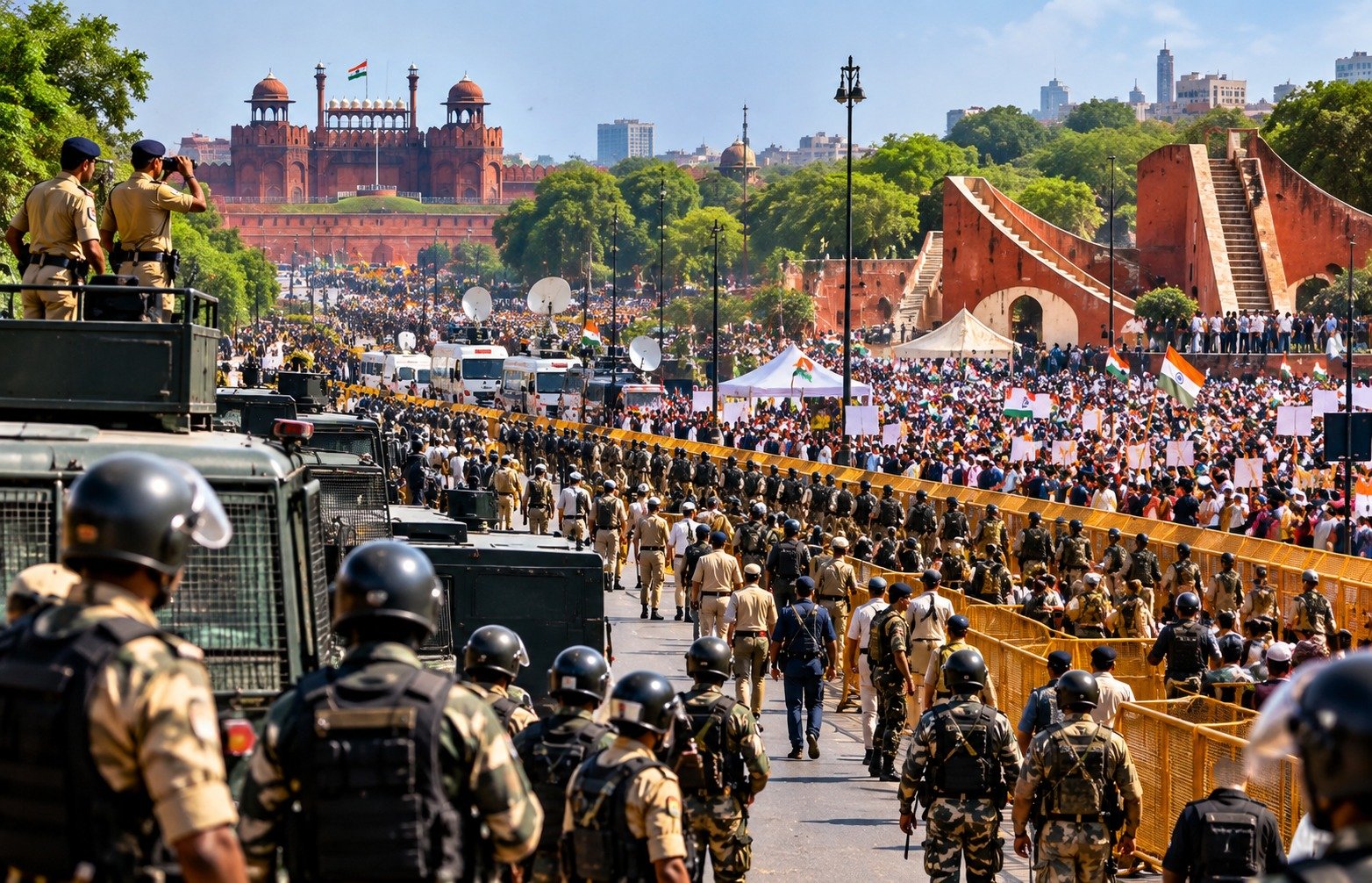
New Delhi, October 10, 2026: Delhi has tightened security ahead of the Cockroach Janta Party’s (CJP) planned “Jantar Mantar 2.0” protest against Chief Election Commissioner Gyanesh Kumar. Reports indicate that a large police and paramilitary deployment, checkpoints, barricades and preventive detention arrangements have been put in place to manage demonstrations and maintain law and order across the national capital.
The Times of India and other media outlets have reported a security mobilisation involving approximately 35,000 personnel. However, deployment estimates have varied across reports, with other outlets citing lower figures. The scale of the preparations reflects authorities’ concerns about crowd management, possible attempts to reach restricted areas and disruption around central Delhi.
Delhi Security Plan: Why Is the Capital on High Alert?
The heightened security arrangements are linked to the proposed CJP demonstration at Jantar Mantar on October 10. The party is demanding action against Chief Election Commissioner Gyanesh Kumar over controversy surrounding the Special Intensive Revision (SIR) of electoral rolls.
According to reporting by The Indian Express, Delhi Police refused permission for the proposed demonstration and prepared a citywide plan to prevent unauthorised gatherings and manage potential law-and-order challenges. Police officials have also focused on coordinating deployments across districts and preventing large groups from converging on sensitive locations.
The preparations follow an earlier CJP agitation in July, during which senior police officers identified shortcomings in crowd assessment and the coordination of personnel. The revised arrangements are intended to improve deployment planning and establish clearer responsibilities for individual units.
The phrase “Delhi Qila” in the headline describes the extensive security posture around the capital; it does not refer to a newly established fort or a separate security installation.
35,000 Security Personnel: What Reports Say About the Deployment
Reports published ahead of the demonstration described a substantial mobilisation of Delhi Police and paramilitary personnel. The Times of India reported that approximately 35,000 personnel were expected to be deployed, while India Today reported a figure of more than 20,000. These estimates may reflect differences in reporting time, geographic coverage or the units included in the count.
The reported deployment covers central Delhi, the New Delhi district and other areas where authorities expect protesters might gather or travel through.
The objective is to manage crowd movement, enforce applicable restrictions and respond to incidents without allowing demonstrations to escalate into wider disorder.
Police units have been assigned responsibilities at designated deployment points. The Indian Express reported that the plan includes 37 blocking points in the New Delhi district and dedicated detention facilities across all 15 police districts.
The presence of a large force does not, by itself, establish that violence will occur. It indicates the scale of the preventive arrangements authorities have prepared for a potentially significant demonstration.
Barricades, Checkpoints and Preventive Detentions
Delhi’s security plan extends beyond personnel stationed near Jantar Mantar. Authorities have also prepared measures intended to limit unauthorised movement towards the proposed protest location.
According to The Indian Express, the plan includes multiple checkpoints, district-level coordination and designated detention centres. Police were instructed to stop groups travelling to join the demonstration within their respective jurisdictions, according to the report.
These arrangements are intended to reduce pressure on central Delhi and help officers respond to gatherings at different locations.
Preventive detention is a consequential measure, however, and any detention or restriction must be assessed under the applicable law and the circumstances of the individual case. The existence of a security plan should not be interpreted as proof that every person travelling to Delhi for the protest has committed an offence.
Authorities must also balance public safety with applicable legal protections, including the rights of peaceful assembly and expression.
Why Is CJP Planning ‘Jantar Mantar 2.0’?
The demonstration is connected to public and political controversy surrounding changes to electoral rolls under the Election Commission’s Special Intensive Revision exercise.
The Cockroach Janta Party, a youth-led movement that emerged from online satire, has called for Chief Election Commissioner Gyanesh Kumar to resign. The demand echoes calls from opposition parties that have questioned the impact of voter-list revisions.
Reuters reported on October 9 that Election Commission data showed approximately 130 million names had been removed from voter lists during the verification exercise. The reported categories included people who had relocated, individuals who could not be traced and people recorded as deceased.
The figures have fuelled debate about voter verification, electoral participation and the accuracy of electoral rolls. Opposition parties have raised concerns about the possible effects of deletions, while the BJP and the Election Commission have rejected allegations of electoral manipulation.
The distinction is important: the number of names removed is a reported administrative figure, while claims about political intent or electoral consequences remain disputed.
The CJP’s proposed demonstration brings these wider questions into the streets of the capital. Its demands concern electoral accountability, while the police response centres on maintaining public order and enforcing restrictions around the planned gathering.
Delhi Police’s Revised Strategy After the July Protest
The current arrangements reportedly reflect lessons drawn from the earlier CJP agitation in July.
The Indian Express reported that police officials identified two key shortcomings: an inadequate assessment of the number of protesters and the deployment of different units or districts at the same locations.
For the October 10 demonstration, the strategy assigns specific points to designated units and introduces a more coordinated approach across police districts. Dedicated detention facilities and instructions to manage gatherings within district boundaries form part of the reported plan.
The approach is designed to give senior officers clearer oversight of personnel and make it easier to coordinate responses across different locations.
At the same time, the effectiveness of the plan will depend on implementation, communication between units and the handling of crowds on the ground. Large deployments can help authorities manage a difficult situation, but they also require clear instructions, proportionate enforcement and safeguards against unnecessary confrontation.
Metro, Trains and Traffic: What Commuters Should Know
The security operation may affect people who are not participating in the demonstration.
Reuters reported on October 9 that several long-distance trains entering Delhi had been cancelled and 57 metro stations were closed from Friday night, according to information from authorities. Separate reporting has described additional restrictions and security checks around central Delhi.
These measures can affect office workers, tourists, students, traders and passengers travelling through major transport hubs.
People travelling across the capital should check official Delhi Police traffic advisories, Delhi Metro Rail Corporation updates and railway notifications before leaving home. Station access, road closures and service arrangements can change during a developing security operation.
Commuters should also allow additional time for journeys near Jantar Mantar, Connaught Place, Janpath and other central Delhi locations affected by police deployment. Travellers should follow instructions issued by transport staff and police officers and avoid entering barricaded or restricted areas.
The precise impact on an individual journey depends on the route, time and latest official restrictions. A general security alert should not be taken to mean that every road or metro station across Delhi is closed.
What the Security Measures Mean for Delhi Residents
The extensive preparations underline the challenge of managing a politically sensitive protest in a densely populated capital.
For residents, the immediate concerns are likely to include travel delays, access to commercial areas, police checks and the possibility of temporary restrictions around sensitive locations. Businesses near affected roads may also experience changes in customer footfall if access becomes difficult.
Authorities must manage these disruptions while protecting public safety and ensuring that restrictions remain proportionate to the situation.
For protesters, the key issues include the status of permissions, the boundaries of restricted areas and the legal consequences of violating applicable orders. Organisers and participants should verify official instructions before travelling to a proposed gathering.
For the wider public, reliable information matters. Unverified claims about closures, detentions or the size of the crowd can cause unnecessary confusion. Official advisories and independently verified reporting are the best sources for updates as events develop.
What Happens Next?
The immediate focus is on how the authorities manage the planned CJP demonstration, whether groups attempt to gather at Jantar Mantar or nearby locations, and how transport and movement restrictions are implemented.
The reported deployment of thousands of police and paramilitary personnel represents a significant preventive operation. However, the final assessment of the arrangements will depend on developments on the ground, including the handling of crowds, any detentions, traffic disruption and the enforcement of applicable restrictions.
The political dispute that prompted the demonstration also remains unresolved. Questions about electoral-roll revisions, voter verification and accountability are likely to continue through political and institutional channels.
For now, Delhi residents and commuters should rely on current official advisories rather than assume that every reported restriction applies uniformly across the city.
Conclusion: Delhi’s preparations for CJP’s “Jantar Mantar 2.0” protest combine a large reported security deployment with checkpoints, barricades and district-level coordination. While some reports put the planned force at approximately 35,000 personnel, estimates differ across outlets. The immediate priorities are public safety, orderly crowd management, accurate communication and respect for applicable legal rights.