

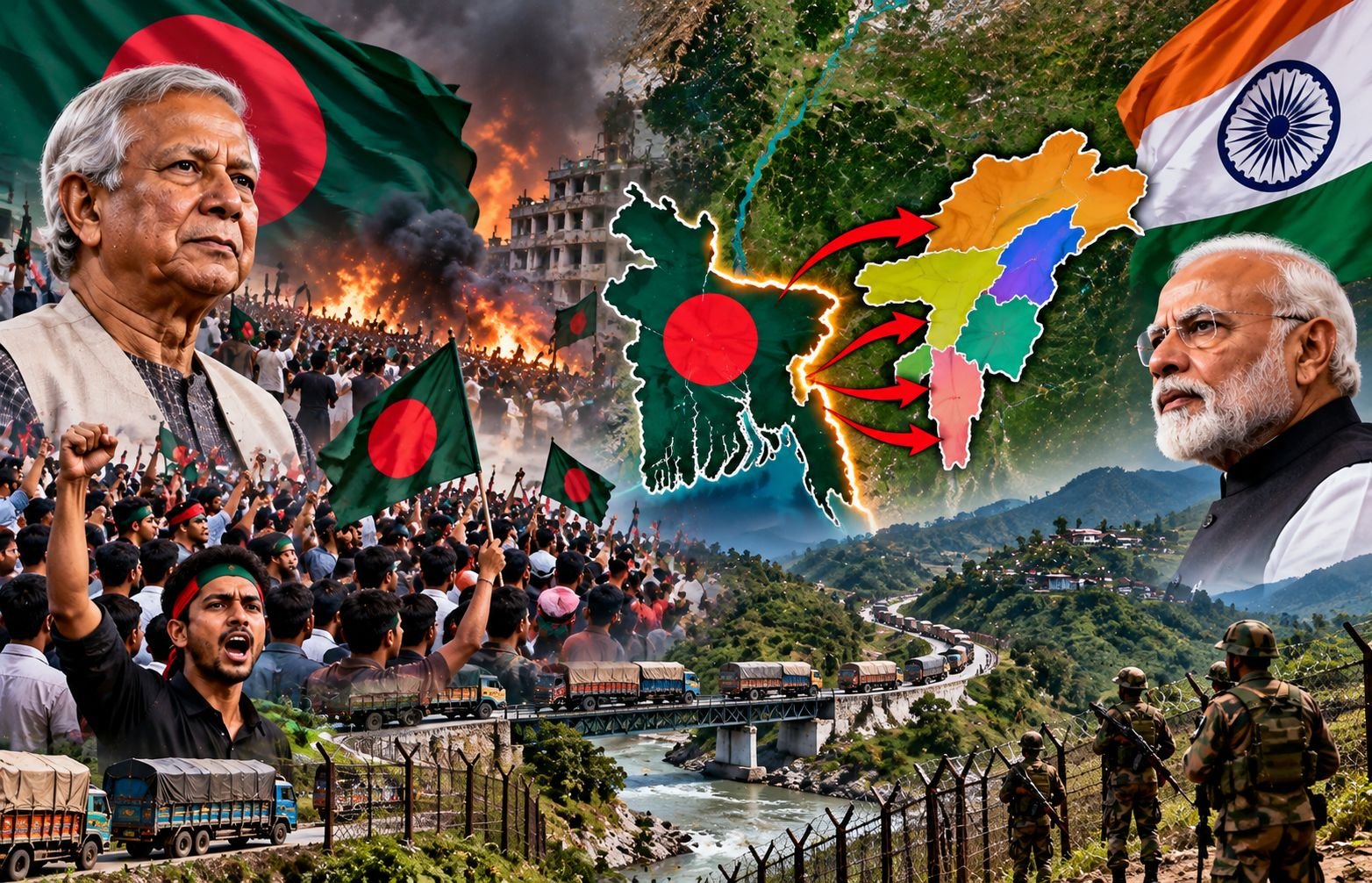
Bangladesh is going through one of its most turbulent political periods in decades. Following the political upheaval that saw Sheikh Hasina’s government fall in 2024, the country has been navigating a complex transition that has significant implications for its relationships with both India and China — and particular consequences for India’s northeastern states that share a 4,156-kilometre border with Bangladesh.
The Current Political Situation
Bangladesh is currently governed by an interim administration led by Nobel laureate Muhammad Yunus. While Professor Yunus brings international credibility and goodwill, the underlying political tensions between the Awami League’s supporters and opposition factions have not been resolved. Planned elections have been repeatedly delayed, and the security situation in parts of the country remains fragile.
Impact on India-Bangladesh Relations
The relationship that Sheikh Hasina built with India over 15 years — characterized by cooperation on water sharing, border security, and transit rights that transformed India’s connectivity to its Northeast — has been recalibrated under the new administration. The Interim Government has sought to balance its India relationship with more explicit engagement with China, which has offered significant infrastructure investment.
The Teesta water sharing agreement, long-promised to Bangladesh, remains unresolved — partly because of West Bengal’s internal politics and partly because the new Dhaka government wants to renegotiate terms. This has become a friction point in otherwise pragmatic diplomatic conversations.
The Northeastern States’ Perspective
For Tripura, Assam, Meghalaya, and Mizoram, the Bangladesh situation is not an abstract foreign policy issue — it’s felt daily. Illegal migration across the porous border remains a source of political tension. The land transit and port access agreements that allowed goods from India’s Northeast to reach the rest of India through Bangladesh have been affected by the political uncertainty. And the Agartala-Akhaura rail link, which was supposed to transform northeastern connectivity, has been stalled.
What India Is Doing
India has adopted a policy of patient engagement, maintaining respectful relations with the Interim Government while making clear its concerns about anti-India sentiment in some quarters of Bangladesh’s political discourse. The strategic calculation: Bangladesh ultimately needs India more than it needs China for economic stability, and the pragmatic interests of ordinary Bangladeshis align more naturally with strong India ties than Beijing’s infrastructure-heavy model.
For readers and citizens trying to make sense of a rapidly changing landscape, the most useful approach is to track credible reporting, maintain a healthy scepticism about unverified claims, and remember that initial reports are often incomplete. The full picture takes time to emerge — but when it does, it usually tells a richer and more nuanced story than the first headlines suggested.