

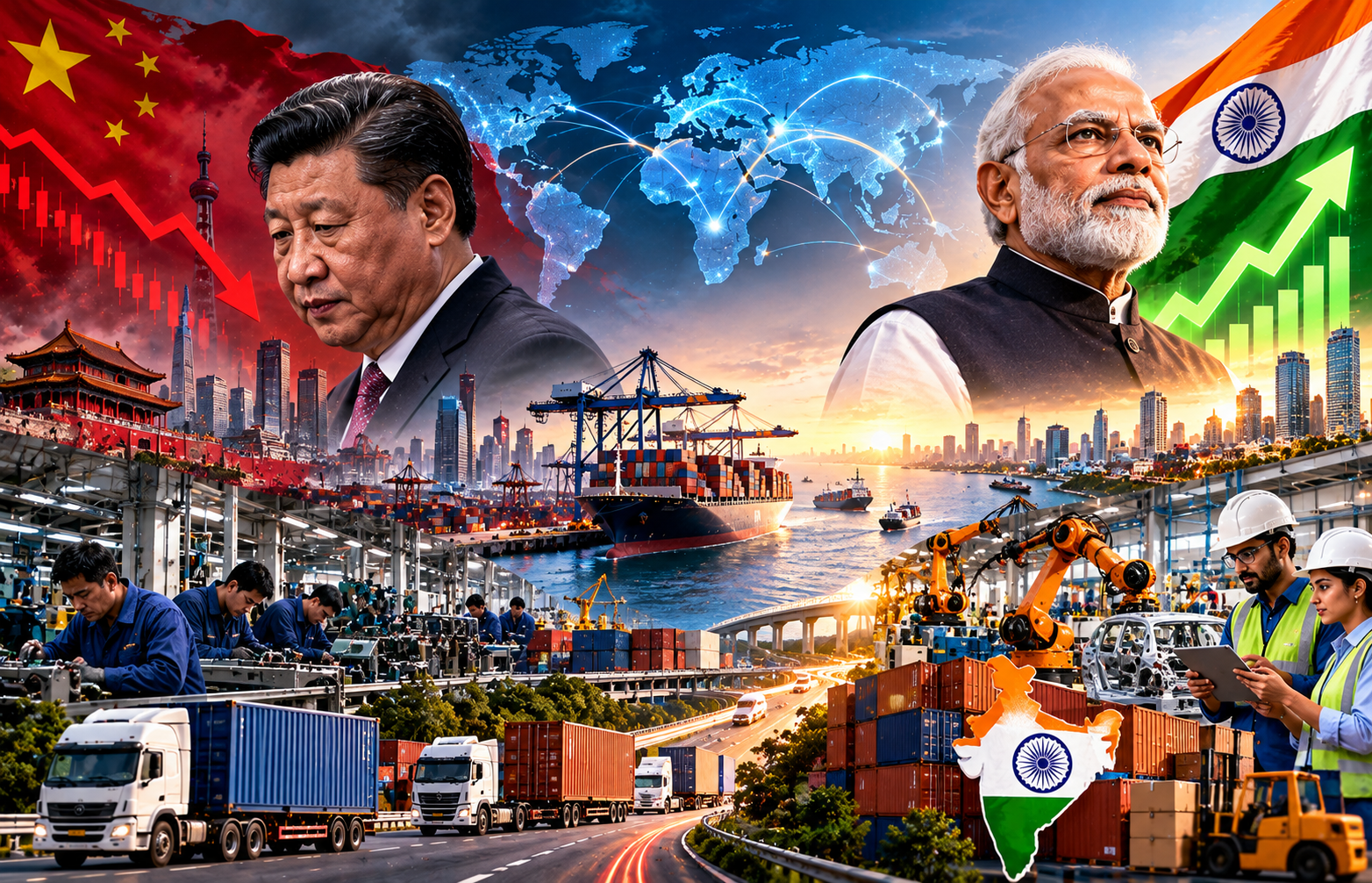
China’s economy is experiencing its most significant slowdown in decades, with GDP growth falling to just 3.8% in 2026 — less than half the double-digit rates seen in the early 2000s. This structural deceleration has profound implications for global supply chains, trade patterns, and creates a historic opportunity for India to emerge as the world’s new manufacturing hub.
Why China’s Economy is Slowing Down
Multiple structural factors are driving China’s slowdown. The property sector crisis, triggered by the collapse of heavily-indebted developers like Evergrande and Country Garden, has wiped out trillions in household wealth. Demographic decline has led to a shrinking working-age population. Geopolitical tensions with the US and Europe have triggered supply chain diversification away from China.
Impact on Global Supply Chains
China’s slowdown is already reshaping global trade. Apple has moved 25% of iPhone production to India and Vietnam. Companies like Samsung, Dell, and HP are diversifying manufacturing bases across Southeast Asia and South Asia. The phrase “China+1” has become standard corporate strategy as businesses seek to reduce dependency on single-country supply chains.
India’s Window of Opportunity
India is emerging as the primary beneficiary of supply chain diversification. Apple’s India manufacturing, now accounting for over $17 billion in exports annually, is just the beginning. India’s PLI schemes have attracted over $25 billion in foreign investment commitments across 14 sectors including semiconductors, electronics, and pharmaceuticals.
Challenges India Must Overcome
To truly capitalize on China’s slowdown, India must address critical bottlenecks: improving logistics infrastructure, streamlining labor regulations, developing a competitive manufacturing ecosystem, and upgrading skilling programs to produce the technically trained workforce that global manufacturers need.
For readers and citizens trying to make sense of a rapidly changing landscape, the most useful approach is to track credible reporting, maintain a healthy scepticism about unverified claims, and remember that initial reports are often incomplete. The full picture takes time to emerge — but when it does, it usually tells a richer and more nuanced story than the first headlines suggested.