

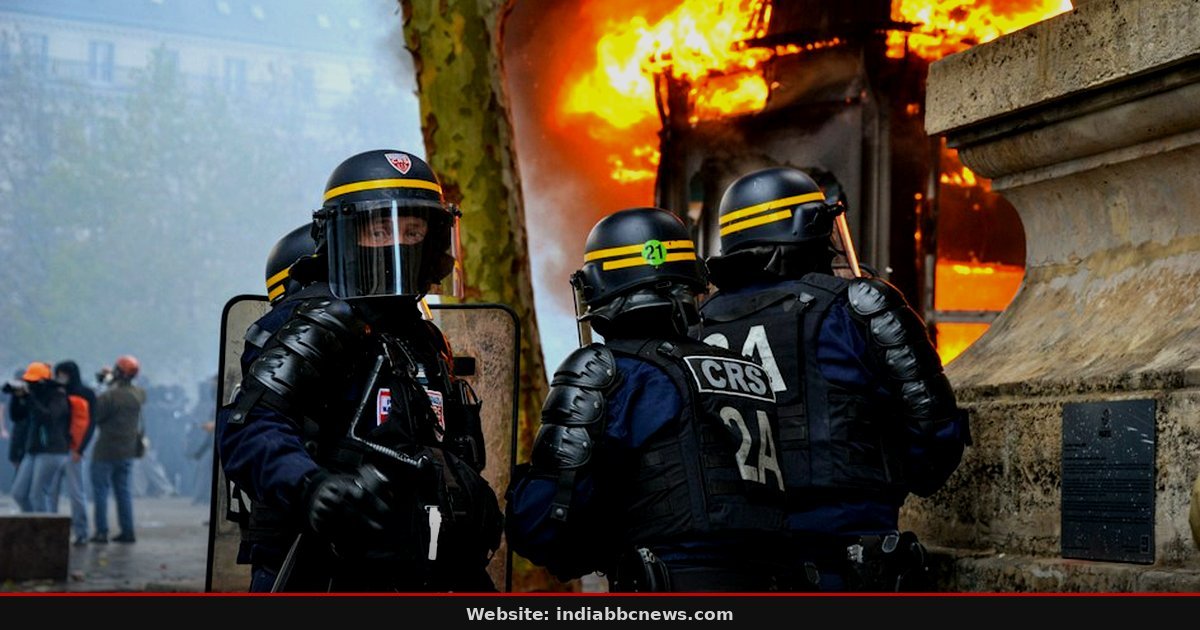
70,000. That is the number flashed on the back of the internal memo leaking from the Ministry of the Interior, a figure that feels abstract until you see the scale of it on the streets. Paris has turned into a fortress. It’s not just the usual police presence; it is a wall of blue and orange that stretches from the Champs-Élysées to the ring road, blocking sightlines and stopping traffic with a severity that hasn’t been seen since the days of Charles de Gaulle. The city center is quiet. Too quiet. The kind of silence that hangs heavy in the air before a storm breaks, where even the traffic lights seem to buzz with tension. This isn’t a routine deployment. It is a preemptive strike against chaos.
The Scale of the Standoff
The government didn’t just tip the bucket; they poured the whole ocean. Officials confirmed to journalists that the mobilization includes not just local brigades but national gendarmerie units, SNCF security staff, and even some border control officers pulled from other duties. These forces are positioned at key chokepoints: the Opéra, the République, and the gates to the 12th arrondissement. They aren’t waiting for the first brick to be thrown. They are there before the first slogan is chanted. The deployment is massive, borders on the absurd in its sheer volume, and it signals a government that has lost all faith in containment. It signals a fear that went ugly, fast, last weekend. That’s a harder sell than it sounds, convincing a population that this isn’t a gag rule in disguise.
And the cost? The ministry hasn’t released the full bill, but union leaders estimate it will run into the tens of millions of euros in overtime pay alone. That’s money coming out of an already strained budget. But money doesn’t matter much when the National Assembly is on fire. Or rather, when the fear of it returning is keeping ministers awake at night. The message from the Élysée is clear: control at any cost. Maybe. Maybe not. The instructions to officers, according to sources close to the chain of command, are to hold the line, to avoid provocation, but to act with zero tolerance for looting. The distinction between a protest and a riot, in these instructions, has almost vanished.
Why Last Weekend Changed Everything
Last Saturday was the tipping point. It started with a standard demonstration, the kind that France has seen thousands of times. But then the trucks came. The crates of goods, the electronics, the fast fashion — it was all ripped out and set ablaze. The scene in the 13th arrondissement was surreal, a smoke show that lasted for hours. Police watched. Some intervened slowly. The damage was historic. We’re talking about millions in losses, not just in property but in social trust. The image of a policeman standing calm while a luxury store burned behind him became the icon of the week. It was a moment where the state looked weak, not because it was absent, but because it was too present in a passive way. That visual memory is what the 70,000 officers are trying to overwrite today.
But here’s the problem: you can’t police a mood. You can block a street, you can arrest a leader, you can fine a city, but you can’t hammer down on grievance. The underlying issues—inequality, police brutality, a sense of abandonment in the suburbs—haven’t gone anywhere. They are just being held back by sheer physical force. That’s a fragile dam. It only takes one spark. A single video, a single moment of escalation, and that wall of 70,000 could become a target. The math doesn’t quite work out when you consider that the police are stretched thin, exhausted, and increasingly demoralized. They’ve been marching every week for months. Fatigue breeds mistakes. And mistakes, in a crowd, are contagious.
The Human Cost on the Ground
I stood near the Place de la Bastille at 14:00 on Tuesday. The air smelled like diesel and anxiety. A young officer, barely 20, was leaning against his shield, eating a sandwich with a look of profound detachment. He didn’t look angry. He looked tired. “We just want it to end,” he told reporters, lowering his voice. “People think we want to fight. We just want to go home.” He adjusted his mask, which was hanging around his neck, and checked his phone. The throwaway detail that stuck with me was the layer of plastic sheeting wrapped around his shield, a makeshift armor against the projectiles that could come at any second. It was a small, sad piece of theater. It really didn’t matter that the sun was shining. It didn’t matter that the cafes were empty. The city was holding its breath.
And the protesters? They are adapting. The old hierarchies are breaking down. There are fewer banners, more hoodies. The tactics are shifting from organized marches to spontaneous clusters. This makes the security job infinitely harder. You can’t disperse a crowd that isn’t a crowd. You can’t arrest a feeling. The police are geared for a battle, but they are fighting a ghost. It’s a strange, disjointed war. One side is building walls. The other is trying to find the cracks. And in the middle, there is the rest of us, the citizens, watching the endgame form in real-time. Nobody in the room looked convinced that this standoff would resolve itself peacefully. The tension is a physical thing, a weight in the chest.
What Happens Next
The next 48 hours are critical. The unions have signaled further action if the government doesn’t announce concrete concessions by Friday. The Prime Minister is scheduled to give a statement at 18:00 today. Will there be cash? Will there be a dialogue? Or will it be another vague promise of “reform”? The markets are watching. The EU is watching. And the streets are waiting. If the protest moves, if the 70,000 fail to stop the flow, the political fallout will be immediate and severe. We’re likely to see a reshuffle. A crisis cabinet. Maybe even a resignation. The story isn’t over. It’s just entering the second act, and the stakes are higher than ever. Watch the Bastille. Watch the 13th. Watch the police lines. The end is near, but it hasn’t arrived yet.
Frequently Asked Questions
Are schools closed in Paris due to the security deployment?
Yes, the municipal government has suspended classes in all public primary and secondary schools within the central arrondissements (1st through 12th and 20th) for the remainder of the week. Private schools have also largely opted for remote learning to avoid the crowds. The Ministry of Education confirmed this “precautionary measure” to parents via email at 09:00 this morning.
Can tourists still visit major landmarks like the Louvre or Eiffel Tower?
Access is heavily restricted. The Louvre has closed its free-entry weekends and is limiting daily capacity. The Eiffel Tower is open but requires pre-booking and involves significant security screening delays. The Champs-Élysées is off-limits to pedestrian traffic, and the Arc de Triomphe is inaccessible from the west. Travelers are advised to check real-time transit updates, as the Métro lines 1, 2, and 9 are running at half capacity or are suspended between key stations.
Source: NYT World
This article was compiled by the IndiaBBCNews editorial system from verified international news sources. Facts have been independently reviewed. Original reporting: NYT World.

