

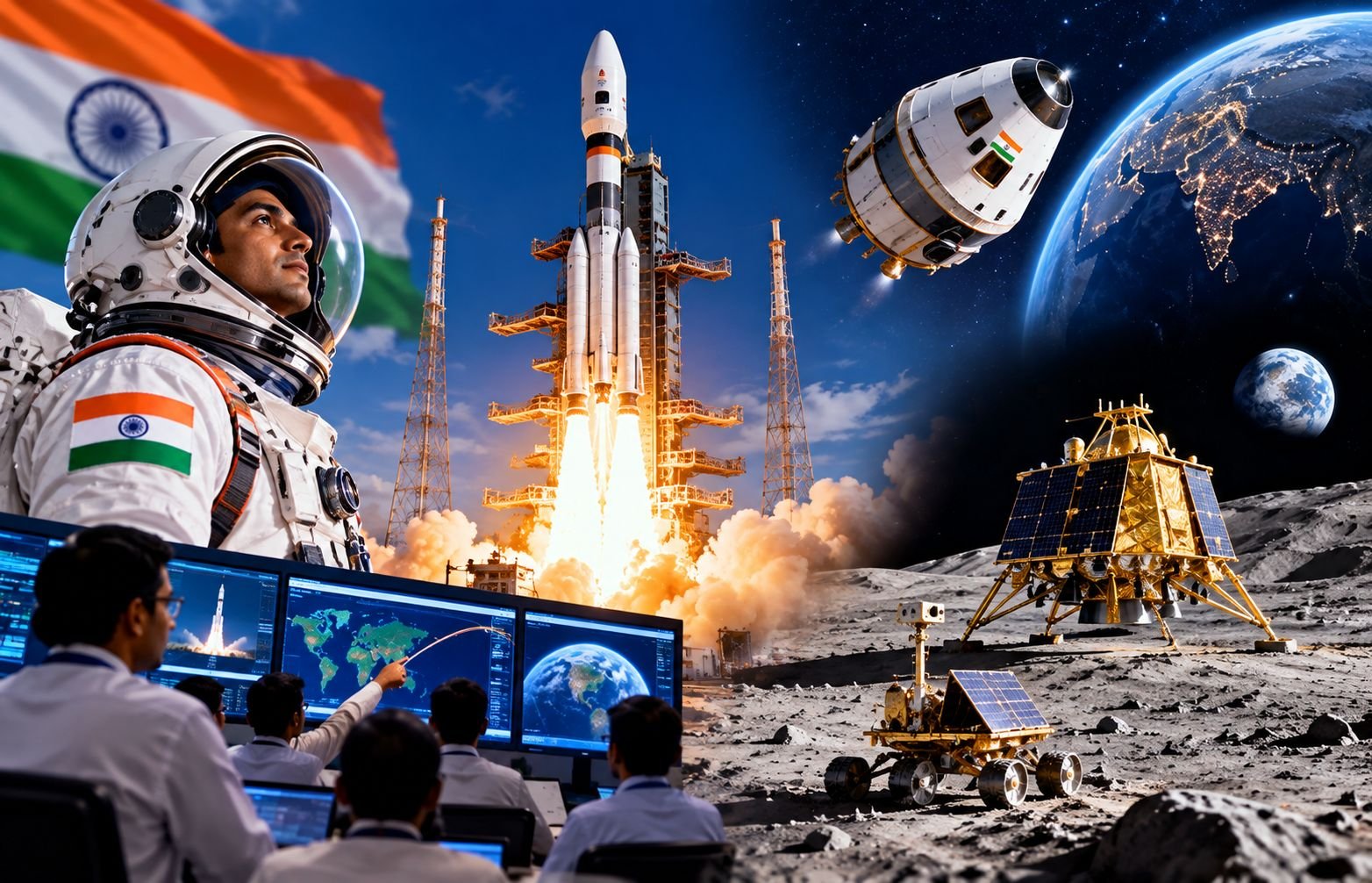
India’s space programme is having its most consequential year since Chandrayaan-3’s historic lunar south pole landing in 2023. ISRO has a packed agenda for the coming 18 months — Gaganyaan human spaceflight, a joint mission with Japan, and early planning for a crewed lunar mission that would make India only the fourth nation to send humans to the Moon.
Gaganyaan: The Human Spaceflight Mission
India’s first crewed spaceflight mission, Gaganyaan, is targeting a launch window in late 2026 or early 2027. The mission will carry three Indian astronauts — Group Captain Prashanth Balakrishnan Nair, Group Captain Ajit Krishnan, Group Captain Angad Pratap, and Wing Commander Shubhanshu Shukla — to a low Earth orbit altitude of approximately 400 km for a mission duration of three days.
Before the crewed flight, ISRO will conduct at least one more uncrewed test flight to verify all systems. The abort systems, life support, and re-entry heat shield have all been independently tested. ISRO Chairman Dr. V. Narayanan expressed confidence that all major technical challenges have been addressed.
Chandrayaan-4 Plans
The success of Chandrayaan-3 has given ISRO the confidence to plan an even more ambitious lunar mission. Chandrayaan-4, targeting a 2027-28 launch window, aims to achieve what no mission has done since the American Apollo programme: return a sample of the lunar surface to Earth. The technical challenge is significantly greater — a robotic return mission requires a lunar ascent vehicle, a rendezvous in lunar orbit, and a precise Earth re-entry.
The Japan Partnership
ISRO and JAXA — Japan’s space agency — have formalized a joint lunar mission called LUPEX (Lunar Polar Exploration Mission) that will investigate the presence of water ice in the Moon’s permanently shadowed craters. India contributes the landing system while Japan contributes the rover, making it a genuinely collaborative mission that demonstrates India’s value as an international space partner.
What This Means for India
India’s space programme is increasingly a story about national pride that actually justifies the pride it generates. ISRO consistently achieves remarkable results at a fraction of the cost of comparable missions by NASA or ESA. The commercial spinoffs — satellite launch services, space technology expertise, inspiring a generation of young Indians toward STEM careers — are multiplying as the programme’s ambitions grow.
For readers and citizens trying to make sense of a rapidly changing landscape, the most useful approach is to track credible reporting, maintain a healthy scepticism about unverified claims, and remember that initial reports are often incomplete. The full picture takes time to emerge — but when it does, it usually tells a richer and more nuanced story than the first headlines suggested.