

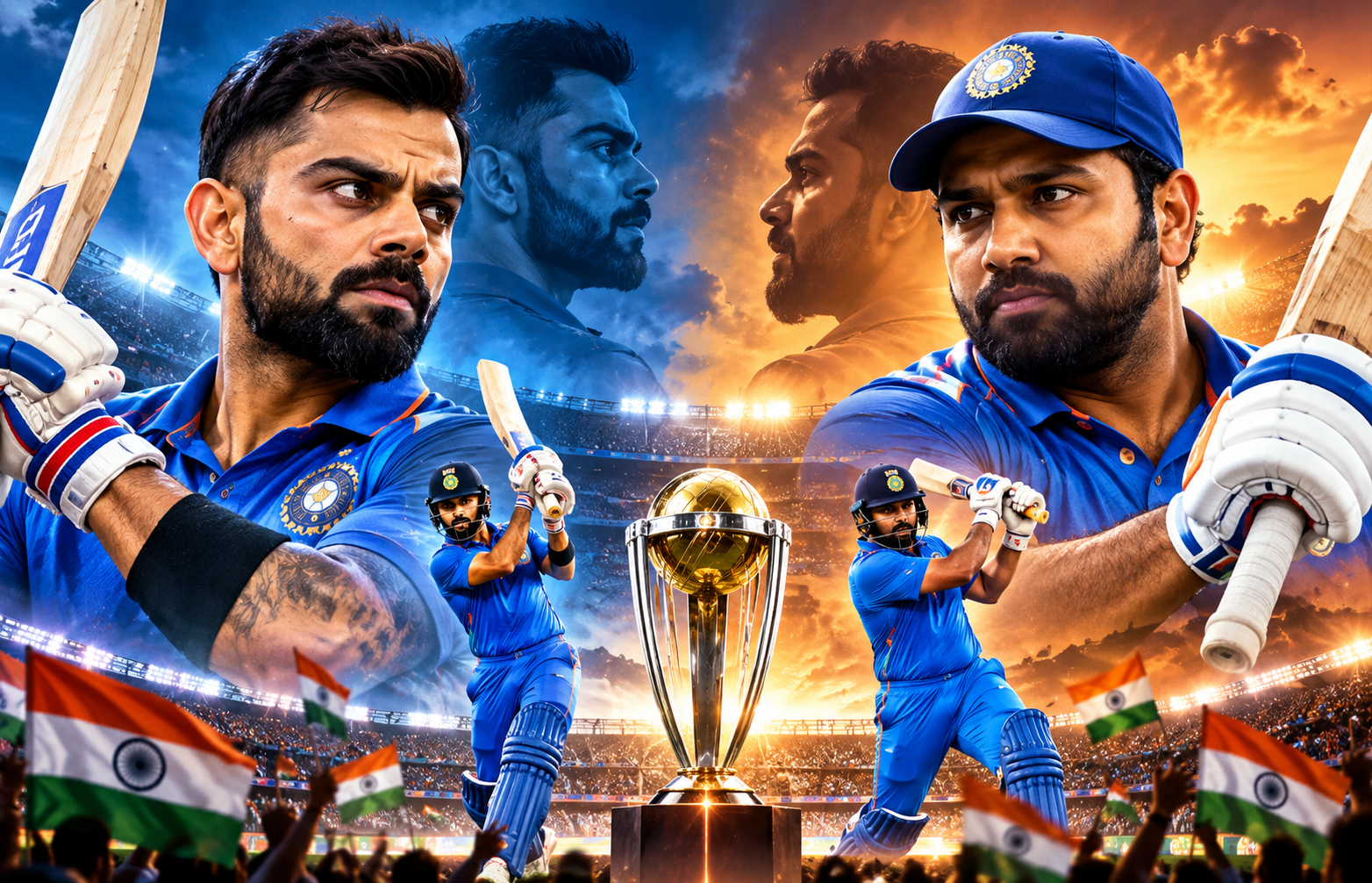
Few debates in Indian cricket spark as much passion as the comparison between Virat Kohli and Rohit Sharma. Both are legends of the game. Both have carried India to glory on the biggest stages. And as both players enter the twilight of their international careers, the debate about their relative greatness has never been more intense — or more heartfelt.
Let me be clear about something upfront: this isn’t a question with a clean answer. What it is, is an opportunity to appreciate two extraordinary careers that happened to unfold simultaneously, each complementing and pushing the other to greater heights.
The Numbers
Kohli in Tests: over 9,000 runs, 30+ centuries, averaging 49+ across a career that reshaped what batting in the longest format could look like. In ODIs, his record is arguably the greatest ever — an average above 58, 46 centuries, and a consistency that no other batsman has come close to matching in the format’s history.
Rohit in Tests: transformed from a middle-order batsman to arguably India’s best opening batsman since Virender Sehwag. 10 centuries as an opener, including multiple 150+ scores. In T20Is, his conversion rate and strike rates are simply better than anyone who has ever played the format. Six IPL titles as captain — a number that speaks for itself.
Leadership vs Individual Brilliance
This may be the most significant differentiator. Rohit Sharma’s captaincy record is extraordinary: multiple IPL titles, an Asia Cup, and India’s T20 World Cup victory in 2024. He has proven himself a tactical genius who reads the game with exceptional clarity. Kohli’s leadership record, while impressive, is complicated by the Test series losses in South Africa and the unfortunate early exit from the 2021 T20 World Cup.
The Honest Answer
In pure batting terms across all formats, Kohli’s numbers make the strongest statistical case for the greatest Indian batter ever. But Rohit’s transformation story, his captaincy legacy, and his extraordinary effectiveness in the two shorter formats give him a claim to the title of India’s most complete cricketer. The good news? We don’t have to choose — we got to watch both of them, simultaneously, for over a decade. That was the privilege.
Key Takeaways
As we look at this story in the broader context of what’s happening in India and around the world, several important points stand out. First, the pace of change in this area has accelerated significantly over the past 24 months. Events that once took years to unfold are now happening in months or even weeks.
Second, the impact on ordinary Indians is real and immediate. Whether it’s the price of petrol, the availability of jobs, or the content we watch on our phones, the big stories of 2026 touch everyday life in ways that weren’t true of news stories a decade ago. That’s partly why public interest in these topics has never been higher.
What Experts Are Saying
Analysts across India’s leading think tanks and media organisations have weighed in on this development. The consensus appears to be that this is a significant moment — one that will have ripple effects for months and possibly years to come. The speed with which the situation is evolving means that yesterday’s analysis can quickly become outdated, so staying informed through reliable sources matters more than ever.
Industry observers point out that India’s unique position — as a rapidly growing democracy with 1.4 billion people, a young population, a dynamic private sector, and an increasingly active foreign policy — means that developments here don’t just affect Indians. What happens in India has consequences for the global economy, geopolitics, and technology that reverberate from Silicon Valley to Beijing to Brussels.
Looking Ahead
The next few weeks and months will be critical. There are several key developments to watch: policy responses from the government, market reactions, public opinion shifts, and how this story interacts with other major trends unfolding simultaneously. India rarely has the luxury of dealing with one challenge at a time, and the interplay between different stories is often where the most important dynamics emerge.
For readers trying to make sense of a rapidly changing landscape, track credible reporting, maintain healthy scepticism about unverified claims, and remember that initial reports are often incomplete. The full picture takes time to emerge — but when it does, it usually tells a richer and more nuanced story than the first headlines suggested.
Stay tuned to indiabbcnews.com for the latest updates, analysis, and expert commentary on this and all the major stories shaping India’s present and future.