

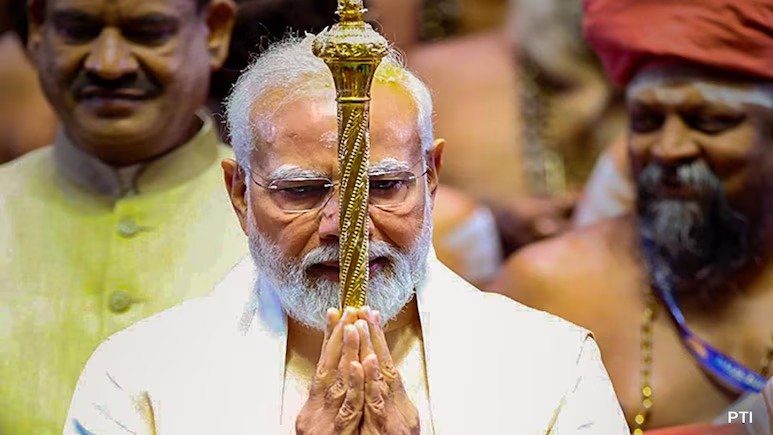
If you picked up NCERT’s new Class 9 Social Science textbook this week, you’d find something that wasn’t in any previous edition: an account of the Sengol — a gold-plated sceptre — being presented to Jawaharlal Nehru at midnight on August 15, 1947, as a symbol of the transfer of power from British rule to independent India. The textbook, Understanding Society India and Beyond – Part 2, was released this week, six months after the academic session had already begun. And it has sparked a debate that’s been simmering since 2023, when Prime Minister Modi installed a Sengol in the new Parliament building.
The question isn’t whether the Sengol exists, or whether it has historical significance in Tamil culture. It clearly does. The question is whether the specific claim — that it formally represented the transfer of power at Independence — is historically accurate. And on that, the textbook and several prominent historians are telling very different stories.
What the NCERT Textbook Actually Says
The textbook describes the Sengol as “a cultural marker of rulership and good governance,” tracing its origins to the Chola period more than a thousand years ago. It states that the tradition was revived at the time of Independence, when Adheenam saints from Tamil Nadu’s old Shaivite tradition presented the sceptre to Nehru at midnight on August 15, 1947.
The textbook also connects the Sengol to the 2023 inauguration of the new Parliament building, where PM Modi placed it inside the Lok Sabha chamber. It further notes — perhaps controversially — that several medieval rulers including Chhatrapati Shivaji were “believed to have” received swords from gods and goddesses. Critics have questioned why this religious-mythological framing is appearing in a secular social science textbook for 14-year-olds.
What Historians Say: “We Can’t Find the Evidence”
Here’s where it gets complicated. Aditya Mukherjee, a historian who specialises in India’s freedom struggle, has said he could find no historical evidence showing that the Sengol represented anything more than a gift from a religious institution to Nehru. He has described the recent interpretation — particularly the idea that it was part of a formal ceremony marking the transfer of power — as an attempt to reinterpret Independence through a Hindu-nationalist framework.
Rajmohan Gandhi — Rajagopalachari’s own grandson and biographer — has added a particularly striking detail. The government’s version of the story involves Nehru asking C. Rajagopalachari (popularly known as Rajaji) for a ceremony to mark the transfer of power, with Rajaji then arranging for the Sengol to be made. But Rajmohan Gandhi has stated plainly that he had never heard of Rajaji playing the role attributed to him. For a biographer who has spent years studying his grandfather’s life, that’s not a small thing to say.
The Congress party has also challenged the narrative. They point out that the original Independence transfer of power was a constitutional and political event, not a religious ceremony, and that including the Sengol story in a school textbook without acknowledging these disputes is misleading.
The Government’s Position
The Union Ministry of Culture, and the BJP government more broadly, have consistently maintained that the Sengol was indeed presented to Nehru as a “civilisationally rooted” symbol of the transfer of authority from colonial rule to an independent Indian state. They describe it as handcrafted by Vummidi Bangaru Chetty and sanctified by seers of the Thiruvaduthurai Adheenam.
There’s no dispute that such an object existed, or that saints may have presented something to Nehru. The dispute is about what it meant at the time — a formal symbol of transfer of power, or a gift from a religious institution — and whether the 2023 reimagining of the event is historically grounded or politically motivated.
Why This Matters for Students
What happens in NCERT textbooks matters enormously. These books are used by millions of students across India, and what’s presented in them as historical fact tends to stick. This is precisely why the controversy over the Sengol account feels significant to many educators and historians — not because the Sengol isn’t culturally important, but because presenting a disputed historical claim as established fact in a school textbook, without acknowledging the debate, is a different kind of problem.
The textbook’s release was already delayed by six months. And in a week when students and teachers are just getting their hands on the book, the Sengol passage is already dominating the conversation about what NCERT has — and hasn’t — chosen to include.
For a fuller understanding of India’s Independence story, the real answer probably lies somewhere that textbooks rarely go: in the acknowledgment that historical events can be interpreted differently, that the record is sometimes incomplete, and that the meaning of symbols changes over time. That’s a harder lesson to teach than a clean narrative — but it might be the more honest one. Stay updated with India BBC News for more on NCERT textbook changes, Indian history, and education news.