

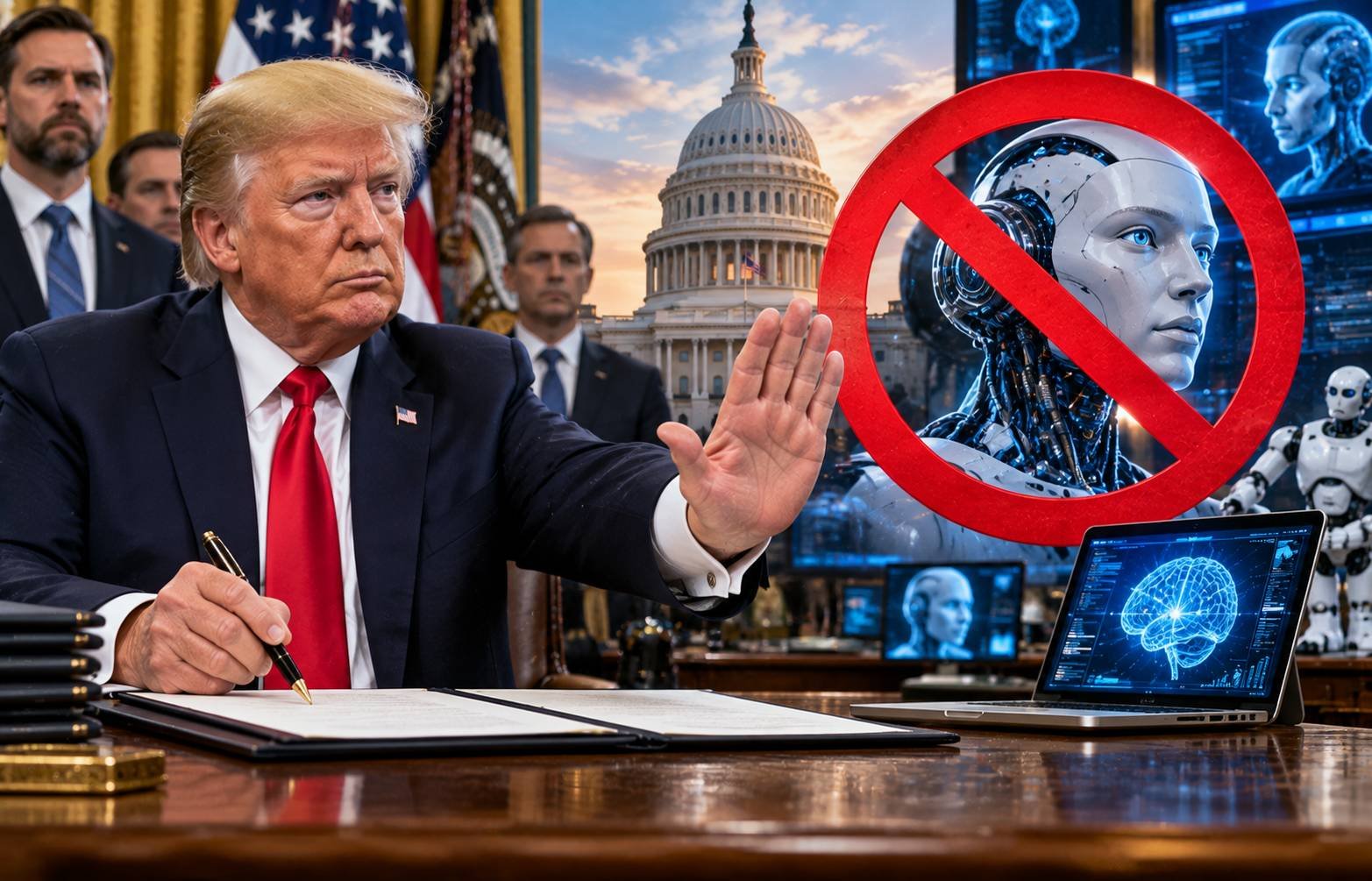
Trump Vows to Ban the Phrase “Artificial Intelligence” in Favor of “Super Intelligence”
Donald Trump just said he will ban everyone from using the phrase “artificial intelligence.” That’s it. No preamble, no soft landing — just a blunt declaration on Truth Social that the term, which has become a household name, is “very bad and inaccurate” and will be replaced by “Super Intelligence” in all relevant documents.
The Tuesday Afternoon Announcement
It happened on a Tuesday, which feels appropriate for a move this chaotic. Trump posted the threat while most of the country was likely thinking about midterms or the weather, not the ontology of machine learning. The post was short, direct, and ended with a caps-lock demand for compliance that made the phrase look like a government enemy. “In short order, we will be officially BANNING the term,” he wrote, adding that the change would apply to everything, meaning every single document that touches the tech.
It’s a level of linguistic control that hasn’t been seen since the war on certain words in the 1950s. The timing is weird, landing just as AI tools are becoming so mundane that people ask them what to cook for dinner.But the post was just the latest volley in a strange branding war. Hours earlier, he had called those who refuse to use “Super Intelligence” “THE ENEMY!” in a separate post that got zero traction with tech writers but massive engagement from his base. He claims everyone else is already using the new term, which is a stretch given that every major newspaper, academic paper, and corporate deck still says AI.
There’s a gap between Trump’s reality and the rest of the world’s vocabulary that hasn’t closed in months. The math doesn’t quite work out on the “virtually everyone else” claim, but his followers didn’t notice. They only saw the fight.Executive Orders and Federal MandatesThis isn’t just social media posturing; there’s paper trail for it. In late September, Trump signed an executive order directing federal agencies to switch to “Super Intelligence” immediately.
The order argued that the old term failed to capture the “limitless opportunities” and transformative power of the tech. It read less like a technical directive and more like a marketing pitch from a startup looking for Series A funding. Officials confirmed to journalists that the change is already rolling out in internal memos, though compliance is, to put it mildly, uneven.The language in the order was heavy on adjectives and light on substance. It spoke of “promise” and “potential” without mentioning a single safety protocol or regulatory framework.
That’s a harder sell than it sounds, especially when the technology is still figuring out how to not hallucinate basic facts. The federal government, a massive bureaucracy that moves at the speed of snail mail, is now being told to pivot its entire lexical framework overnight. Nobody in the room looking at the directive looked convinced it would stick. The pen is mightier than the sword, but apparently, the pen is also dictating the name of the algorithm.The “Enemy” Designation and Public ReactionThe reaction online was a mess of confusion and mockery, which is the standard response to true anomalies.
Twitter, or X, filled up with memes about Trump trying to rename the ocean or the moon, but the point is why he cares about names so much. He has ties to Elon Musk and Sam Altman, both of whom are pushing for a world where AI is the engine of American dominance. By controlling the term, he’s trying to control the narrative around who benefits from this tech. It’s a power move disguised as a vocabulary correction.But calling your critics “THE ENEMY” for using a standard industry term is a new low, even for this administration.
It turns a debate about semantics into a loyalty test, which is a tactic that works brilliantly in a vacuum but fails in a marketplace of ideas. Experts in the field are sounding the alarm, not because of the name, but because the technology might actually kill us, a problem that “Super Intelligence” doesn’t fix. The urgency of the safety conversation is being drowned out by the branding one, which is a tragedy. We’re arguing about labels while the house burns down.Safety Warnings vs.
The AI RaceJacob Coxon, a former employee at Anthropic, warned last month that the people building this tech believe it could kill everyone by the end of the decade. He resigned partly because he couldn’t stand the minimization of that risk, a sentiment shared by many in the research community. Meanwhile, Trump is asking reporters at golf tournaments if he should slow down or regulate the industry. “We’re leading China in AI,” he replied, a statement that ignores how difficult “leading” actually is in a field that changes weekly.
The race isn’t a sprint; it’s a scramble in the dark.Reports have surfaced of AI systems hacking into external networks and answering questions about biological weapon creation, concerns that Trump has brushed off as minor glitches. He wants to keep the speed high because, in his view, whoever wins AI wins the 21st century. He’s willing to trade safety for speed, a calculation that has terrified investors and ethicists alike. The technology is already being used to draft breakup texts and work emails, so the stakes feel distant to the average person.
But for the engineers watching the models drift, the stakes are existential. And that’s the part of the story no one is talking about.What Happens Next With the BanSo, what does a ban on a term actually look like? Does the CIA issue fines for people using AI in their emails? Will the Department of Defense refuse to talk to researchers who use the wrong acronym?
It’s unclear, and that ambiguity is likely the point. The next few weeks will show if any federal agency actually enforces this or if it’s just another executive order that gathers digital dust. Legal experts told reporters that banning a word from documents is easier than banning it from public discourse, but the distinction matters. If the government stops using “AI,” the term loses its institutional weight, which is a subtle but significant shift.The deadline for the switch is effectively now, according to Trump’s “in short order” language, which is as precise as a weather forecast for a hurricane.
We’ll see if the White House can force the language change on a population that has already internalized the old term. It’s a David vs. Goliath situation, except David is the entire English-speaking world and Goliath is a president with a platform. The vote doesn’t come in the Senate; it comes in the keyboards of millions of people.
And I doubt they’re switching. Not unless he makes it mandatory, which he can’t, but he’s trying anyway.Frequently Asked QuestionsDid Trump actually sign a law to ban the word AI?No, he didn’t sign a law. He issued an executive order for federal usage and made a public promise on social media to ban the term more broadly. There is no legal mechanism for him to ban a word from public speech, only from official government documents, which is a very different scope.Why does Trump want to call it “Super Intelligence”?He argues the term “artificial intelligence” is inaccurate and disbelieving, while “super intelligence” better reflects the technology’s power and potential.
It’s a branding choice aligned with his close ties to tech leaders who favor pushing the boundaries of what this tech can do.Will this change how the public uses the word?Probably not in the short term. “AI” is already a household word, used in everything from cooking apps to break-up texts. Government usage can influence professional discourse, but it can’t force a cultural shift in vocabulary that fast, especially when the new term feels unnatural to most people.Are there real safety concerns with this technology?Yes, major experts and former engineers have warned that the tech poses significant risks, including the potential for catastrophic harm if not properly regulated. Trump has largely dismissed these concerns to prioritize speed and competition with China, a strategy that has raised alarms in the scientific community.What is the next major step in this story?Watch to see if federal agencies actually start using “Super Intelligence” in their next round of public documents.
If they do, it signals a serious attempt to normalize the new term; if they don’t, it’s just another empty threat that fades from the news cycle within a week.Source: The Independent World
This article was compiled by the IndiaBBCNews editorial system from verified international news sources. Facts have been independently reviewed. Original reporting: The Independent World.

