

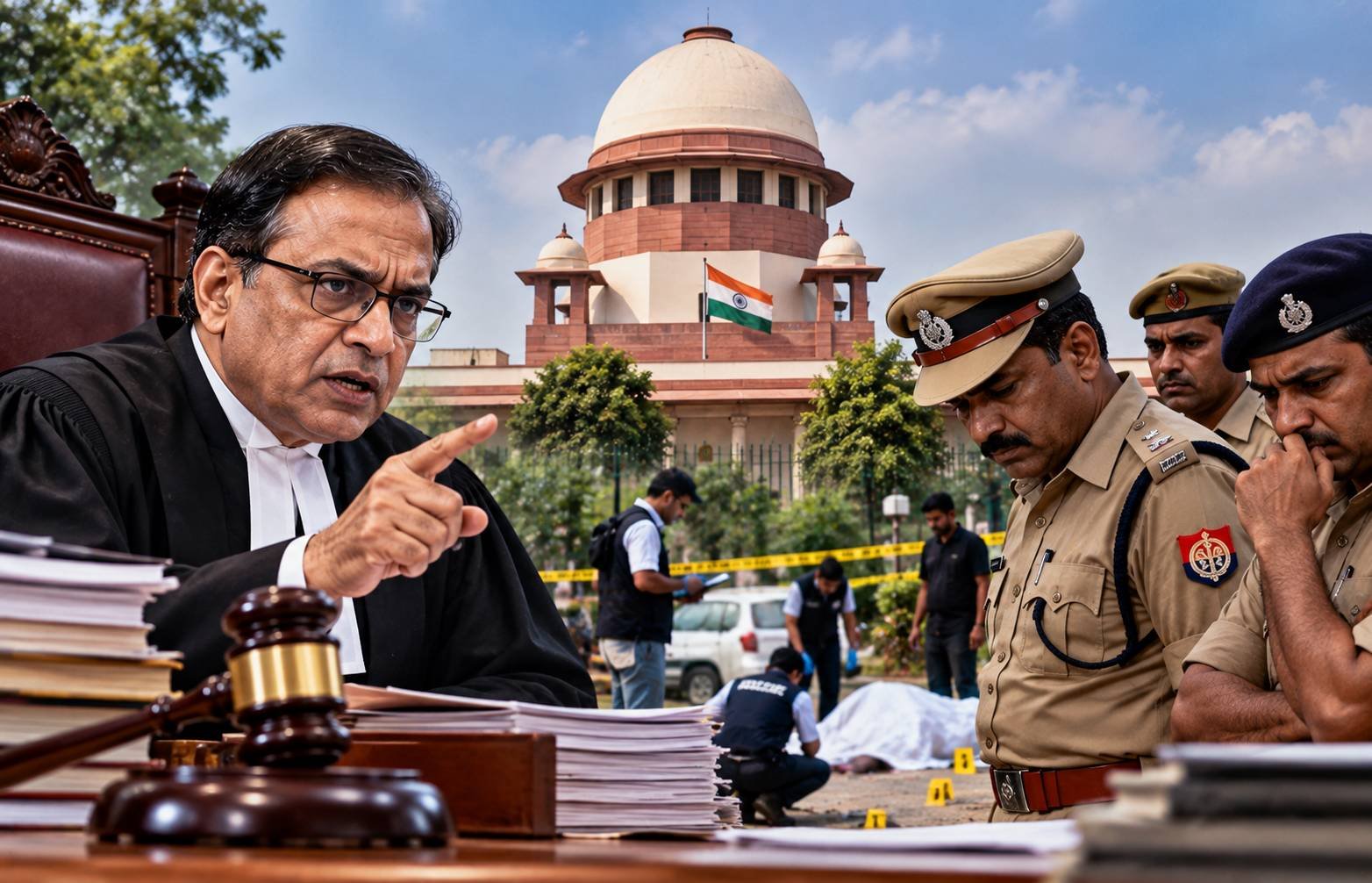
6,00,000. That’s the number. Not the date of the incident, not the name of the victim, but the amount the Supreme Court ordered U.P. police to pay as reparation after the judges finished reading through a file that looked less like an investigation and more like a creative writing exercise. The verdict dropped on a Tuesday, but the outrage in the corridors of justice had been building for weeks, a slow boil that finally erupted when the bench delivered its final order with a severity that few in the state bar expected from the apex court.
The case, rooted in a murder that occurred in a village near Lucknow, had dragged on for nearly 2 years. Two years of unanswered questions, of missing witnesses, of reports that contradicted police diaries, and of a victim’s family that hadn’t stopped calling lawyers hoping for answers that never came. It’s the kind of story that usually gets buried under the noise of daily court proceedings, a mundane entry in the register of pending cases, but the Supreme Court didn’t let it slip through the cracks. Instead, they grabbed it with both hands. The bench, led by the Chief Justice, spent an hour going through the procedural failures. They didn’t just point out errors; they dismantled the entire methodology used by the investigating officers, pointing to gaps that suggested not just incompetence, but a kind of willful negligence that bordered on malice. The reparation amount is small in the grand scheme of state finances, but the symbolic weight of it is crushing. It’s a slap across the face of a system that has long been accused of treating criminal investigations as a bureaucratic chore rather than a duty of conscience.
The Court’s Appalled Reaction Was Rare
Supreme Court benches don’t usually shout. They don’t usually use words like “slipshod” or “appalled” in their written judgments unless the circumstances are truly egregious. And yet, here we have them, etched in ink, a permanent record of how bad things got in this particular case. The judges noted that the police had failed to register the case for months, had failed to secure the crime scene properly, and had failed to interview key witnesses until weeks after the initial incident report was filed. It wasn’t just a delay; it was a breakdown of the fundamental steps required to establish a crime. The court observed that the investigation was “a mess,” a phrase that is polite, almost too polite, for what was actually a chaotic scramble. One senior advocate, who has argued before this bench for over a decade, told reporters that he had never seen the tone of the judgment so sharp. He said the court was clearly frustrated, not just with the individuals involved, but with the systemic apathy that allowed such a botched probe to make it to the highest court in the land. The language used was direct, devoid of the usual legal mumbo-jumbo that often obscures the real issues. They wanted the administration to sit up and take notice. And they wanted it to hurt, just a little.
Procedural Failures Were Cited in Detail
Let’s look at the specifics, because the numbers don’t lie. The FIR was registered 14 days after the incident. By then, forensic evidence could have been compromised, or simply gone missing. The police diary entries were inconsistent, showing times and locations that didn’t match the medical reports. The court pointed out that the investigating officer had visited the scene only twice, both times after the area had been cleaned up by locals, a detail that suggested the police were more interested in closing the file than solving the crime. The bench asked a pointed question: “How can one reconstruct a crime scene if you don’t bother to preserve it?” It’s a rhetorical question, but the answer is painfully obvious to anyone who has ever dealt with serious criminal law. The court also noted that the witness statements were vague, often repeating generic phrases that seemed copied from a template rather than reflecting the actual recollections of the people present. It’s a practice that is all too common in lower courts, where officers are overwhelmed with cases and have no time to do their jobs properly. But when it happens in a murder case, the cost is human life. The dead don’t get to appeal. The living don’t get justice. They just get another year on the clock, another round of hearings, another bill for lawyers. The math doesn’t quite work out when you factor in the emotional toll on the families involved.
Reparation Amount Sends a Strong Signal
₹6 lakh is not a sum that will move the needle in the state police budget. U.P. spends billions on infrastructure, on salaries, on equipment. But the reparation isn’t about the money. It’s about the principle. It’s about forcing the institution to acknowledge, in writing, that it failed. That it owes the victim’s family an apology, paid in cash, as a token of institutional contrition. The court ordered that this amount be paid within 30 days, a deadline that is short but doable if the administration wants to comply. If they don’t, the court suggested that further penalties could be imposed, though it stopped short of specifying exactly what those penalties would look like. The ambiguity is deliberate, a reminder that the court’s patience is finite. Several legal experts told journalists that this is a new tactic, using financial remedies to police administrative behavior. It’s a move that has been tried in other jurisdictions, where cities pay damages for negligence or human rights violations. In India, it’s still relatively new, but it’s gaining traction. The idea is simple: if you’re going to be negligent, it should cost you something. Not just your reputation, but your wallet. It’s a hard sell for some bureaucratic minds, but it’s a necessary one. The alternative is a system that treats the lives of ordinary citizens as disposable, where a botched investigation is nothing more than a paperwork error.
Victim’s Family Sees It as a First Step
For the family of the deceased, the judgment is a mixed bag. On one hand, they have finally gotten some acknowledgment that the system failed them. The money will help cover some of the legal costs that have drained their savings over the past 2 years. But on the other hand, the person responsible for the murder is still at large, or at least, the investigation into their identity remains inconclusive. The family’s lawyer said in a statement that the reparation is not a substitute for justice. “We want answers,” the lawyer said. “We want to know who did this and why. Money doesn’t bring anyone back.” The sentiment is common, but it’s often lost in the shuffle of legal technicalities. The family has been described by local reporters as resilient, holding onto hope even as the months turned into years. They’ve organized small protests, met with local politicians, and attended every court hearing. Now, with the Supreme Court’s order, they have a new tool in their arsenal. They can use the judgment to push for a fresh investigation, or to hold the department accountable for its failures. It’s a long road, and the odds are still stacked against them. But at least they know that the highest court in the country is watching. That matters. It has to.
What Happens Next for U.P. Police?
The ball is now in the U.P. government’s court. They have 30 days to pay the reparation and, more importantly, to review their internal processes. Will they issue new guidelines? Will they train their officers better? Will they punish those responsible for the slipshod probe? We don’t know. History suggests that these kinds of orders are often filed away in a distant corner of the department, to be ignored until the next scandal breaks. But this time, the stakes are higher. The Supreme Court’s judgment will be cited in every law school in the country, and it will be used by lawyers to challenge similar investigations in the future. It creates a precedent, a benchmark against which future police work will be measured. If U.P. police want to avoid more litigation, they have to do better. There’s no other option. The next deadline is the payment date, but the real test is whether the culture within the police force changes. It’s a harder question, with no easy answer. But it’s one that the state has to answer, soon. The eyes are on them, and the court’s patience is wearing thin. We’ll see if the lessons are learned, or if this was just another footnote in a long list of failed promises. The clock is ticking, and the next hearing could be just as dramatic as this one. For now, the family waits, and the police try to figure out how to fix what they broke.
Frequently Asked Questions
Why did the Supreme Court award reparation instead of a jail term?
The court awarded reparation because the primary failure was administrative and procedural on the part of the state, not just a criminal act by an individual. Reparation is a civil remedy to compensate for the state’s negligence and the distress caused to the victim’s family. It does not preclude criminal charges against the actual perpetrator if they are identified.
How much is ₹6 lakh in a practical sense?
₹6 lakh is a significant amount for an average Indian family, able to cover several months of living expenses or major medical bills. For the victim’s family, it helps offset the legal costs incurred over the 2-year struggle, but it is symbolic more than restorative. It acknowledges the state’s failure to provide justice.
Can the U.P. Police appeal this order?
While the Supreme Court’s orders are generally final, a review petition can be filed under specific circumstances, such as a discovery of new evidence or a clear error in the judgment. However, appeals against reparation orders are rarely successful, especially when the failure is as clear-cut as the court described. The risk of losing on review is high, so most departments choose to comply.
What does “slipshod” mean in legal terms?
“Slipshod” is not a legal term but a descriptive adjective used by the judges to characterize the quality of the investigation. It implies carelessness, lack of precision, and failure to meet the basic standards of due diligence. In legal documents, such language is rare and signals that the court is not just noting a technical error but a fundamental breakdown in duty.
Will this change police investigation procedures across India?
It is unlikely to change procedures overnight. However, it serves as a powerful reminder to police departments across the country that the Supreme Court is actively monitoring the quality of investigations. Other states may look to this judgment as a guide for improving their own processes, but implementation will depend on local will and resources. It’s a push, not a mandate.
Source: The Hindu
This article was compiled by the IndiaBBCNews editorial system from verified international news sources. Facts have been independently reviewed. Original reporting: The Hindu.

