


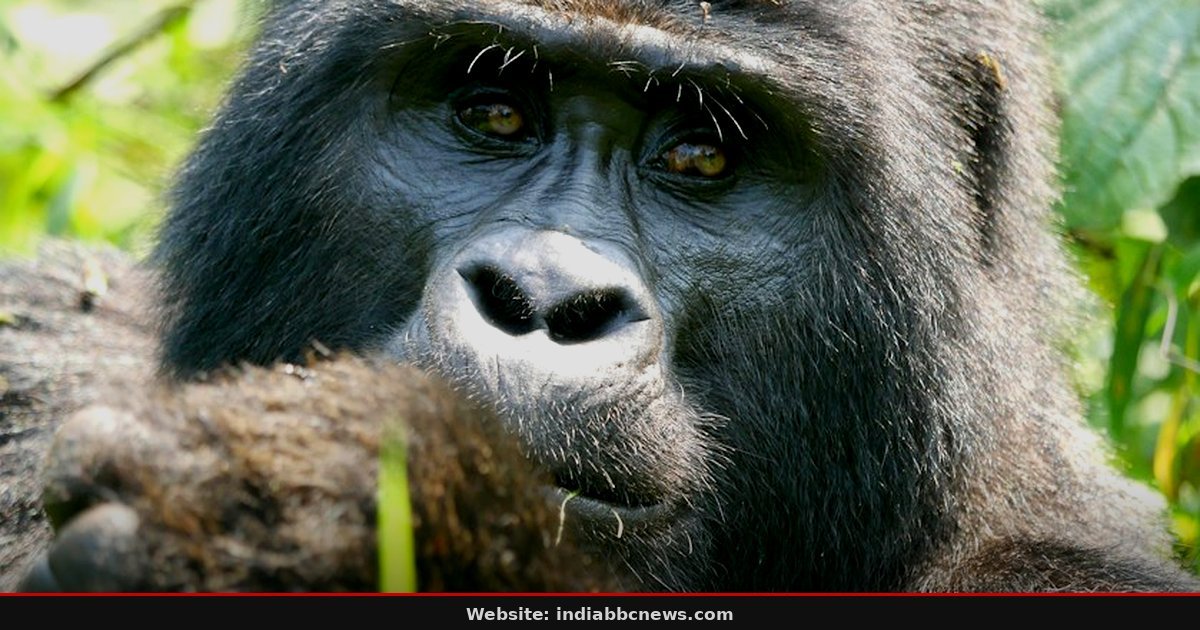
Jojo’s nose is cold. Not in a seasonal sense, but physiologically stuck in a state of chronic alertness that his body cannot shut off. It is a telltale sign that his stress response is broken, a biological scream that no amount of sanctuary space can silence. He has spent 11 years in a cage in Gabon, and now he is free but profoundly, terrifyingly alone.
For most gorillas, the first 14 to 19 years of life are spent huddled inside a tight-knit family unit. Jojo never had that. He was less than a year old when poachers killed his family and sold him. Since then, he has only known iron bars and the eyes of tourists.
The question isn’t just whether he can find a friend. It is whether his mind is still wired to accept one, and if we can even find a compatible soul mate in a global trade that has displaced 6,000 primates in the last two decades. Prof Gillian Forrester from the University of Sussex is doing something that sounds like science fiction but is pure necessity. She uses thermal cameras to watch the blood flow in Jojo’s face. Specifically, she watches his nose.
The Cold Nose Signal: Reading Primal Trauma
When any primate feels threatened, blood rushes to their ears and eyes to boost sensory acuity. This leaves the nose temporarily cooler, a phenomenon known as a nasal dip. In healthy animals, this subsides quickly once the threat passes. For Jojo, the dip never leaves.
It is a constant warning light on a dashboard that is already red-lining. “He’s probably the most extreme case of isolation I’ve ever seen in a great ape,” Forrester said in a statement, underscoring the severity of his condition.
This isn’t just sadness. It is a physiological malfunction caused by decades of untreated trauma. The body expects danger that is never there, or perhaps danger that is everywhere. It is exhausting, and it is invisible to the naked eye.
Most people visiting sanctuaries see an animal eating or sleeping. They do not see the broken thermostat of his nervous system. That is a harder sell than it sounds, convincing the public that emotional healing requires scientific intervention, not just a bigger enclosure. The data shows Jojo is stuck in a state of perpetual survival mode. He cannot relax because his biology thinks he is still in the cage, even though he is now in a sanctuary with much more room to move.
Leaves, Tricks, and the Ghost of Companionship
Maxe Anaclet Makaba, the head keeper at the Lekedi Foundation, sees Jojo every single day. He has noticed behaviors that no scientific paper can fully capture: the small, desperate bids for connection that an isolated adult makes with humans. Jojo gathers leaves and places them in the keepers’ hands. It is a calculated trade. He offers the leaf to get a treat, but the real prize is the moment of contact.
“He will even go to the trouble of gathering leaves for us to hold,” Makaba told reporters, describing the ritual. “So that we [trade them] for a treat – to interact with us.” It is a heartbreaking adaptation. He is using human interaction as a substitute for the troop he lost. He is trying to build a bridge across an ocean of silence using nothing but dried foliage and hope.
When women who know him well leave his enclosure, Jojo calls out. Éric Willaume, who runs the sanctuary, notes that these are the specific vocalizations silverback males use to summon females in the wild. It is an instinct firing into a void. There is no female to summon. There is no troop to return to. Just the echo of a sound that means nothing here.
Willaume says it is clear that Jojo “definitely feels lonely – you can see it in his eyes.” The keeper adds that the silence in the enclosure is heavy. It is not the peaceful silence of a resting animal. It is the tense, waiting silence of someone who expects someone else to walk through the door. That is a much heavier burden to carry than simple boredom or lack of stimulation.
Why “Gorilla-Led” Rehab Fails for Adults
In the Congo Basin, the Grace Center uses a method they call “gorilla-led” rehabilitation. When they rescue infants, they immediately integrate them into a group. The babies learn what it means to be a gorilla by watching and participating. It works beautifully for the very young. They have not yet fully severed the social thread.
But Jojo is fully mature. He is not a baby learning manners. He is an adult with entrenched behavioral patterns and a history of isolation that rewired his social expectations. You cannot just drop a 30-year-old gorilla into a troop and expect magic.
He has not been taught the subtle body language of deference, aggression, and bonding. He has only known the static gaze of a cage. Bringing him into a group now is like sending a man to a party after 20 years of seclusion. The social cues will feel alien, perhaps even threatening.
Dr Katie Fawcett from the Grace Center says forming social relationships is “essential” for any animal considered for wild release. Without these bonds, Jojo is functionally unready for the wild. But the path to those bonds is blocked by the very isolation that is currently harming him. It is a cruel catch-22. He needs a friend to be healthy enough to make a friend.
Tony King of the Aspinall Foundation has seen the raw impact of early separation. He recounts rescuing two infant sisters who clung to each other in a “little tight ball” for three days. That physical connection kept them alive. Jojo had no one to cling to.
He had no tight ball. He had only the cold metal of his enclosure. The difference in their outcomes is stark and tragic.
What This Means for India’s Primate Conservation Efforts
While Jojo is in Gabon, India faces its own silent crisis with its native langurs and macaques. The Indian government has banned the trade in private monkeys, yet sightings of “pet” macaques in urban areas of Bengaluru and Delhi remain common. These animals, often abandoned when they grow too large or aggressive, suffer from distinct behavioral disorders similar to Jojo’s. They become fixated on humans, begging for food, and displaying signs of severe cognitive disorientation. The lesson from Jojo is clear: isolation is a toxic poison to primate psychology.
Indian conservationists are now looking at Jojo’s thermal imaging data with new interest. The University of Delhi’s primate research center has begun experimenting with non-invasive thermal monitoring of rescued langurs. If a cold nose can signal broken stress responses in a gorilla, it could be a critical tool for assessing the mental health of thousands of stray macaques in Indian cities. This is not just about saving one ape.
It is about building a protocol that can scale to India’s massive urban primate population. We need to know if our “rescued” monkeys are actually healing, or just surviving with invisible injuries.
The High-Stakes Gamble of Introducing a Friend
So, who will Jojo meet? The keepers are looking for a rescued or zoo-bred gorilla. This is no small undertaking. It requires an international committee to approve the transfer, based on genetics, health records, and personality profiles.
The risk is real. Two isolated animals, both with broken social scripts, could clash violently. An introduction could result in injury or death for one or both animals.
The process will be agonizingly slow. Experts suggest starting with scent exchange, perhaps placing an object that smells of the other animal in Jojo’s space before any visual contact. Then, perhaps through a barrier. If that fails, the project collapses.
If it succeeds, Jojo might finally learn to sit quietly with another being. Dr Robin Morrison from the University of Zurich notes that this “just sitting together quietly sharing space” is the core of gorilla society. It is a low-effort, high-reward activity that Jojo has never experienced. He has never had the luxury of peaceful co-existence.
But will he recognize the smell as a friend? Or will his brain flag it as a threat? Nobody knows. The thermal cameras will watch his nose.
If the dip remains, the integration is failing. If the blood flow normalizes, there is hope. It is a scientific bet with a sentient life on the line. We are trying to teach an old ape new tricks, and we are doing it in a world that keeps pushing more animals into isolation every year.
The trade does not stop. The cages keep filling. Jojo’s story is a spotlight, but it is a slow-moving one. And for him, time is the one resource he is running out of the most.
Frequently Asked Questions
Why is Jojo the gorilla’s nose cold?
Thermal imaging shows a persistent “nasal dip,” indicating his stress response is stuck in overdrive. This is a physiological marker of chronic trauma and anxiety that has not resolved despite his move to a sanctuary. Not yet. Experts state that forming social bonds is essential for wild release. Currently, Jojo lacks the social skills and emotional stability required to survive in a wild troop without a companion to anchor him.
Can Jojo be released into the wild?
Where does Jojo live now?
He resides at the Lekedi Foundation, a sanctuary in Gabon. He was moved there from a private zoo where he spent 11 years in a small cage following his capture as an infant. Estimates suggest over 6,000 African primates were bought or sold globally between 2000 and 2023. Thousands more are trafficked illegally for the pet trade, meat, and traditional medicine, according to the Pan African Sanctuary Alliance.
How many primates are in the illegal trade?
What is the next step for Jojo?
The Lekedi Foundation is seeking a compatible gorilla companion. An international committee must approve the transfer, after which a slow, carefully monitored introduction will begin, starting with scent exchange to assess compatibility. Source: BBC Science
Source: BBC Science

