


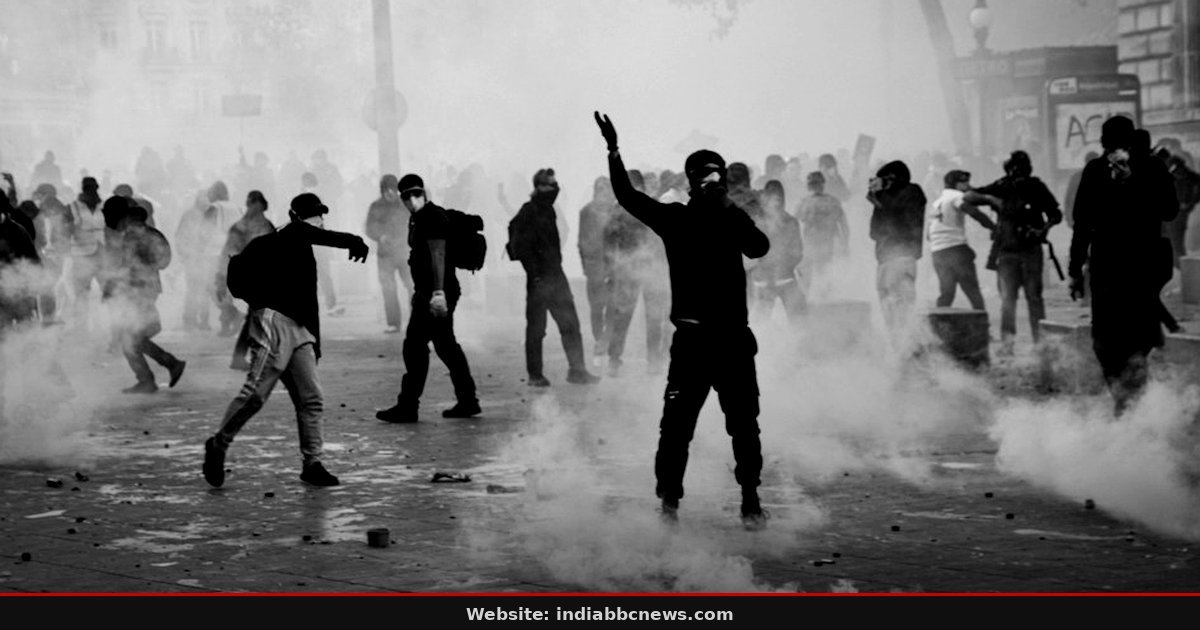
18,000 people in Paris. That’s the number the French police handed out on Tuesday morning, a figure that felt small against the backdrop of a nation simmering for weeks. But ignore the raw count for a second and look at the faces instead. They weren’t marching in orderly lines like a political rally.
They were smashing shop windows in the 2nd arrondissement while tossing stones at police lines that had already retreated two blocks down the Champs-Élysées. The air smelled of burnt tires and expensive perfume. It was chaotic, loud, and utterly unpredictable. No one in the crowd looked like they were planning to go home soon.
This was personal now. The economic anxiety that started with pension reform has morphed into something visceral, a rejection of the status quo that feels akin to the unrest of 2005. The authorities are struggling to keep up. The political leadership is visibly trembling.
And the rest of Europe is watching, terrified that the fire won’t stay contained within the Republic’s borders. It wasn’t a radical manifesto or a disputed election that triggered this latest wave of violence. It was a Tuesday afternoon. Students from the Sorbonne and Sorbonne Nouvelle universities, already restless over budget cuts to higher education, decided to occupy the main building. They locked the doors.
The Spark That Caused the Wildfire
They painted slogans on the concrete. They simply refused to leave. What started as a sit-in quickly drew in trade unionists who had been waiting for an excuse to act. The reaction from the government was immediate and, many argue, disproportionate.
Police entered the campus with tear gas and water cannons. The footage went viral by evening. By Thursday, the occupation had spiraled into a city-wide general strike. Trains stopped.
Buses didn’t run. Factories in the north ground to a halt. The rhythm of daily life in France didn’t just stumble; it broke. The opposition parties, usually fractured by their own internal squabbles, found themselves united in shouting at the president to resign.
That unity is what really scares the establishment. It suggests the problem isn’t left or right anymore. It’s everyone against the top.
The historical context here is undeniably heavy, but it also helps explain the current ferocity. The last time France saw this level of sustained social unrest was during the Yellow Vests protests in 2018. But those protests were about fuel taxes and cost of living. This is different.
This feels structural. It’s about the fundamental perception that the social contract has been broken. Workers aren’t just asking for higher wages; they’re asking for recognition that the state has failed in its basic duty to protect them from economic precarity. Experts in labor relations often say that strikes are rarely really about the specific grievance on the table.
The grievance is just the litmus test. If the system can absorb a small hike, it survives. If the system snaps under the weight of a universal one, it reveals how rot is underneath. That’s a harder sell than it sounds.
The government has been trying to frame this as an isolated incident, a bunch of “rioters” rather than legitimate workers. But you can’t arrest a mood. You can’t arrest a sense of betrayal. And the more the police use force, the more the narrative shifts from “disorder” to “state oppression.” It’s a classic trap.
Once you step into it, there’s no easy way out. The legitimacy crumbles. The streets fill up. And the political capital evaporates into the smoke of the barricades.
What This Means for India
For Indian readers, this might feel like a distant European drama, but the parallels for the domestic economy are striking and worth considering. India is currently navigating its own complex social and economic landscape. We have seen massive farmer protests in Delhi, where tractors blocked highways and the national capital gridlocked for weeks. The core issue was similar: a perception that central policies favored corporate interests over those of the actual producers and workers.
In France, it’s the cost of living versus the cost of labor. In India, it’s often the push for liberalization versus the protection of livelihoods. The lesson from Paris is that economic discontent doesn’t respect borders or cultural differences. When people feel left behind, they find a way to make noise.
For Indian policymakers, the French situation is a warning shot. As India pushes for deeper integration into global supply chains, the social fabric needs to be reinforced, not stretched thin. If workers and students feel that the benefits of growth aren’t reaching them, the stability of the world’s fifth-largest economy could be tested. It’s not just about GDP numbers anymore.
It’s about sentiment. There are also direct market implications for Indian investors and businesses. French inflation is running high, and political instability tends to weaken the Euro. A weaker Euro makes Indian exports to Europe slightly cheaper, which is a small boon for sectors like pharmaceuticals and textiles. However, the bigger issue is global risk sentiment.
When France is on fire, investors get nervous. They pull money out of emerging markets. We’ve seen this pattern before. Crisis in one major G7 economy often leads to a brief, sharp selling spree in Asian equities.
Nifty 50 and Sensex indices might see increased volatility in the coming weeks as global funds hedge their bets. Indian companies with significant exposure to the French market, particularly in luxury goods or automotive components, need to watch for supply chain disruptions. But perhaps the most important takeaway for Indians abroad is the immigration angle. France is a major destination for Indian students and professionals.
If the political situation becomes truly volatile, security concerns could rise. Embassies in high-risk zones often issue travel advisories. Students in Paris or Lyon should stay alert. Follow local news.
Avoid large gatherings. It’s rare for European protests to turn into long-term civil conflict, but the risk isn’t zero. And for the Indian business community, the message is clear: diversify your risk. Don’t put all your eggs in one basket, whether that basket is the EU or the US.
The world is becoming more unpredictable, and the cost of stability is rising. The French economy is already under pressure. Inflation hit 5.2% last month, well above the central bank’s target. Energy prices remain stubbornly high. The Bank of France has raised interest rates aggressively, but it hasn’t stopped the damage to consumer purchasing power.
The Economics of Breaking Points
Now, with a general strike shutting down major industries, the loss in productivity will be significant. Estimates from the national employers’ federation suggest that the strike could cost the economy the equivalent of $400 million in lost output over just four days. That’s a lot of money. But it’s not the only cost.
The cost to reputation is harder to quantify. International investors are watching the headlines. They are asking questions about governance risk. They are wondering if France is becoming a nation that can’t manage its own internal divisions.
That uncertainty has a price. It shows up in bond yields. It shows up in currency markets. It shows up in the hesitation of companies thinking about where to set up their next European headquarters.
Berlin is winning those deals. Amsterdam is winning those deals. France is losing them. And that’s a silent, damaging erosion of economic power that won’t show up in the daily news until it’s too late to fix.
The government is trying to spin this as a temporary blip. But markets hate uncertainty. They hate it. And they will punish France for it until the streets go quiet and the promises start looking real.
There’s a specific sector that is taking a hit: tourism. Paris is the most visited city in the world. When the Champs-Élysées is a battlefield, tourists stay home. Hotels are seeing cancellations.
Restaurants are empty. Small business owners in the city center are devastated. They’re not part of the political fight. They just want their money to come back.
One hotelier in the 16th arrondissement told reporters that his occupancy rate has dropped by 30% in the last week. “It’s not sustainable,” he said, wiping dust off a display case. “We can’t operate at this level.” This is the human cost behind the macro data. It’s not just about GDP growth rates.
It’s about the shopkeeper who can’t pay his staff. It’s about the tour guide who has no customers. It’s about the tourist who booked a flight and now sees a news alert on their phone. The ripple effects of political instability are felt most acutely at the street level.
And in France, the street level is where the anger lives. It’s where the grievances start. And it’s where the resolution has to happen. Until the government finds a way to listen, the noise will continue.
And the noise is very expensive. French police force is caught in an impossible position. On one hand, they are mandated to maintain public order. On the other hand, they are facing citizens who feel the state has abandoned them. This is a psychological war as much as a physical one.
Why The Police Are Stuck
The police are exhausted. They’ve been working double shifts for weeks. Their morale is low. They’re being told by the government to hold the line, but they’re also being told by their own unions that they need better equipment and more support.
There have been reports of police officers refusing to deploy, citing safety concerns. That’s a red flag. When the enforcers of the law start questioning the law, the state’s grip on the situation weakens. The government has tried to replace some units with reinforcements from other regions, but that hasn’t stopped the clashes.
In fact, it might have made them worse. Outsiders don’t have the same relationship with the local communities. They don’t know the names. They don’t know the history.
They just see a crowd. And the crowd sees a wall of blue helmets. It’s a recipe for escalation. Break.
You shoot. Everyone claims to be the victim. And the truth gets lost in the smoke. The government needs to de-escalate.
But de-escalation looks like weakness to a base that is already angry. It’s a lose-lose scenario. And the police are caught in the middle. They’re just doing a job.
A job that is becoming impossible to do well. The media’s role in this is also complicated. Social media has accelerated the spread of misinformation. Videos of minor scuffles are shared as evidence of widespread violence. Narrative is being constructed in real-time, often without context.
This makes it harder to have a rational public debate. People aren’t arguing facts. They’re arguing perceptions. And perceptions are sensitive.
A single image of a police officer firing a tear gas can dominate the conversation for days, regardless of the broader context of what happened an hour earlier. It’s a feedback loop. The more we see, the more we fear. The more we fear, the more we protest.
The more we protest, the more the police respond. It’s a cycle that is hard to break. And it’s driven less by ideology and more by emotion. Anger is a powerful fuel.
And it’s cheap. The government is trying to control the narrative by claiming victory when the numbers are low, or blaming foreign agitators when the numbers are high. But the public isn’t buying it. They’ve seen this movie before.
They know the script. And they’re tired of their part. They want a new ending. And until they get it, the screen won’t go dark.
It will just get brighter. Louder. And more chaotic.
Where This Goes Next
The next 72 hours are critical. The government has scheduled a press conference for Thursday morning, where the prime minister is expected to outline a new “socle social,” or social foundation, for the economy. It’s a vague term that usually means a mix of tax cuts for the poor and subsidies for the rich. But the opposition wants more.
They want a referendum. They want the president to step down. The tension is palpable. If the government’s proposal is seen as insufficient, we could see a second wave of strikes, this time involving public sector workers in health and education.
That would be a game-changer. Hospitals can’t close. Schools can’t close. It’s a different kind of pressure.
It’s a humanitarian crisis dressed up as a political one. That’s where the maximum leverage lies. And that’s where the government is most vulnerable. They can’t send police into hospitals.
They can’t arrest a nurse for striking. It’s a moral high ground that is impossible to defend from a distance. The stakes are rising. And the clock is ticking.
Every day of protest costs the economy more. Every day of silence costs the government more legitimacy. It’s a race against time. And neither side wants to be the first to blink.
But perhaps the most likely outcome is a stalemate. France is a nation of stasis. It changes quickly, but it also settles slowly. The anger will simmer.
The hot points will cool. The strikes will end. The shops will reopen. But the underlying issues won’t go away.
They’ll just wait for the next trigger. The next
Source: NYT World

