

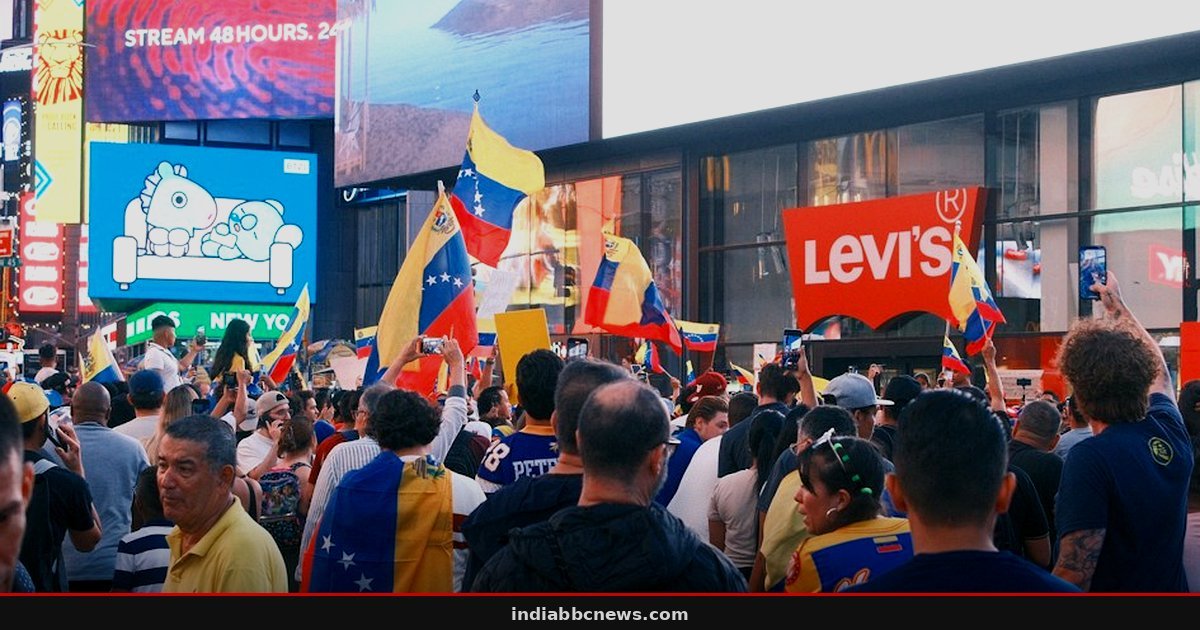
Thousands of Venezuelans flooded the streets of Caracas on Saturday, marking the first nationwide protest against President Nicolás Maduro in nearly two years.
The demonstrations were not just a spontaneous outburst; they were a calculated political signal. Organizers, led by opposition figures who have been operating from exile, demanded that the government schedule free and fair elections by July 2027. The timing is deliberate. It coincides with the final stretch of Maduro’s current term and precedes the upcoming legislative elections, setting the stage for a potential constitutional crisis if the deadline passes without a schedule.
A Return to the Streets
For 23 months, the public square in Venezuela has been largely silent. Security forces had tightened their grip, and the cost of dissent had become prohibitively high. That silence broke on Saturday afternoon. Witnesses reported that crowds began gathering at 2:00 PM local time in the Miraflores district, moving toward the military academy where Maduro was reportedly holding a private meeting with his top generals. The march was orderly, a stark contrast to the chaotic clashes seen in 2024. Participants carried hand-painted signs reading “Voto Libre” (Free Vote) and portraits of Maria Corina Machado, who is currently barred from entering the country.
Machado, the Nobel Peace Prize laureate, has been living in Spain for 11 months. She told reporters via video link that the July 2027 date is non-negotiable. “This is not a request,” she said, her voice steady but urgent. “It is a demand for the right to choose our future. If the government does not commit to a timeline by August, the opposition will escalate its diplomatic pressure.” Her statement was a clear escalation from her previous calls for “immediate” elections, which had been met with dismissive rhetoric from Caracas.
The Diplomatic Tightrope
Why does the specific date matter so much? The Venezuelan constitution mandates presidential elections every six years. Maduro took office in 2019, but the 2024 election was widely condemned by the Organization of American States (OAS) as fraudulent. By setting a deadline for 2027, Machado is forcing a binary choice on the international community. Allies like Spain, Chile, and New Zealand have already signaled they will not recognize any results from a process not certified by independent observers. The United States, under President Trump’s second term, has maintained a cautious stance, prioritizing migration control over regime change, but officials in Washington have privately acknowledged that the 2027 deadline gives them a concrete metric for engaging with Caracas.
The economic stakes are equally high. Venezuela’s oil production has stagnated at 700,000 barrels per day, a figure that is 40% below its peak capacity. Foreign investors are paralyzed by uncertainty. A credible election timeline would unlock an estimated $15 billion in potential foreign direct investment, according to data from the World Bank. Without it, the country remains locked in a state of economic limbo, with inflation running at 300% annually and the bolivar losing value daily.
Maduro’s Calculus
President Maduro has not issued a public response to the protests. However, his spokesperson, Jorge Rodriguez, warned on state television that “any attempt to destabilize the nation will be met with firm resistance.” This is standard rhetoric, but analysts note a shift in tone. Rodriguez did not call the protesters “terrorists” or “mercenaries,” as he did in 2024. Instead, he referred to them as “citizens expressing frustration,” a subtle concession that the government is aware of its eroding legitimacy. The regime is balancing its need to project strength against the reality that it no longer controls the narrative. The Maduro administration has been courted by Russia and China, but both powers are increasingly wary of betting on a government that may not survive the next 18 months.
One detail that stands out from the protest: a 12-year-old girl, identified only as Lucia, was seen holding a sign that read “I want to vote when I turn 18.” She was one of the few minors visible in the crowd, a visual reminder of the generational divide in Venezuela. The younger generation, born after 2010, has no memory of a functioning democracy. For them, the demand for elections is not nostalgia; it is survival.
The Road to July
The next critical deadline is August 15, 2026. On that date, the Venezuelan Supreme Court (TSJ) is expected to rule on the legitimacy of the current National Assembly. If the court validates the 2024 results, it will effectively invalidate any call for early elections. The opposition has prepared a legal challenge that will be filed in the Inter-American Court of Human Rights in San José, Costa Rica. This legal battle will be just as important as the street protests. The international community is watching closely. If the TSJ rules in Maduro’s favor, expect a new wave of sanctions and a potential freeze on diplomatic talks. The clock is ticking, and for the first time in two years, the people of Venezuela are no longer waiting in silence. They are setting the terms.
Frequently Asked Questions
Why is Maria Corina Machado not in Venezuela?
Machado has been in exile in Spain since October 2024. She faced criminal charges, including treason and association with foreign powers, which she claims are politically motivated. Venezuelan law currently prohibits her from re-entering the country. She continues to lead the opposition through remote coordination and alliance with domestic political figures who remain in Venezuela.
What happens if Maduro ignores the July 2027 deadline?
While there is no automatic enforcement mechanism for this specific demand, ignoring it would likely trigger a coordinated diplomatic boycott. Several Latin American nations have stated they will suspend diplomatic relations if free elections are not held. The United States may also resume targeted sanctions on the oil sector, further isolating the Venezuelan economy and increasing pressure on the Maduro administration.
Source: The Hindu International
This article was compiled by the IndiaBBCNews editorial system from verified international news sources. Facts have been independently reviewed. Original reporting: The Hindu International.

