


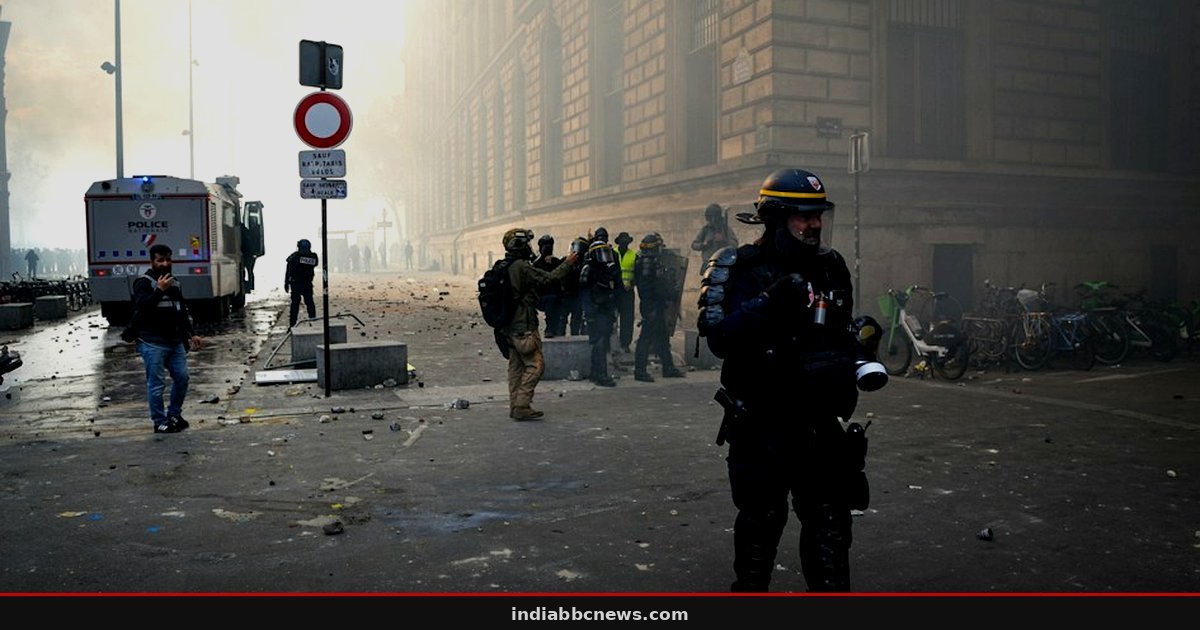
The Hôtel de Ville in Limoges was still smoldering in the grey light of Monday morning when the first official counts came in: 2,300 arrests, 1,000 injured police officers, and more than 2,000 shops looted. It wasn’t just a disturbance; it was a fracture in the social contract, visible in the shattered glass of shop windows and the blackened facade of the town hall. This wasn’t an isolated incident in a single city. It was the latest, and most violent, chapter in a week of unrest that has shaken the foundations of the French Republic just six months before a presidential election that looks increasingly unpredictable.
The numbers are stark, but the financial fallout is sharper. Investors, spooked by images of burning cars and police being pelted with stones, didn’t just watch; they reacted. French borrowing costs have surged, crossing a psychological threshold that has never been seen for a core eurozone nation since the post-war era. Bond yields have risen higher than those of Greece, a comparison that stings particularly deeply in Paris. The country’s national debt now sits at 119% of GDP, a level not seen since 1946. With a budget deficit at 5.1%, the state’s coffers are empty. There is no cushion. There is no reserve. As our Europe correspondent Jon Henley noted, “There is just no money in the bank to ease the cost of living squeeze that brought 550,000 people on to the streets on Saturday.”
The Cost of Chaos: When Debt Meets Discontent
Why does this matter to anyone outside of France? Because the euro is a shared currency, and stability here is stability there. The sell-off wasn’t merely a reaction to the riots, but to the perceived inability of the current government to control either the streets or the ledger. President Emmanuel Macron, whose final months in charge are defined by a sense of being besieged from all sides, has attempted to regain the upper hand. He has banned what he calls “illegitimate” protests, a move that critics say is a heavy-handed response to genuine economic grievances. The irony is palpable. The government is trying to project strength through repression while its financial position suggests a fundamental weakness. The message to markets is mixed, and markets hate mixed signals.
Allegations of police brutality have only compounded the anger. Videos circulating on social media show officers using disproportionate force against demonstrators, some of whom were peaceful. This narrative has fueled a cycle of retaliation. In Limoges, the fire at the town hall wasn’t just property damage; it was a symbolic act of defiance against local authority. The police, already stretched thin and injured in large numbers, are now facing a public that sees them not as protectors, but as the face of an unresponsive state. This erosion of trust is harder to repair than broken windows.
Le Pen’s Windfall: Does Chaos Help the Right?
Who benefits from this instability? The most likely answer is Marine Le Pen. Columnist Paul Taylor argues that the violence has “increased the likelihood of a law-and-order backlash among voters that could propel (Marine) Le Pen into the Élysée Palace.” For years, the National Rally has positioned itself as the party of order, promising to crack down on crime and restore security. The riots provide them with a ready-made storyline. They can point to the chaos and say, “We told you so. Only we can bring peace.” It’s a potent argument, especially for voters who feel abandoned by the establishment.
However, the financial crisis complicates this picture. If the campaign shifts from a debate on security to a debate on who can save the economy, Le Pen’s orthodox fiscal record might become a liability. A candidate who is firm on security but more credible on fiscal policy could outmaneuver her. The risk for the incumbent administration is that they are stuck in the middle. They can’t afford to be seen as weak on security, but they can’t afford to be seen as fiscally irresponsible. It’s a no-win position, and voters know it.
Macron’s Isolation: A Leader Without a Base
Emmanuel Macron finds himself in a precarious spot. His centrism, once his greatest asset, now appears to be a liability. He has alienated the left, who see him as a defender of capitalist interests, and the right, who see him as a failed reformer. The protests that started over pension reforms and cost of living have now morphed into a broader rejection of his leadership. His attempts to distance himself from the riots, labeling them as criminal rather than political, haven’t landed well. Many in France feel that the root cause of the unrest is economic, and pretending it’s a crime problem is a cop-out.
The political landscape is shifting under his feet. The traditional parties are struggling to gain traction, while populist movements on both the far-left and far-right are gaining ground. Macron’s isolation is evident in the ferocious criticism from all sides. He has no clear base of support. His coalition partners are fractured, and his own party is divided. The question now is whether he can survive the next six months without triggering a constitutional crisis or a deeper political collapse. The pressure is immense, and the margin for error is zero.
Frequently Asked Questions
Why have France’s borrowing costs risen above Greece’s?
Investors are pricing in the political risk associated with the upcoming presidential election. The recent riots and the government’s inability to control the situation have raised concerns about policy stability. When investors fear that a government may be forced to implement erratic or populist economic policies to appease voters, they demand a higher yield to compensate for that risk. This is a classic “risk premium” adjustment, and it signals a loss of confidence in France’s fiscal management. It’s a warning sign that the country’s creditworthiness is being questioned, which could have long-term implications for its ability to fund public services and infrastructure.
How might the riots affect the outcome of the 2027 presidential election?
The riots could significantly shift the dynamics of the election. They provide a powerful narrative for parties on the right, who can frame the issue as one of security and law and order. This could boost Marine Le Pen’s chances, as she positions herself as the strong candidate who can restore stability. Conversely, the economic fallout from the debt sell-off could benefit a candidate who is seen as fiscally responsible and capable of managing the economy. The outcome will depend on how the major parties frame the issue in the coming months. If the debate remains focused on security, the right may gain the upper hand. If it shifts to economic management, the candidate with the most credible fiscal plan could emerge as the favorite. The riots have added a new layer of complexity to an already volatile political environment.
The next few weeks will be critical. The government needs to demonstrate that it can control the situation without further alienating the public. The opposition needs to present a credible alternative. And voters need to be convinced that the next president can deliver stability, both politically and economically. The stakes are high, and the time for action is now. The next decision, the next vote, the next deadline, will determine whether France can weather this storm or if it will be swept away by the currents of political change. The eyes of the world are on Paris, watching to see what happens next.
Source: Guardian World

