


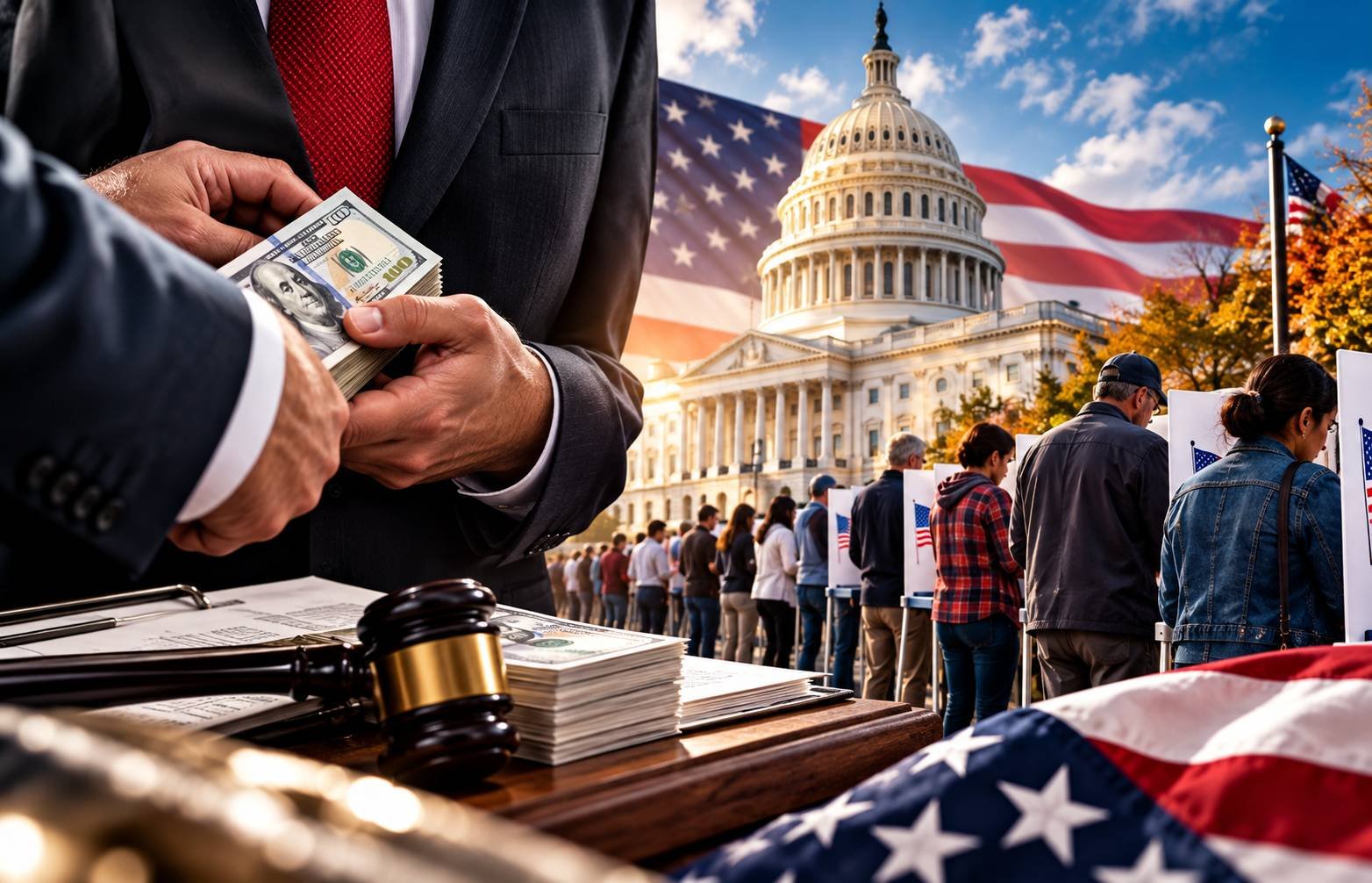
Trump’s Midterm Nightmare: Why Corruption is Now the Issue Voters Can’t Ignore
Donald Trump’s crypto empire made $1.4 billion last year. It’s a number that stings harder now than ever before, as a new Harris poll for the Guardian reveals government corruption has overtained immigration and AI to become the second biggest issue for US voters.
The Poll That Changed the Narrative
The data is undeniable, and it doesn’t care about political spin. An exclusive October Harris poll found that 87% of respondents view corruption as a serious problem. That’s a staggering number, higher than concerns about artificial intelligence or border security. The breakdown is even more telling for the White House. Only 50% of voters are worried about immigrants receiving public benefits, a classic wedge issue that failed to gain traction.
Real anger is directed at elected officials putting their own interests first. This shift marks a profound change in American political psychology. We’re seeing a move away from identity politics toward a pure audit of financial integrity. The president’s closest allies are treating this as a minor blip, but the numbers suggest otherwise. If the media cycle continues to highlight the SEC’s leniency toward Trump-linked crypto ventures, this issue won’t go away.
The Reusable Playbook from 1980
There’s a ghost in the machine of American conservatism. Ronald Reagan popularized the myth of Linda Taylor, a Chicago welfare recipient he claimed was stealing $150,000 a year. The actual theft was closer to $9,000, but the damage was done. Taylor became the “welfare queen,” a symbol of fraud used to slash social spending for a decade. The narrative stuck because it tapped into a deep-seated fear of the “other.”
Vice President JD Vance is now deploying a similar tactic. He recently announced an anti-fraud taskforce that claimed to find $40 million in SNAP fraud. He framed it as heroes catching thieves stealing from hungry children, a move that’s designed to evoke sympathy and outrage. But context matters, and the public is increasingly savvy to historical echoes.
The comparison isn’t accidental; it’s a deliberate strategy to distract from higher-level self-dealing. Critics argue this is a smokescreen for a different kind of theft.
The Crypto Loophole and the SEC
Let’s talk about the money. Trump made $2.2 billion in his first year back in office, with $1.4 billion coming from cryptocurrency. The Securities and Exchange Commission, under his leadership, has paused a fraud lawsuit against a crypto billionaire who bought $40 million in $Trump meme coins. That billionaire also invested $75 million in another Trump crypto business. The correlation is impossible to ignore, even if causation is legally hard to prove.
Furthermore, the administration dropped investigations into Coinbase, Ripple, and Kraken, all donors to Trump’s campaigns. Vance insists he has seen no evidence of presidential corruption, arguing that a billionaire doesn’t need to steal. That’s a harder sell than it sounds when the regulatory bodies are effectively idled. The Supreme Court granted Trump immunity for official acts, creating a shield that feels more like a fortress. Nobody in the room looks convinced by the idea that this is purely coincidental timing.
What This Means for India
For Indian readers, this isn’t just a US soap opera; it’s a signal about global market stability. Indian tech giants and startups are heavily invested in the US digital infrastructure and fintech sectors. If US regulatory bodies like the SEC become unreliable due to perceived bias, it creates a “trust deficit” for all foreign investors, including from New Delhi. Indian policy makers need to be aware that US standards are shifting from rule-of-law to rule-of-person.
There’s also a direct impact on the Indian diaspora. Many Indian Americans work in compliance, finance, and tech roles in Washington and New York. As corruption scandals deep, reputational risk for these firms increases. We’ve seen similar patterns in past administrations where scandals led to tighter scrutiny of foreign-owned businesses.
Indian exporters, particularly in IT services that rely on US government contracts, might face longer payment cycles or increased audits. The moral clarity of the business world is fracturing, and business hates uncertainty.
Transparency International’s Red Flag
Last year, the US dropped to 29th on the Transparency International Corruption Perceptions Index. That’s a significant fall from 18th place in 2016. For a global superpower, that ranking is embarrassing, and it signals to international partners that US institutions are weakening. Experts in political economy have warned that when core institutions lose credibility, capital flight accelerates. Investors start diversifying into gold, real estate, or offshore havens.
The next step in this saga is likely legal. The DOJ may attempt to institutionalize the immunity precedents set by the Court. This could set a precedent that affects not just the US, but how other nations view the US legal system as a safe harbor for dispute resolution. It’s a slow burn, but the heat is rising. The question isn’t if the midterms will be affected, but how violently the pendulum will swing.
Frequently Asked Questions
Why is corruption a bigger issue for US voters now?
Perception has shifted from abstract policy debates to tangible financial self-interest. Voters feel that political leaders are profiting from their positions, which violates the social contract. The Harris poll shows that this concern now outweighs traditional partisan issues.
What did JD Vance say about the fraud taskforce?
Vance announced that his taskforce had stopped $40 million in SNAP fraud and cancelled health coverage for 760,000 people. He framed these actions as necessary measures to protect public funds from abuse by individuals. It creates a conflict of interest where the person enforcing the rules may benefit from their laxity. The SEC’s inaction toward Trump-linked crypto ventures is seen by many as quid pro quo, even without a formal agreement on record.
How does Trump’s crypto wealth affect the corruption debate?
Is the US economy at risk?
While the economy remains robust, trust is a critical asset for capital investment. A decline in the Corruption Perceptions Index can lead to higher risk premiums for US assets over the long term. Indian businesses and the diaspora face increased reputational and regulatory risks in the US. A decline in US institutional integrity can impact cross-border investments, IT services contracts, and the legal frameworks that protect foreign entities.
What is the India angle in this story?
Source: Guardian World
Source: Guardian World

