


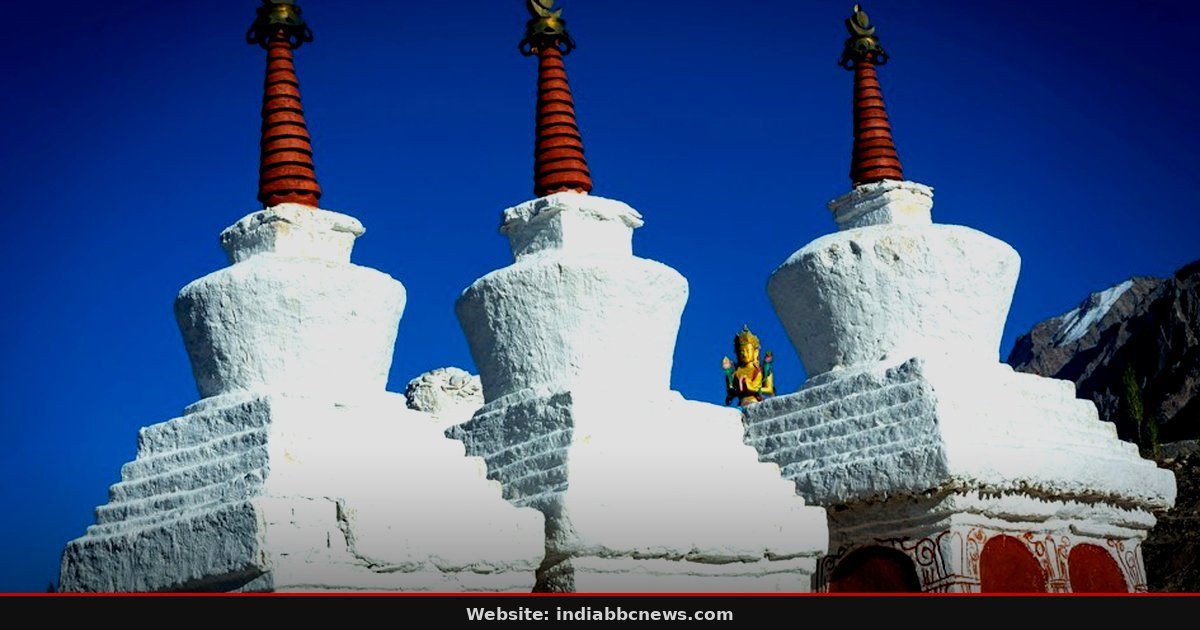
The stupa at number 76 is not just stone and mortar. It is a diplomatic lever, a pixel in the larger geopolitical map, and a very explicit thank-you note addressed to New Delhi, all wrapped in the serene aesthetic of Gelephu. King Jigme Khesar Namgyel Wangchuk didn’t just break ground today; he laid a foundation that is as symbolic as it is structural, dedicating this specific stupa to Prime Minister Narendra Modi to mark India’s unwavering support for the Gelephu Mindfulness City (GMC) project. It was a quiet ceremony, stripped of the usual bombastic state fanfare one might expect from a Head of State, yet the message was loud.
In a region where every brick seems to carry a policy weight, this gesture signals that Bhutan’s “Gross National Happiness” is now tightly interlocked with India’s economic security. The 9-hour construction of 108 stupas is a logistical marvel, yes, but the dedication of number 76 is the story that will echo through corridors in both Thimphu and Delhi for years. It’s a reminder that in the Himalayan front, religion and real estate are increasingly the same enterprise.
The 9-Hour Sprint and the Stone of Solidarity
The clock started at dawn and stopped before the sun had even fully cleared the eastern ridgelines. 108 stupas. That’s the number. Monks, engineers, and local laborers worked in a synchronized frenzy that looked more like a construction site at a major infrastructure project than a spiritual ritual. The speed was staggering — 9 hours to complete structures that typically take months to build, a testament to pre-fabricated components and a workforce primed for this specific milestone.
It’s not just about the speed, though; it’s about the precision. Each stupa is a geometric statement of impermanence, yet the commitment they represent is meant to be permanent. The king watched from a distance, hands clasped, his expression unreadable but his presence commanding. He didn’t need to shout; the stones did the talking.
Stupa 76 stands out visually, perhaps due to its placement or a slight variation in the pattern, marking it as the vessel for this diplomatic bond. The dedication to PM Modi was announced with a solemnity that cut through the bustling activity. This wasn’t a political rally; there were no flags waving in aggressive unison, just the quiet, heavy weight of a handshake that happened earlier in the day. The gesture acknowledges that GMC is not a foreign experiment but a joint venture of histories.
It recognizes that India’s support, both financial and strategic, is the oxygen keeping this ambitious city alive. Without that support, the city is just a drawing on paper; with it, it’s a destination. The number 76 is arbitrary in Buddhist cosmology but highly specific in diplomatic signaling. It’s a pin on the map that says, “We are partners in this.”
Gelephu Mindfulness City: More Than a Retreat
Let’s strip away the mystical branding for a second. GMC is an economic zone. It’s about taxing minerals, processing data, and attracting a new class of affluent traveler who seeks silence as a luxury good. The “mindfulness” angle is the marketing wrapper, but the core is infrastructure: roads, power grids, and hospitals that meet international standards.
Bhutan is betting that the world is tired of noise and wants a place to plug in and reset. It’s a bold gamble, taking a landlocked, mountainous nation and turning it into a hub for the digital and spiritual elite. The king has framed this as a realization of a vision, but the execution is purely modern. You need fiber-optic cables, not just prayer flags, to make a city function in the 21st century.
The tension between ancient spirituality and high-speed connectivity is the central conflict of this project, and it’s a fascinating one to watch. The dedicated stupa to PM Modi signals that the Indian government is a key stakeholder in this transformation. It’s not just moral support; it’s likely a pipeline of investment and regulatory cooperation. The city aims to be free of harmful chemicals and emissions, a standard that India is increasingly pushing in its own urban planning. This alignment suggests a deeper ideological sync, where sustainability is not just an environmental mandate but an economic advantage.
The question is, can a city built on the concept of “slowing down” actually operate at the speed required to be economically viable? Maybe. Maybe not. But the construction of these 108 stupas in 9 hours shows that when the will is there, the pace can be relentless.
It’s a blend of the divine and the industrial, a strange but potent cocktail. New Delhi’s interest in Gelephu is not sentimental; it’s strategic. By supporting GMC, India is ensuring that its border region is developed, stabilized, and integrated into the Indian economic sphere. A prosperous, connected Gelephu is a buffer against other influences. It’s a way to lock in Bhutan’s loyalty through economic dependency and shared vision.
What This Means for India’s Northern Border Strategy
The dedication of a stupa to the PM is a public reaffirmation of this axis. It tells Beijing, and the rest of the world, that India’s northern frontier is a zone of cooperation, not conflict. The ripple effects extend to trade, tourism, and even data flows. Indian companies are likely to play a significant role in GMC’s development, from construction to tech.
This is a soft power play that is hard to counter. You can’t argue with a spirit. You can argue with the contract, but the spirit sets the tone. That’s a harder sell than it sounds, but it seems to be working.
For India, this also opens a window into Bhutan’s internal transformation. By being a key partner in GMC, New Delhi gains insight into Bhutan’s evolving political and social fabric. It’s a way to stay relevant in a country that lives on the edge of autonomy. The gesture from the King is a signal of trust.
It says, “We hear you, we see your support, and we remember.” In diplomatic terms, this is rare. Most alliances are transactional, cold, and whispered. This one is public, spiritual, and loud. It changes the narrative of the India-Bhutan relationship from one of dependency to one of partnership.
And for Indian voters, particularly those in the northeast, this is a symbol of security and opportunity. It’s a story of brotherhood that is tangible, stone by stone.
The Mystique of the 108: A Cultural Deep Dive
In Buddhist tradition, 108 is a sacred number. It represents the 108 defects of the human mind, or the 108 paths to enlightenment. Building 108 stupas is a ritual of purification and aspiration. But doing it in 9 hours?
That’s a modern twist on an ancient practice. It suggests that in the digital age, even enlightenment has a deadline. The speed of construction might seem irreverent to some, but for the project, it’s a demonstration of capability. It shows that Bhutan can move fast when it wants to.
It’s a flex of muscles, both spiritual and logistical. The image of workers on scaffolds, laying stones with haste, contrasts sharply with the meditative pause required to visit a stupa. This dichotomy is the heartbeat of GMC. It’s a place where you rush to get to the place where you slow down.
And nobody in the room looked convinced that the speed was the main point, but it certainly set the mood. The cultural significance of dedicating a stupa to a leader is also rich. Stupas are memorials, places of reverence. By linking a modern political figure to this structure, the King is elevating the relationship to a quasi-spiritual status. It’s more than a handshake; it’s a blessing.
This is a powerful tool in Bhutan’s diplomatic arsenal. It makes the relationship personal, almost familial. It’s not just statecraft; it’s kinship. The number 76 was likely chosen for logistical reasons during the design phase, but its accidental or intentional alignment with this dedication gives it a weight it never had before.
It becomes a landmark. People will visit Stupa 76 not just for its architecture, but for the story behind it. It’s a monument to a specific moment in time, a freezing of the dial on a very tightrope walk.
Market Signals and the Indian Investor
So, where’s the money? That’s the question every Indian reader is probably asking. GMC is projected to be a multi-billion dollar project. Indian infrastructure firms, real estate developers, and tech companies are eyeing this opportunity.
The dedication of the stupa is a green light, a signal that the political risk is low and the partnership is solid. For Indian investors, this reduces the uncertainty that usually plagues cross-border projects in the Himalayas. It’s a de-risking event. The market may not react visibly to a stupa dedication, but the subtext is clear: business as usual, but with a spiritual buff.
The rise in interest for GMC projects in Indian stock exchanges might be subtle, but it’s there. Funds are floating closer to the Himalayas. The “mindfulness” economy is a new asset class, and India is now at the center of it. It’s a niche, but a lucrative one.
There’s also the tourism angle. India has a massive domestic market for spiritual tourism. GMC offers a product that is uniquely Bhutanese but accessible to Indians. The dedicated stupa will likely become a pilgrimage site for Indian visitors, further blending the two nations’ cultural spheres.
This isn’t just about sending tourists; it’s about creating a flow of people, ideas, and money that is constant and growing. The 9-hour construction speed also implies that future expansions can be rapid. This agility is attractive to investors who are tired of red tape. It suggests a government that knows how to deliver.
And isn’t that what every market wants? Efficiency wrapped in mystique? That’s a brand India can champion. It’s a unique selling proposition that no other Himalayan nation can match.
FAQs
Why did Bhutan dedicate Stupa 76 to PM Modi?
The King stated it was a gesture to recognize India’s steadfast support for the realization of the Gelephu Mindfulness City. It symbolizes the deepening strategic and economic partnership between the two nations, going beyond traditional diplomacy into a shared vision for the region’s future. The construction was completed in just 9 hours. This rapid timeline highlights the use of modern construction techniques and the project’s emphasis on efficiency and speed, marking a modern twist on traditional religious architecture.
How long did it take to build the 108 stupas?
What is the Gelephu Mindfulness City (GMC)?
GMC is a special economic zone in Bhutan aimed at transforming Gelephu into a hub for mindfulness, wellness, and technology. It seeks to attract global investment by offering a unique blend of spiritual tourism and modern infrastructure, with a strong focus on sustainability and environmental health. Yes, by integrating Gelephu into India’s economic orbit, the project enhances stability in the border region. It creates mutual dependencies that make conflict less likely and cooperation more beneficial, serving as a soft power tool for New Delhi in its northern frontier strategy.
Does this affect Indian border security?
Source: The Hindu International
Source: The Hindu International

