


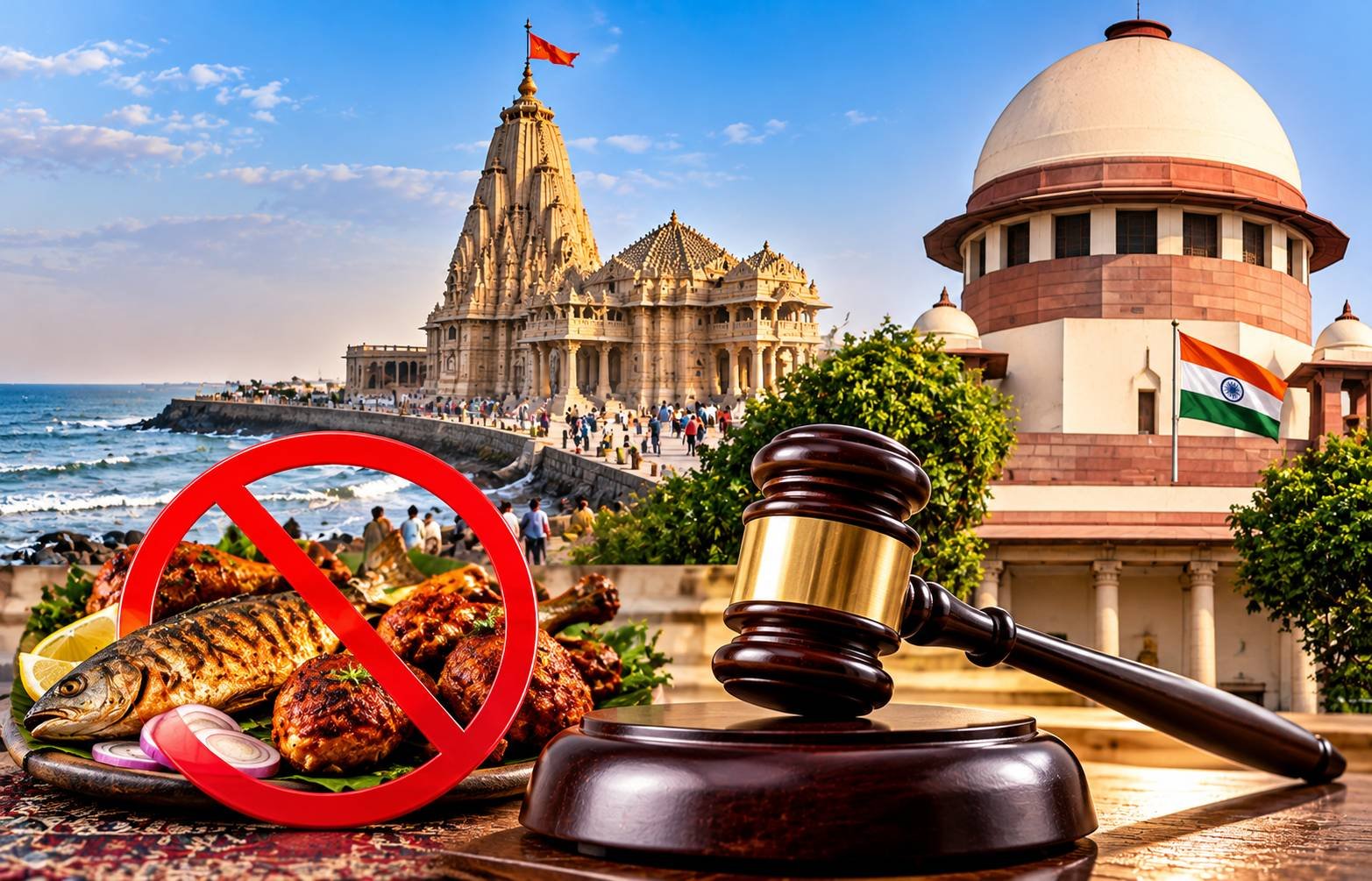
Judicial Whiplash in Somnath: How a Single Judge’s Verdict Turned the Ban on Non-Veg Sales Upside Down, Then Back Again
Justice Nisha Thakore struck down the ban. Then the Higher Court reversed it. In a matter of hours, the legal status of chicken sold in one of India’s holiest shrines flipped twice, leaving local vendors and travelers in a state of confusion that mirrors the deeper tensions within Indian constitutional law regarding religious sentiment and commercial freedom.
The episode is a textbook case of procedural chaos. It’s not just about meat. It’s about who gets to decide what a sacred space can hold, and how fast a single judge’s pen can change the economic reality for hundreds of families who live on the margins of pilgrimage tourism. The Supreme Court of Justice is watching.
The One-Day Life of a Landmark Verdict
For 48 hours, the ruling seemed settled. Justice Nisha Thakore, sitting as a single judge of the Gujarat High Court in Ahmedabad, delivered a judgment that cut against the grain of decades of precedent. She argued that the Collector’s notification, which banned the sale of beef, pork, and other non-veg food items in a 5-km radius around the Somnath Temple, violated the fundamental right to practice any profession. The logic was sharp, aggressive, and very human.
It asked a simple question: can a state use “religious sentiments” as a blanket shield to crush livelihoods? The answer, she said, was no.
But the Gujarat government didn’t wait for the morning coffee to cool. They filed an urgent appeal with a two-judge division bench, arguing that the single judge had misread the scale of public order risk. They claimed that the area surrounding the temple is not just a market, but a zone of intense spiritual sensitivity where any provocation could spark violence. The division bench, comprising senior justices, agreed to stay the order immediately.
They didn’t issue a full judgment on the merits. They just hit pause. This is a common tactic in administrative law, but it feels like a cheat code to the losers of the first round. The vendors who had already started cooking, the tourists who had been told they could eat what they wanted, all of it evaporated by afternoon.
The speed was what shocked local lawyers. Usually, these appeals take weeks, maybe months, to get to the calendar. This one jumped the queue because the subject matter is so volatile. It’s a reminder that in India, the law doesn’t just interpret reality; it reacts to the temperature of the public mood.
And the mood in Somnath is always hot. That’s a harder sell than it sounds, trying to separate faith from food when both are tied to identity. The stay order is not a final verdict. It’s a breath held in a crowded room, waiting to see if anyone blinks first.
Why Somnath Is Not Just Another Temple
Context matters here, and it’s easy to dismiss this as a local dispute over chicken curry. But Somnath is the first of the twelve Jyotirlingas. It’s a site of deep historical memory, rebuilt multiple times after destruction, and currently a major target for nationalistic tourism. The government’s ban wasn’t just about hygiene or offense; it was about controlling the narrative of the space.
By banning non-veg, the state was effectively curating the sensory experience of pilgrims. It’s a form of architectural regulation applied to the menu. The legal battle is really about who owns the atmosphere of the shrine.
Historically, courts have been careful in these zones. The Supreme Court has ruled in past cases that religious sentiments are a legitimate ground for restricting activities, but not infinitely. There’s a line somewhere. Justice Thakore drew a different line than the division bench did.
The former said the line was the right to earn a living. The latter said the line was the right to peaceful worship without provocation. Both arguments are strong. Both are weak when translated into 3 a.m. realities for a vendor who doesn’t know if he can open his shop tomorrow.
The tension isn’t new. We saw similar clashes during the Ram Janmabhoomi disputes, but this time the battlefield is a food stall, not a plot of land.
The division bench’s decision to stay the order without a detailed hearing suggests they wanted to avoid creating a fresh precedent while the dust settles. It’s a safe move. It also means that the legal vacuum remains. For the average person, this creates a dangerous ambiguity.
If I buy beef in Somnath, am I breaking the law? The single judge said no. The division bench said maybe, or at least let’s think about it. That uncertainty is the real hazard.
It turns every transaction into a potential legal minefield. Nobody in the room looked convinced that this confusion was the intended outcome.
The India Angle: Beyond the Boundary Stones
This isn’t just a Gujarat problem, though it happened in Gujarat. The ripple effects are already visible in how other states are drafting similar notifications. Haryana, Punjab, and parts of Uttar Pradesh have been experimenting with restrictions on non-veg sales near religious sites. The Somnath case has given legal cover to those who want to expand such zones.
If the ban stands, it could legitimize a patchwork of dietary laws across India, where your menu depends on your geography and the dominant religion of the area. For Indian readers, this signals a weakening of the uniform civil code principles that protect commercial freedom. It’s a slow, administrative tightening of the noose around secular public spaces.
For the diaspora and Indian travelers abroad, there is a subtle reputational sting. Images of tourists being turned away from food, or of judges fighting over chicken, rarely end up in the glossy brochures of tourism boards. Yet, they shape the perception of India as a place where rules change with the wind. The economic angle is also sharp.
Somnath is a major engine for local tourism in Saurashtra. By creating legal uncertainty, the state is essentially gambling with its own tourism revenue. Small businesses suffer most. They don’t have lawyers.
They have customers. If customers are afraid, the shops close. And when shops close, the holy spirit of the place feels a little less welcoming. That’s an irony the government probably didn’t calculate.
There’s also a digital dimension. This story went viral in minutes. Hashtags about #SomnathBan and #FoodFreedom trended within an hour. The social media reaction was split, as always, but intense.
This shows how quickly a local administrative order can become a national political issue. It’s a test case for how digital mobilization intersects with traditional faith structures. The courts are now not just adjudicating law, but managing a digital public sphere that moves faster than ink can dry. The India angle is that this case will define the boundaries of state power over personal choice for the next decade.
It’s not over. It’s just paused.
What This Means for the Economy of Faith
Livelihoods are hanging by a thread here. The Somnath area has hundreds of small vendors who special in non-veg food for the sake of convenience. Many of them argue that pilgrims come from all over India, not just from cow-venerating communities. To ban food is to segregate the pilgrim into categories based on diet.
The economic impact is not abstract. It’s a specific number of families whose monthly income has dropped to zero in a single day. The government’s argument that “public order” justifies this ignores the economic order that already exists. It’s a zero-sum game where the state wins a point on moral purity, and the private sector loses a point on survival.
Experts in economic policy often warn against using regulation as a proxy for social engineering. When the state tries to engineer moral behavior through bans, the result is usually inefficient and unpopular. The black market for non-veg food will likely persist. You can’t legislate taste.
You can only make it illegal to satisfy it openly. This creates a shadow economy that is harder to police and less safe for consumers. The hygiene argument, often cited by the government, is a weak shield. If you’re selling non-veg, you should be regulated for hygiene, not banned for existence.
That’s a distinction that matters. It’s the difference between public health and public morality. The line is blurry, but it should be drawn somewhere.
The stay order complicates this further. Vendors are now in limbo. They can’t expand. They can’t close.
They just wait. This is a unique form of economic stagnation. It’s not a recession. It’s a regulatory coma.
The next step will likely be a full-fledged hearing, which could take months. In the meantime, the market adapts. Some vendors have started selling only veg. Others are going underground.
The state has lost some control over the narrative, even if it won the legal stay. The economy of faith is resilient, but it is also fragile. It depends on trust. And trust is hard to rebuild after a verdict is struck down and then revived.
The cost of this legal ping-pong is paid by the smallest players in the market. The next move belongs to the Gujarat High Court’s full bench, or possibly the Supreme Court if an appeal is filed. The timeline is uncertain, but the pressure is high. The government will likely argue for a permanent ban, citing the stay order as validation. The opposition groups will argue for the single judge’s view, citing the fundamental right to trade.
What Comes Next: The Legal Roadmap
This is a classic constitutional clash, pitting Article 19 (right to practice any profession) against Article 25 (right to freedom of religion) and Article 19(1)(b) (public order). The Supreme Court’s past rulings suggest a preference for balancing test, not absolute bans. But the current political climate adds a layer of unpredictability.
Vendors and civil society groups are preparing for a long fight. They have formed legal committees and are gathering evidence of economic loss. The media is watching closely. Any violation of the ban will be filmed, shared, and punished.
This creates a climate of self-censorship. People will stop asking for chicken. They will stop serving it. The ban will take effect not through police enforcement, but through social fear.
That is the most powerful law of all. And it’s the one the courts can’t really control. The next deadline is the next hearing date, which is expected within 2 weeks. Until then, the status quo remains: the ban stays, but it’s technically flawed.
That’s a precarious position to be in. The next few days will tell us if the law can keep up with the people. Justice Nisha Thakore ruled that the ban violated the fundamental right to practice any profession. She argued that the state cannot use “religious sentiments” to block commercial activities without specific evidence of harm.
Frequently Asked Questions
Why was the non-veg ban struck down?
What is the current status of the ban?
The ban is currently in force, but only because a two-judge division bench stayed the single judge’s order. The legal matter is not resolved; it is paused for a higher review. Officially, the Collector’s notification is active, so shops are not supposed to sell non-veg. However, there is no immediate police crackdown reported, but the risk of legal action remains high for vendors.
Can I buy non-veg food in Somnath now?
Will this affect other temples in India?
It could set a precedent, but the outcome is uncertain. If the single judge’s view prevails, it may weaken similar bans in other states. If the stay holds, it may encourage stricter regulations elsewhere.
Source: The Hindu
Source: The Hindu

