


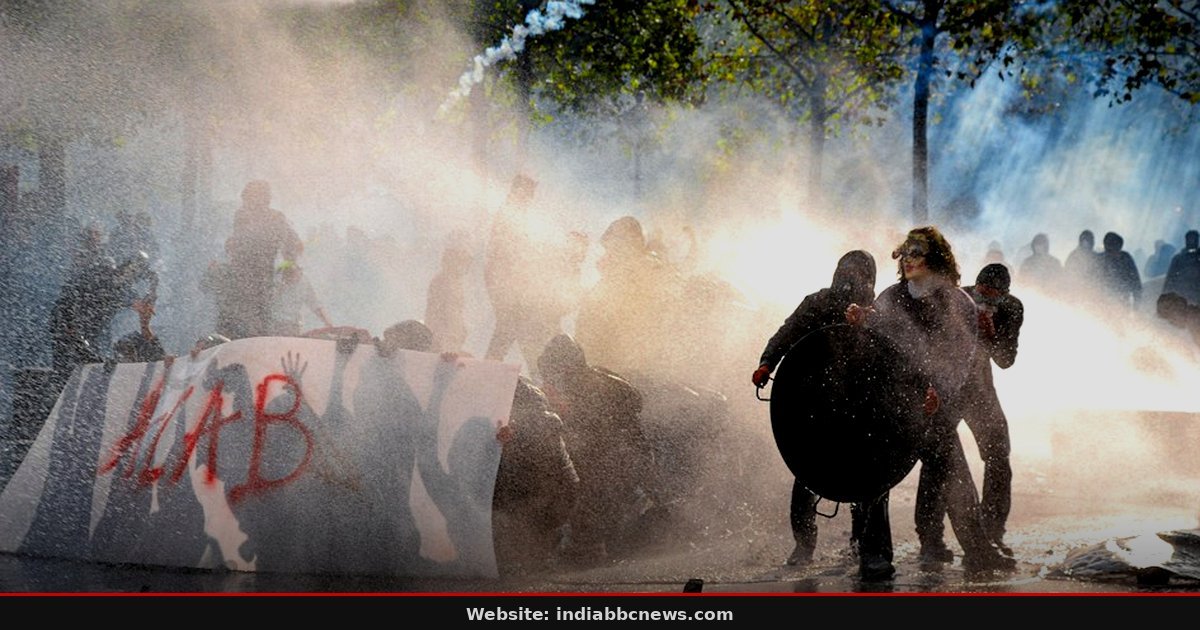
320,000 people. That is the number the French interior ministry released at 6:08 p.m. on a Friday that was supposed to be quiet. It is down from 410,000 last week and 550,000 the week before, which tells you something about the exhaustion in the crowd. The streets of Paris were thick with smoke, but the real fight was already being picked over in the social media feeds that incited the march in the first place.
The Declining Numbers Tell a Harter Story Than The Headlines
The drop in attendance is not a victory for the government, it is a warning sign. When a movement loses 20% of its base week over week, it usually means the easy recruits are gone. What remains is the core, and the core is harder to manage. The police in Paris reported 70,000 marchers, a steep dive from the 110,000 who turned out previously.
It’s a math problem that keeps Interior Minister Laurent Nuñez awake at night, because fewer people does not mean less danger. In fact, smaller crowds are often more volatile, packed with those who feel the most ignored. The energy has shifted from mass participation to targeted disruption. This is a pattern seen in urban uprisings around the world, from Jakarta to London, where the second wave is always more difficult to predict.
Laurent Nuñez confirmed to journalists that they are keeping 70,000 officers on the front lines, matching the resource deployment from Oct. 24. He said in a statement that the remaining participants are being drawn from far-left networks and radicalized yellow vest remnants. These are not casual protesters; they are organized. They have plans, they have supplies, and they have a specific hatred for the establishment that goes beyond cost-of-living gripes.
The minister warned that gatherings after 8 p.m. are now explicitly forbidden. That’s a harder sell than it sounds, because most of the trouble starts exactly then. The sun goes down, the adrenaline rises, and the line between a demonstration and a riot blurs completely. You can’t arrest the feeling of inadequacy, and that is what is driving this whole mess.
Halloween Masks And The Criminality of Disguise
It is Saturday, and in France, that means Halloween. The authorities have identified a specific threat here, as social media influencers encouraged crowds to wear costumes and masks to the rallies. Nuñez stated clearly that concealing one’s face during public order disruptions is a criminal offense. It’s a trap that is hard to escape legally, but it is easy to fall into emotionally.
Many young people see the mask as a symbol of freedom from identification, a rejection of the state’s database. They are also, frankly, having a bit of fun in a situation that has become grim. The police are now looking for faces behind the rubber clown heads and the evil grins. It creates a surreal visual landscape, one that looks like a festival until the tear gas canisters start arcing through the air.
The irony is not lost on the reporters covering this beat. We are watching people dress up as monsters while pretending to be human.
The interior ministry has denied speculation that President Emmanuel Macron is considering suspending major social media platforms. That denial came directly from the president’s office, a move to stop the panic from spiraling out of control. But the pressure is on, and the digital tools used to organize this chaos are becoming a flashpoint. Officers told reporters that they are seeing calls for “revolution” and “insurrection” posted online with precise timestamps.
It is a digital smokescreen, designed to confuse the timeline and the legitimacy of the protest. The government cannot fight a ghost, but it is trying to pin down the hand that is summoning it. The disconnect between the physical street and the digital incitement is widening by the hour. And nobody knows for sure who is pulling that specific lever right now.
The fear is that the next wave will not be a march, but a coordinated series of small, violent strikes. That is a scenario the police are deeply ill-equipped to handle without causing significant collateral damage. The optics are terrible, and the politics are even worse.
Student Grievances Fuel The Long-Term Fire
The students are coming back to school on Monday, but the truce is fragile. The Education Ministry offered caps on class sizes and low-interest loans for infrastructure, but the students rejected this as a token gesture. They vowed to keep protesting, which means the movement is not subsiding, it is maturing. Their two-month-old campaign has expanded beyond high schoolers to include university students, public workers, and veterans of the 2018 yellow vest movement.
This coalition is dangerous because it has depth and institutional memory. These are people who have beaten the police before, and they know how the system works. They know where the weak points are. The government’s response feels like a patch job on a sinking ship.
It’s a structural failure that no amount of low-interest loans can fix. The anger is real, and it is rooted in a generation that feels the social contract has been broken. This is not a protest about one issue, it is a protest about the entire trajectory of French society. And it is not going away quietly.
Official sources confirmed that bands of young men with far-right links are infiltrating these crowds, too. They use the excuse of protecting local shop owners from looting, but they often end up clashing with the far-left groups. This creates a third direction of violence, one that complicates the narrative for the government. The state is trying to blame only the radicals, but the presence of far-right agitators muddies the waters.
It makes the protest look like a total collapse of social order, rather than a specific policy dispute. This is a tactic that has been seen in other European capitals, where proxy conflicts replace direct political debate. The result is a police state reaction that benefits no one except the extremists on either side. The middle ground, the place where compromise lives, is being burned down.
And the students, who started this with a placard and a marker, are now standing in the middle of a war zone. That is a harder sell than it sounds, but it is the reality on the ground. The next round of these protests will be the true test of France’s stability. If the numbers drop further, the government may think it has won.
They haven’t. They have just made it harder to see the enemy.
What This Means for India and the Global South
For India, this is not just a European curiosity, it is a template for domestic unrest. The Indian government is watching the French model with extreme interest, specifically the use of digital surveillance to track protest organizers. The recent crackdowns on anti-land-acquisition protests in India have drawn parallels to the French “insurrection” rhetoric. Indian analysts note that the French experience highlights the limits of force when the grievance is economic.
The youth bulge in India is similar to the demography in France, with a class of young people who feel priced out of the economy. This is a mirror image of the situation in cities like Mumbai and Bangalore, where cost-of-living crises are starting to show up in small, sporadic protests. The lesson for New Delhi is clear: you can arrest the organizer, but you cannot arrest the sentiment. If the French government finds a way to break this movement, that playbook will be copied.
If it fails, it will encourage a more aggressive approach in other democracies. India’s diplomatic corps in Paris is likely drafting reports on this very topic right now. The implications for regional stability are not trivial. We are all part of the same global current of discontent, and the waves are getting higher.
It’s a sobering look at where our own society might be heading if left unchecked. The connection is not tenuous; it is direct and relevant. The tools of control are being refined in Europe, and they are coming south. India needs to be ready for that transfer of tactics.
The timing could not be worse for a government facing its own set of internal pressures. This is a global trend, and France is the testing ground. We are all watching to see which side of the fence the system falls on. The answer will shape policy in Delhi just as much as in Paris.
It’s a complex web of influence that most people ignore at their peril. The next time you see a protest in India, look for the French influence in the tactics used. It is there, whether we acknowledge it or not. The world is smaller than we think, and anger travels fast.
This is not just a French story, it is a story about the future of democratic resilience. And it is playing out in front of our eyes, in real time. We can’t look away now. The stakes are too high, and the lessons are too clear.
India must learn from this, or it will suffer the same fate. There is no other option left. The clock is ticking, and the noise is getting louder every day. It’s a race we may not have time to win.
But we have to try, for the sake of our own people. The evidence is piling up, and it is hard to ignore. The parallels are stark, and the consequences are severe. We are standing on the edge of a precipice, and we need to look down.
That is the only way to understand the depth of the problem. And the only way to solve it. It’s a simple truth, but it is often the one we forget. The world is changing, and we must change with it.
Or be left behind. That is the ultimate challenge facing modern democracies today. And France is leading the charge, whether it likes it or not. The rest of us are just following the smoke.
Where The Violence Breaks Next
The interior ministry’s primary concern is the hours after dark. Nuñez stated that the most violent eruptions happen when the sun goes down and the crowds refuse to leave. This is a predictable pattern, but it is hard to counter without looking like heavy-handed oppressors. The police are walking a tightrope between maintaining order and avoiding provocation.
Any sign of aggression from the authorities will be used as fuel for further protests. It’s a classic cycle, one that has played out in Paris for decades. The government is trying to break the cycle by being more aggressive pre-emptively, but that risks giving the protesters a martyrdom narrative. The balance is precarious, and one bad move could tip the scales.
The next few nights will be critical in determining the trajectory of this unrest. If the police can keep the peace without looking weak, they may have a chance. If they crack down too hard, they will ignite the very fire they are trying to extinguish. It’s a gambler’s ruin, and the house is always at a disadvantage.
The outcome is uncertain, but the stakes are never higher. The world is watching, and the next move is up to the authorities in Paris. Let’s hope they choose wisdom over force. The alternative is chaos, and everyone loses in that scenario.
It’s a simple calculus, but it is easy to get wrong. And getting it wrong is not an option. The margin for error is zero, and the cost of failure is incalculable. We are all betting on the wrong side of this coin.
And the coin is spinning out of control. It’s a mess, and nobody has the key. The door is locked, and the key is lost. We are trapped inside, and the smoke is getting thicker.
There is no way out, only through. And only one way to do that. Keep breathing, and keep watching. The end is not near, but it is getting closer.
The clock is ticking, and the noise is growing. We are all part of this now. There is no escape. Just the next breath, and the next moment.
That is all we have. And it is enough, if we use it well. The future is unwritten, and it is in our hands. Let’s hope we write a better story this time.
It’s the only chance we get. The pen is in our hand, and the ink is running dry. We have to be quick, and we have to be right. There is no other path.
Just the forward march, into the unknown. And the hope that we make it. That is all we can ask for. Nothing more.
Nothing less. Just the chance to try. And to fail, if we must. But to try, always.
That is the human condition. And it is beautiful, in its own grim way. We are all that we have. And we are all that we need.
The rest is noise. The rest is distraction. The rest is the smoke. And we are trying to see through it.
It’s a hard task, but it is necessary. We have to stay sharp, and we have to stay awake. The night is long, and the eyes are open. We are watching, and we are waiting.
And we are ready. For whatever comes next. The storm is here. And we are standing in it.
Let’s see how we
Source: NYT World

