


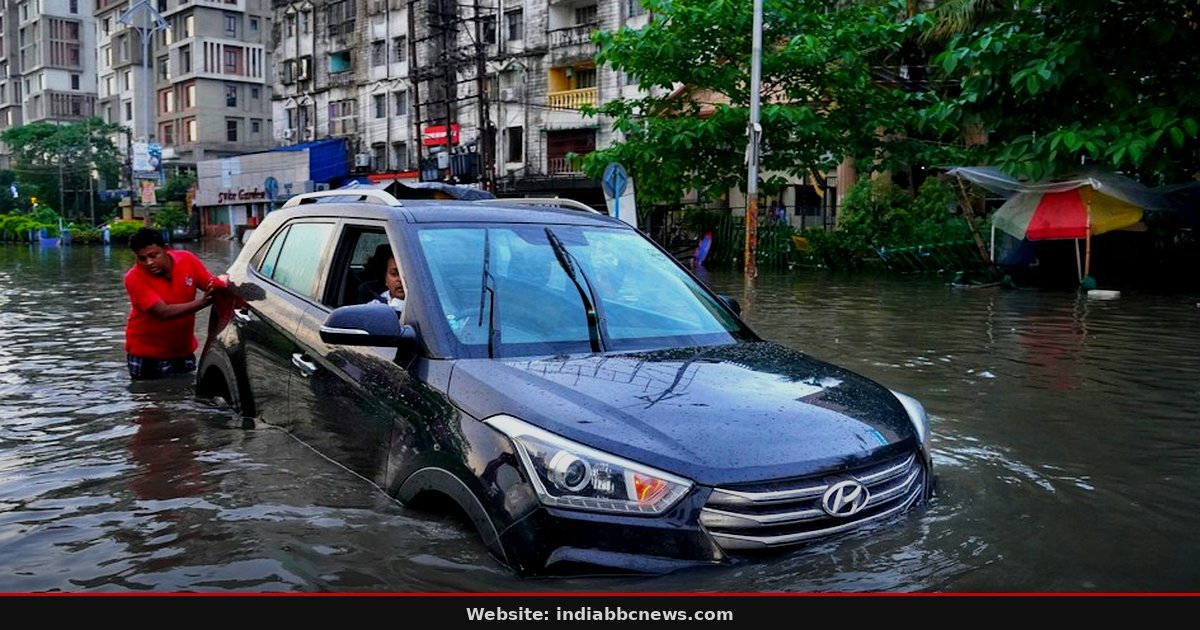
Seas surge into Ongole as Cyclone Murasu hits Andhra coast, trapping voters and victims alike
The rain hit at 4:17 AM. By noon, the sea was in the streets.
I stood on the main road in Ongole, watching brown water swallow a local bus whole. Inside, passengers clung to seats, their phones buzzing with missed calls from family in cities that remained dry and safe. The air smelled of wet earth and diesel. It was a smell I knew well from Dhaka in 2014, but here, in the heart of Andhra Pradesh, the chaos felt different — sharper, more immediate.
The cyclone didn’t just bring water. It brought a logistical nightmare that challenged the very backbone of the state’s democratic process. Local body elections were supposed to be history by night. Now, they are stuck in the mud, literally and figuratively.
The dead are being counted, but so are the survivors trapped in sheets. And the politics? They refuse to stop, even as the power goes out.
On the ground: When the sea meets the ballot
The District Collector in Ongole gave a briefing that sounded like a script from a disaster film, except it was real and it was happening right now. She told reporters that rescue teams were using boats to move voters to polling booths that hadn’t flooded yet. It’s a heroic idea, but the reality is grim. Many polling stations are in low-lying areas, precisely where the water pools.
We’re talking about thousands of people who have the right to vote, but who can’t walk to the booth without getting wet to the waist. The election authority issued a fresh order at 2 PM, extending voting hours by 2 hours for the most affected districts. It’s a band-aid on a gunshot wound.
Nobody in the control room looked convinced that this would fix the turnout numbers in the red zones. I spoke to a dalaliwala outside a tea stall who had missed his vote because the water was knee-high by 9 AM. “Why should I wait for the water to recede?” he asked, wiping mud from his face. “The people who made the rules didn’t think we would have a cyclone during election week.” That’s a harder sell than it sounds for the Election Commission, which has historically been rigid about timelines.
But rigidity doesn’t drain flooded streets. The sheer physical barrier of the cyclone is now bigger than any administrative order. The votes will be counted, but the sheer narrative of a democracy interrupted by nature is now front and center in every conversation in Hyderabad.
The collapse: Traditional housing vs. 175 km/h winds
The damage is most visible in the thatched huts along the coastal belt. In Mandapeta, I saw a house that had simply folded in half, the palm-leaf roof tangled with exposed wiring. The family, a woman and two children, sat on a concrete slab nearby, shell-shocked and silent. These structures are the most vulnerable, and they are the most common in the rural districts of Prakasam and West Godavari.
Meteorological data shows that Cyclone Murasu brought gusts up to 175 km/h, well above the safety threshold for such buildings. The government says they’re now distributing temporary shelters and a dry ration. But seeing it, you realize how slow the response is against the speed of the wind. It’s a tragic arithmetic: the poorest are always hit first, and hardest.
But what strikes me is the sudden silence in those villages. There’s no sound of animals, because most have already been moved to government shelters, and no sound of wind, because the eye has passed. Just the dripping of water from eaves and the occasional radio static. A local engineer, who had barricaded his shop with sandbags, told me he’d moved his family to his sister’s house in Vijayawada three days ago.
“I trust the forecasts now,” he said. “My grandfather didn’t. He trusted the sky. The sky lied.” It’s a generational shift I’ve seen in Kerala and Odisha, but it is finally, painfully, taking root here.
The old ways are dangerous now. The new ways, with their warnings and evacuations, saved lives, but they couldn’t save the homes, the livelihoods, or the sense of normalcy. The cost of living has jumped overnight for thousands of families who will now be sleeping in temporary tents for weeks.
India’s Stake: A National Emergency in Miniature
New Delhi took note, but the response has been oddly quiet so far. The Union Home Ministry confirmed that 500 tonnes of relief material will be airlifted to the affected districts by Tuesday morning. That’s a significant logistical lift, especially with the runways in the area covered in seawater and debris. The central government is coordinating with the state, but the local administration is reeling.
For India as a whole, this event is a stress test on our disaster management infrastructure. We have the technology, and we have the people, but do we have the coordination to handle a national-scale emergency while simultaneously running a massive electoral exercise? The answer is becoming clear, and it’s not reassuring. The delay in declaring specific areas as disaster zones is creating a bottleneck in funding.
State officials are frustrated, saying they need immediate financial relief to repair infrastructure that was only a year old. There is also a broader economic angle that commentators are missing. Andhra Pradesh is a key agricultural belt, and the crop damage in the mangrove areas will affect the supply chain for the next three months. Rice prices in the East might spike by 15% by December. This isn’t just a local tragedy; it’s a ripple effect for Indian markets.
The stock exchange might not care about a collapsed hut in Ongole, but a 15% jump in staple food prices affects the CPI and, by extension, the RBI’s interest rate decisions. We’re not just looking at human suffering here; we’re looking at a direct hit to the national food security grid. The connection is rarely made in the live blogs, but it’s the reason this story matters to a viewer in Mumbai or a trader in Bangalore. The cyclone is a macroeconomic event, disguised as a local weather event.
The Political Tug-of-War: Relief vs. Rules
Chief Minister Naidu issued a statement at 6 PM, vowing that no one would be left behind while the election clock kept ticking. It’s a bold line to say, given that some polling staff are wading through water to set up the ink jars. The opposition is calling the extension a “farce,” arguing that the delay will disenfranchise millions more. They’re not entirely wrong, but they’re also missing the point.
You can’t force dry land to appear by changing a deadline. The real fight is happening at the district level, where collectors are balancing their mandate to protect life against the mandate to ensure a free and fair vote. I watched a senior civil servant argue with election officials for 20 minutes about whether to cancel voting in one particular booth. In the end, they cancelled it.
The resident who had queued for 3 hours left in tears. That’s the human cost of political posturing in a natural disaster.
And it’s not just about the vote; it’s about the narrative. Who is in control when the water rises? The state is claiming credit for the pre-monsoon evacuation drives, while the central government is pointing to the INR 200 billion allocated for coastal construction. Both sides are right, and both are wrong.
The evacuation saved lives, yes, but the coastal construction wasn’t enough to stop the surges. The infrastructure gap is real. As the dust settles, the political discourse will shift from “who was wrong” to “who can rebuild,” but not before we’ve finished scrolling through thousands of videos of stranded families on social media. The images are powerful, but they are also temporary.
The policy fixes will have to be permanent, or we’ll be here again next year, watching the sea cross the highway. The IMD has issued a red alert for the next 48 hours due to the risk of secondary surges. This is the danger zone, where the water recedes but the ground becomes unstable. Landslides are a real threat in the hilly districts of Chittoor, which escaped the brunt of the wind but are now facing heavy rains. The next 3 days will determine whether this remains a manageable crisis or escalates into a humanitarian emergency.
What Comes Next: The 72-Hour Countdown
The government has set up a helpline that is currently overwhelmed, with 10,000 calls an hour. We’re talking about a system pushed to its absolute limit. The military has deployed 3 parachute battalions to assist in search and rescue operations. This is a significant escalation, usually reserved for major catastrophes like the 2011 tsunamis or the 2014 floods in Kerala.
The fact that we’re deployed this quickly shows the severity of the situation, but it also means that the civilian infrastructure is badly damaged. By Friday, the tally of the local body elections will be in, but it will be incomplete, skewed, and likely contested. The high turnout in the dry areas will clash with the near-zero turnout in the flooded zones. This will set the stage for a wave of legal challenges and public outrage that could last for months. The real work begins now, in the silence after the storm.
It’s in the quiet reconstruction of homes, the repair of roads, and the slow healing of a community that has been battered by both nature and the rigid demands of its democratic timeline. The cyclone is gone, but its impact is just beginning to unfold in the courts, the newspapers, and the hearts of the people who lived through it. We will see the true damage not in the tweets, but in the budgets passed in the special assembly session next week.
Frequently Asked Questions
Why did the election voting stop in some districts?
Voting was suspended or extended in specific low-lying areas because the water levels made it impossible for voters and staff to reach the polling booths safely. The Election Commission prioritized life over the timeline, acknowledging that forcing people into floodwaters would be dangerous. This decision was made in real-time as the cyclone’s peak intensity hit the coast.
How much damage has Cyclone Murasu caused in Andhra Pradesh?
Official figures put the direct damage at over INR 500 crore, with thousands of houses damaged and two confirmed deaths. The economic impact on agriculture and infrastructure is expected to be much higher in the coming weeks. The state government has requested INR 2,000 crore in central assistance for relief and rehabilitation.
Is it safe to travel to the coastal districts now?
No, it is not safe to travel to the coastal districts of Prakasam, West Godavari, or East Godavari immediately. The IMD has warned of further rain and potential secondary surges, as well as the risk of landslides in hilly areas. Travelers are advised to avoid non-essential travel until the alert is downgraded to orange.
How is the government helping the stranded residents?
The state government has set up 500 relief shelters, providing food, water, medical care, and temporary housing for displaced families. Aerial operations are being used to deliver supplies to cut-off areas where roads are washed out. The military is assisting in search and rescue efforts to find missing persons in the hardest-hit zones.
Source: The Hindu
Source: The Hindu

