

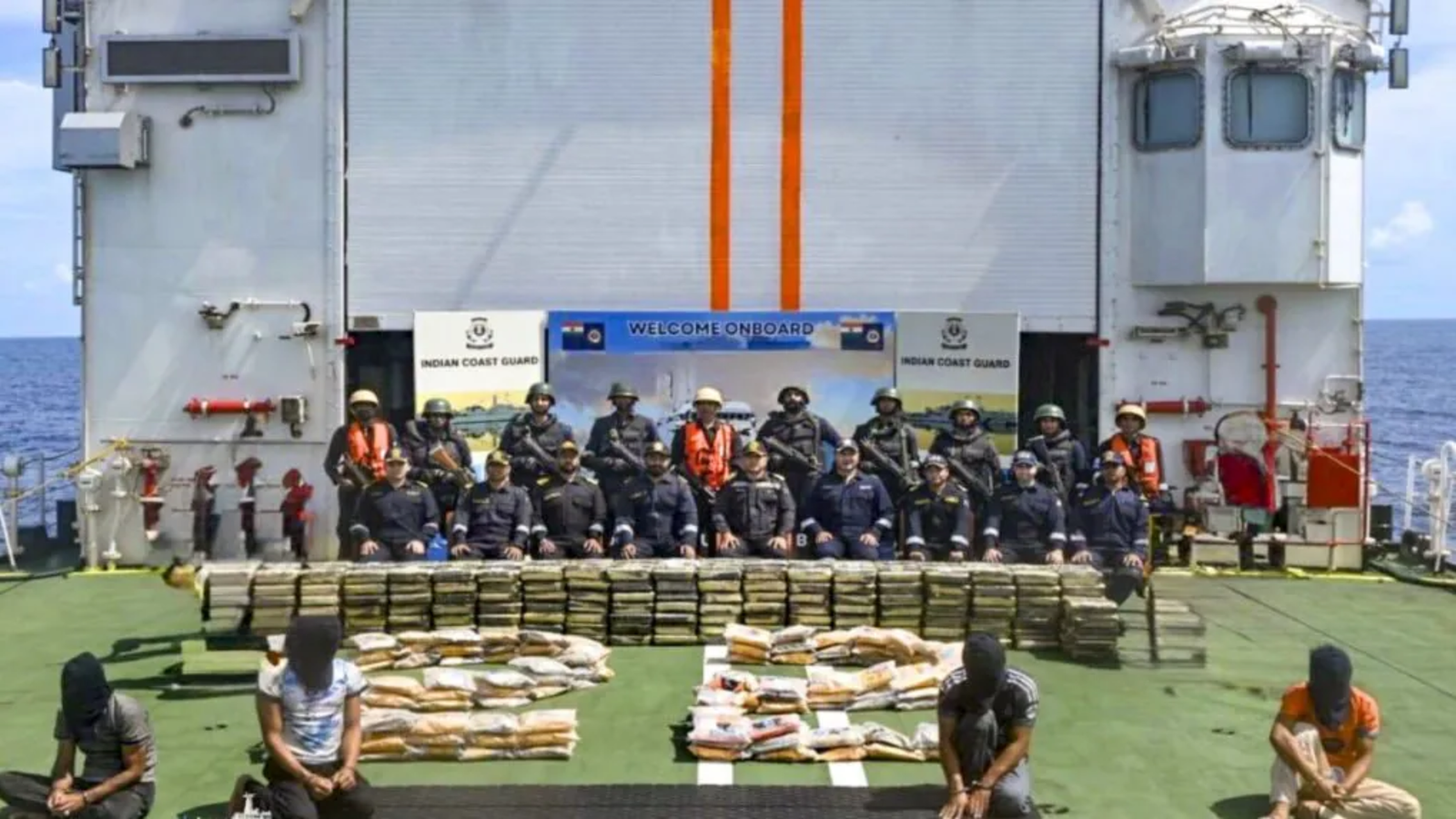
The Indian Coast Guard and Gujarat Anti-Terrorism Squad (ATS) have confiscated 526 kg of drugs worth over ₹3,000 crore in the international market after arresting an Iranian dhow in the Arabian Sea off the coast of Lakshadweep.
The operation was carried out on September 25, 2026, based on inputs regarding the alleged smuggling of drugs by a ship. The five Pakistanis piloting the Iranian ship have been arrested, according to some sources.
It has been revealed that the confiscated lot included methamphetamine and heroin. The dhow, the crew, and the confiscated drugs were taken to Mumbai.
What happened in the 526 kg drug seizure?
526 kg of drugs that were seized from the Iranian ship were confiscated in the context of a joint operation conducted by the Indian Coast Guard and Gujarat ATS.
As was mentioned by officials in several publications, the operation was organized following intelligence received concerning a suspicious ship which is supposedly engaged in an international drug trafficking operation.
In order to conduct surveillance on the ship and track its location, coast guard vessels were used for a joint sea and air mission. The ship was located and tracked; later it was pursued and finally intercepted near Lakshadweep. Boarding and search operations of the ship resulted in confiscation of the narcotics.
The operation shows how intelligence-driven surveillance helps identify the suspected smuggling activities prior to arrival at their destination point.
Where was the Iranian vessel intercepted?
The vessel was intercepted west of Lakshadweep Islands in the Arabian Sea.
The operation took place Sept. 25 after the Coast Guard received intelligence about the suspected shipment of narcotics, reports say. The location is significant as the Arabian Sea offers a huge sea route linking South Asia with Middle East and other regions.
The vessel was later taken to Mumbai where investigators began further questioning and legal proceedings against the crew, the vessel and the seized consignment.
What drugs were seized?
Authorities recovered approximately 526 kg of narcotics, reported to include:
- Methamphetamine
- Heroin
According to reporting based on statements from Gujarat ATS officials, the total quantity comprised approximately 400 kg of methamphetamine and 126 kg of heroin.
The agencies estimated the value of the seized narcotics at more than ₹3,000 crore in the international market. The valuation refers to the estimated illicit-market value of the seized substances and should not be interpreted as a conventional retail or legal-market valuation.
Who was apprehended from the vessel?
Five Pakistani nationals were apprehended from the Iranian dhow during the operation.
Recent reporting identified the crew members as Mohammad Yakub Balochi, Shakirullah, Faridullah, Ahmed Khan and Wahidullah Khan, all reported to be from Peshawar, Pakistan.
Authorities are investigating the alleged role of the crew and the wider network connected to the shipment. Since the investigation is ongoing, details concerning individual responsibility and the wider trafficking network remain subject to the legal process.
How did the Coast Guard track the vessel?
The operation was reportedly based on intelligence received by the Gujarat ATS.
Following the intelligence input, authorities alerted the Indian Coast Guard and coordinated a maritime surveillance operation. Coast Guard assets used sea and air surveillance to identify and track the suspicious vessel.
After sustained tracking, the Coast Guard intercepted the dhow and personnel boarded it for a search. The narcotics were subsequently recovered from the vessel. The Indian Express
The sequence highlights the importance of cooperation between intelligence agencies and maritime security forces in combating drug trafficking at sea.
What was the suspected route of the drug consignment?
Further details released by Gujarat ATS indicate that the vessel was the Iranian dhow named Azad.
According to officials cited by The Indian Express and The Times of India, preliminary questioning indicated that the vessel had departed from Konarak, Iran, while the consignment had allegedly been transferred from another boat that had arrived from Gwadar, Pakistan. Investigators are examining the intended delivery route and possible connections to India.
Other reporting has said investigators were examining a suspected plan involving a transfer to another vessel connected with Tamil Nadu. These details are part of the ongoing investigation and may develop as authorities examine the alleged trafficking network.
Why is the Arabian Sea important in the investigation?
The Arabian Sea plays a critical role in India’s coastal security due to its connection to Indian waters and shipping lanes extending towards the Middle East and beyond.
A large narcotics seizure at sea may involve multiple jurisdictions, vessels and intermediaries. Investigators usually need to establish where a shipment originated, how it was transferred, who controlled the vessel and where the consignment was intended to go.
In this case, authorities are examining the origin of the drugs, the movement of the consignment, its intended recipients and the wider international network allegedly connected to the shipment.
The seizure therefore goes beyond the recovery of narcotics from one vessel. The ongoing investigation is focused on identifying the broader network behind the consignment.
Iranian vessel brought to Mumbai
After being intercepted, the Iranian dhow, its crew, and the seized drugs were brought to Mumbai under armed escort.
Various agencies are likely to be involved in the investigation and prosecution. They are expected to scrutinize the crew members’ statements and other evidence to identify the drugs’ source and destination.
The Mumbai stop is significant because the authorities can question the crew members more closely and coordinate with other law enforcement agencies on next steps.
What happens next in the drug seizure case?
The investigation is continuing.
Authorities are expected to focus on several key questions:
- Where did the narcotics originate?
- How was the consignment transferred to the Iranian vessel?
- Who arranged the maritime movement of the drugs?
- Who were the intended recipients?
- Were additional vessels or intermediaries involved?
- What wider international network was connected to the shipment?
According to reports, a case is being registered by the Gujarat ATS and further investigation is underway.
It is important to distinguish between allegations under investigation and facts established through the legal process. The apprehension of individuals does not by itself establish their guilt, and investigators must establish individual roles through evidence and due process.
Why the 526 kg drug seizure matters
The seizure represents a major maritime narcotics interception in terms of the quantity and reported international-market value of the drugs.
The operation also illustrates the way in which information-sharing, maritime surveillance and coordinated action between agencies can be used to intercept suspected trafficking activity before a consignment reaches land.
The Indian Coast Guard has previously conducted joint narcotics-interdiction operations with other agencies. The latest seizure adds another significant case to India’s continuing efforts to detect and prevent drug trafficking through maritime routes.
For investigators, however, the seizure itself is only one part of the operation.
Identifying the people financing, coordinating and receiving the shipment could provide further information about the network allegedly behind the consignment.
Conclusion
The 526 kg drugs found in the Iranian vessel in the Arabian Sea have become a significant case of maritime narcotics in India. The Indian Coast Guard and Gujarat ATS arrested the vessel west of Lakshadweep on September 25, after the surveillance intelligence.
The seized illicit drugs are said to be mostly heroin and methamphetamine worth more than ₹3,000 crore in the international black market. Five Pakistani nationals were also arrested while the vessel and drugs were taken to Mumbai for the investigation.
The next step of the investigation will try to identify the origin of the illicit shipment, its intended destination and the global network that was involved in smuggling narcotics. As the authorities continue their work, more information may come out about the international and national connections of the case.