

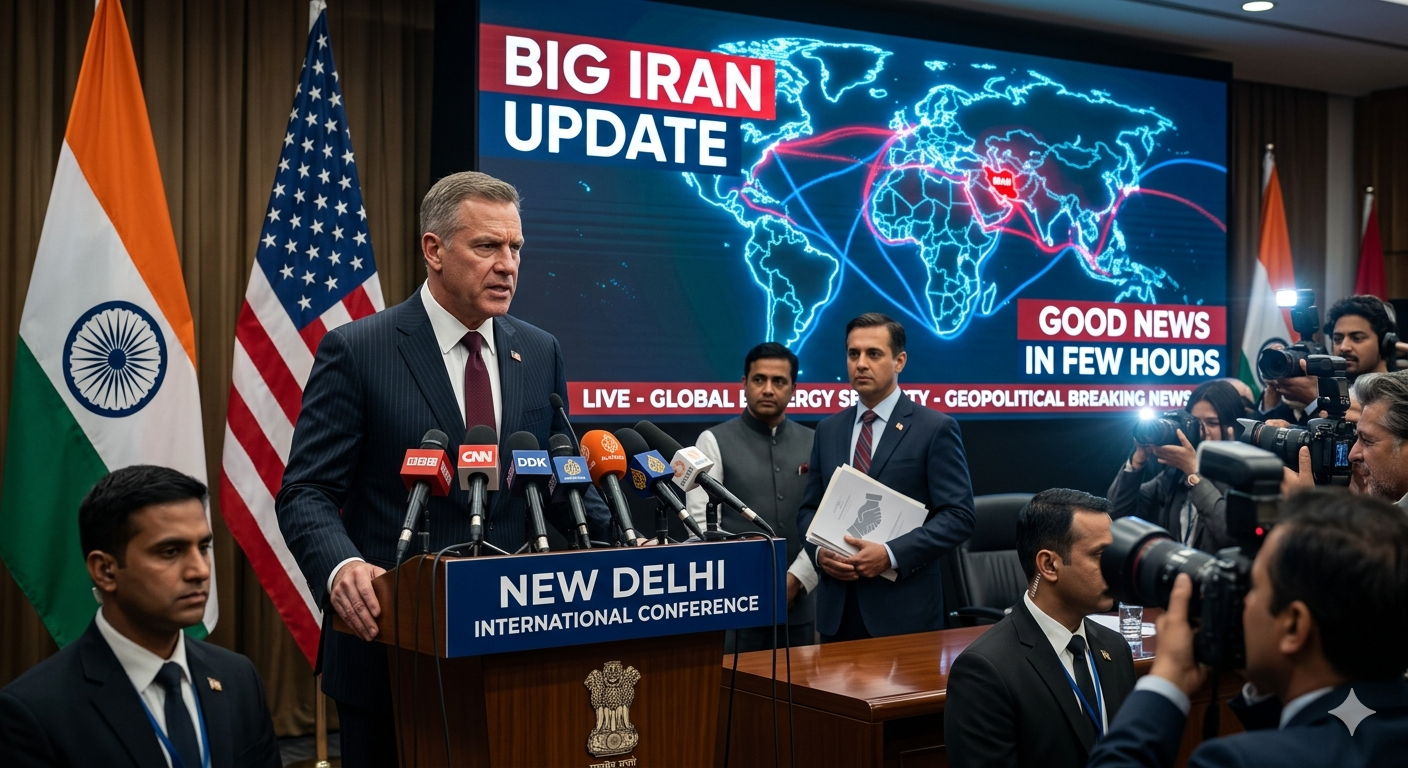
And US Secretary of State Marco Rubio, on an official visit to India, suggested on social media that “good news” about Iran could come within hours, focusing world attention on New Delhi. The statement immediately sparked worldwide speculation of a possible diplomatic breakthrough involving Iran, the United States and rising tensions in the Middle East. Rubio’s comments have raised hopes of a possible peace deal that could reshape the regional geopolitical map at a time when fears of conflict escalation, oil supply disruption and nuclear tensions are still topping international headlines.
“Negotiations with Iran are going well,” Rubio said during a joint press conference with Indian External Affairs Minister S. Jaishankar in New Delhi. He spoke shortly after US President Donald Trump said a peace deal on Iran had been “largely negotiated.”
Marco Rubio’s Big Clue From India
“There is a possibility that in the next few hours the world will get some good news,” said Mr Rubio during the media interaction here in Delhi. Reactions from diplomats, analysts and international media outlets soon followed the statement, many interpreting it as a sign that a major development regarding Iran could soon be announced.
Rubio stressed that the new talks were focused on de-escalation in the Strait of Hormuz and preventing Iran from obtaining nuclear weapons. The US Secretary of State says the prime objective is to secure peace and stabilise one of the world’s most sensitive geopolitical regions.
The timing of the statement is significant, as the Middle East has been on edge following months of heightened tensions involving Iran, Israel and the United States. The conflict has already affected international shipping routes, energy prices and diplomatic relations between a number of countries.
The Importance of the Strait of Hormuz
During his visit to India, Rubio addressed several key issues, including the Strait of Hormuz, one of the world’s most important maritime trade routes. This narrow waterway carries almost one fifth of the world’s oil trade. Any disturbance in the region directly affects the global energy markets and causes uncertainty to the global economy.
Rubio said the proposed peace framework would tackle concerns about navigation and maritime security in the Strait of Hormuz. The route has become more sensitive after Iran allegedly restricted or threatened commercial movement amid military tensions with the US and Israel.
The United States has repeatedly demanded that the Strait of Hormuz remain open under international maritime law. Rubio called attacks or threats against commercial ships in the region “unacceptable and illegal.” His comments suggested that any future agreement with Iran would likely include guarantees on the security of shipping and safe passage for international vessels.
Rumors Fueled by Donald Trump’s Statement
Before Rubio’s press conference in Delhi, Donald Trump stated that negotiations involving Iran had reached an advanced stage. Trump said talks with allies in the region and other world powers have narrowed the gap between the two sides in coming up with a possible deal.
The former U.S. president suggested the possible deal could entail the reopening of the Strait of Hormuz, the easing of sanctions and the establishment of a framework for future talks on Iran’s nuclear program. There have been some reports of optimism about the talks but Iranian officials have stayed cautious and have not confirmed several claims made by US leaders.
There was still uncertainty in the air but diplomatic signals from Washington and New Delhi fed a cautious sense of hope in global markets and political circles. Energy analysts were closely watching the developments as any positive outcome could stabilise oil prices and ease fears of wider conflict in the Middle East.
India’s Strategic Role in Middle East Crisis
India’s involvement in the talks highlighted its growing importance in the world of international diplomacy. Over the past decade, India has strengthened its ties with the United States as well as several key Middle Eastern nations, including Iran, Israel, Saudi Arabia, and the United Arab Emirates.
Rubio’s visit to India reportedly involved discussions on trade, energy cooperation, regional security and maritime stability. India has consistently advocated peaceful dialogue and freedom of navigation in international waters.
Gulf stability is not merely a diplomatic issue but an economic imperative for India. India imports a large chunk of its crude oil from the Middle East and any disruption in shipping routes could directly impact fuel prices, inflation and economic growth.
On the Iran crisis, Indian officials have taken a measured line. At the same time, India has maintained its diplomatic outreach to Iran to safeguard its strategic and economic interests, while it builds its relationship with the United States.
The Nuclear Question Is Still Critical
Another major issue at the heart of the negotiations is Iran’s nuclear programme. The United States has repeatedly said that Iran must never have a nuclear weapon. Rubio reiterated this position at the press conference in Delhi, calling it a non-negotiable goal of US foreign policy.
The talks reportedly could also include discussions on Iran’s enriched uranium stockpile and international monitoring mechanisms. But Iranian leaders have reportedly resisted some demands related to nuclear inspections and uranium transfers.
The nuclear issue is still very sensitive, as it impacts not only the stability of the Middle East, but also the global security dynamics. Western countries fear a nuclear Iran could trigger an arms race in the region. Tehran insists its nuclear programme is for peaceful purposes.
Global Markets Monitor Closes
World financial markets greeted diplomatic developments with caution. Washington, Tehran and New Delhi were watched closely by oil traders and investors for every word spoken.
Any successful agreement involving Iran could potentially reduce tensions in global energy markets. With a large percentage of the world’s oil passing through the Strait of Hormuz, stability in the region is seen as vital to ensuring predictable fuel prices around the world.
Experts said even a temporary ceasefire or diplomatic breakthrough could boost investor confidence and ease fears about supply disruptions. Conversely, a breakdown in talks could result in renewed tensions and more volatility in energy prices.
International Reactions To Rubio’s Statement To
Several countries welcomed the prospect of diplomatic progress. European countries have been calling for negotiations for a long time to prevent an escalation in the Middle East. International bodies and regional powers also hoped the ongoing talks could yield a peaceful outcome.
But analysts cautioned diplomacy with Iran has a history of being complicated and unpredictable. Previous deals have often been bogged down by issues of implementation, disagreements over sanctions and political resistance from various parties.
Iranian officials have been cautious in their response to Mr Rubio’s comments, refusing to confirm directly that any deal has been reached. Reports say Tehran continues to focus on safeguarding its sovereignty and relief from economic sanctions before it will agree to broader commitments.
India-US Relations: The Long-Standing Partnership
The visit of Rubio to India also highlighted the deepening strategic partnership between the two countries. The talks between the two countries covered defence cooperation, trade negotiations, maritime security and technology partnerships.
The United States considers India an increasingly valuable strategic partner in the Indo-Pacific region. At the same time, India continues to carefully balance its global relationships, while protecting its independent foreign policy approach.
The Iran issue is yet another manifestation of India’s increasing diplomatic clout. Hosting sensitive conversations about one of the world’s most sensitive geopolitical crises is a sign of New Delhi’s growing power on the world stage.
Conclusion
Marco Rubio’s remark from India about possible “good news” on Iran has prompted a worldwide wave of anticipation. In a time of dangerously high tensions in the Middle East even the prospect of diplomatic progress is being viewed as significant.
The debates over Iran, the Strait of Hormuz, and nuclear talks could have profound implications for global security, oil markets, and international diplomacy. There is still a lot of fog, but the signals coming out of Washington and New Delhi suggest that the talks are intense.
India’s participation in these talks indicates its expanding role on the world stage, especially as a reliable partner able to engage with different parties in times of global crises. Whether the anticipated “good news” leads to a formal peace framework or just opens the door to more talks, the next few days could shape the future of Middle Eastern stability and global economic confidence.