





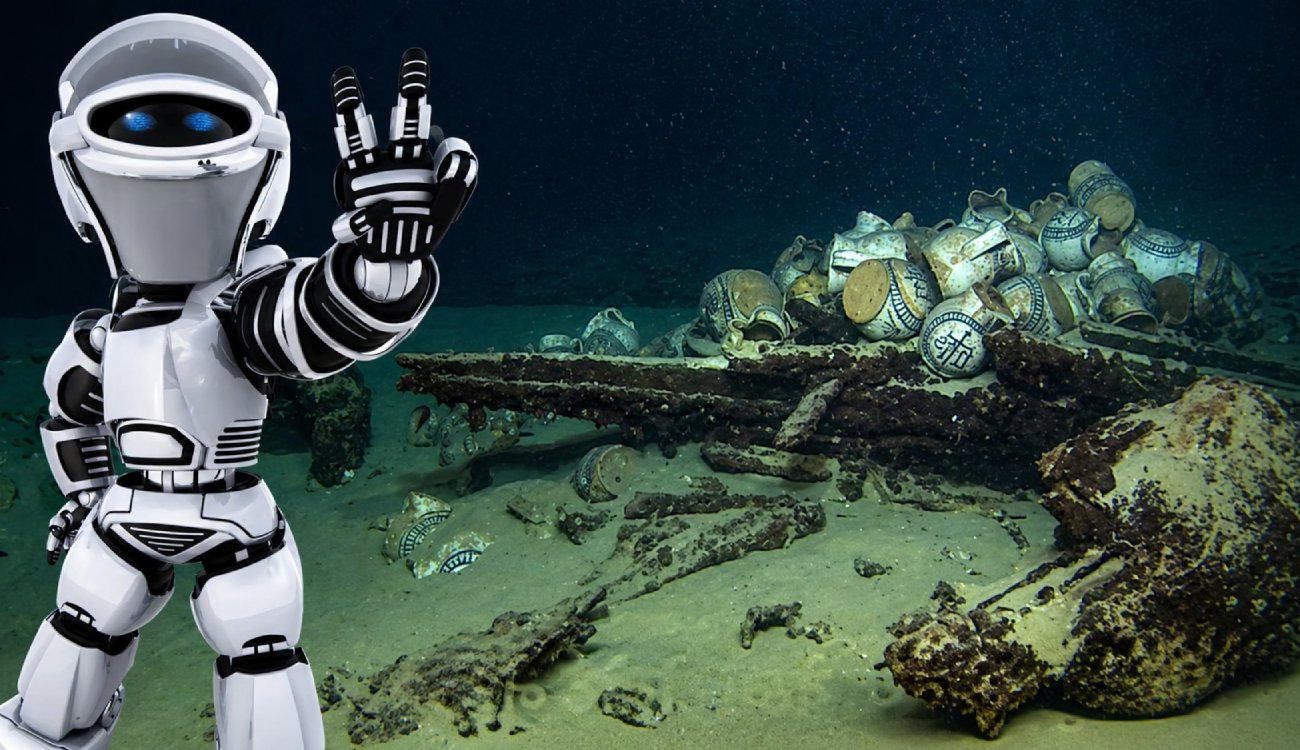
What lies hidden in the depths of the ocean has always remained a mystery to humanity. However, technology has now advanced to such an extent that robots can easily venture into—and conduct explorations in—places where humans cannot reach. One such astonishing mission recently came to light, in which a remote-controlled robot descended nearly 2.4 kilometers into the deep sea and located a shipwreck that had sunk 400 years ago.
This mission was conducted in the Mediterranean Sea, where the remains of an ancient vessel—which had sunk centuries earlier—were discovered. A remarkable aspect of this undertaking was that, at such extreme depths, not only was there total darkness, but the water pressure was also at an incredibly dangerous level. It is considered virtually impossible for humans to reach such an environment.
According to reports, this mission was executed jointly by the French Navy and a team of archaeological experts. The project was officially named ‘Camarat 4.’ The robot utilized in the mission was controlled remotely from a support vessel stationed at the ocean’s surface.
A specialized wired system was employed to lower the robot down to the ocean depths. After a descent lasting approximately one hour, the robot finally reached the seabed. Upon arrival, it captured high-resolution images of the shipwreck and scanned several key components of the vessel.
The greatest triumph of the technology employed was that the shipwreck’s remains sustained absolutely no damage throughout the entire operation. The robot captured thousands of images and navigated through the wreckage with extreme caution. Its onboard robotic pincers and camera systems recorded multiple images every second.
Experts note that very little information currently exists regarding 16th-century commercial vessels. Consequently, this discovery could prove to be of immense significance to both historians and scientists. Plans are now underway to utilize these images to construct a 3D model of the ship, thereby enabling a more comprehensive understanding of its design and structural composition.
Conducting research in the deep sea has always been a formidable challenge. At such depths, temperatures are extremely low, light is virtually non-existent, and the immense water pressure poses a severe threat to the human body. Often, even standard machinery ceases to function in such environments. However, modern robotics and AI technology have significantly alleviated these challenges.
Experts believe that in the near future, such robots will play a pivotal role in marine exploration. Their application is expected to expand beyond merely locating shipwrecks to discovering hidden natural resources, rare marine species, and historical mysteries concealed within the ocean depths.
This mission serves as a prime example of how technology is now reaching places that humans could once only imagine.