


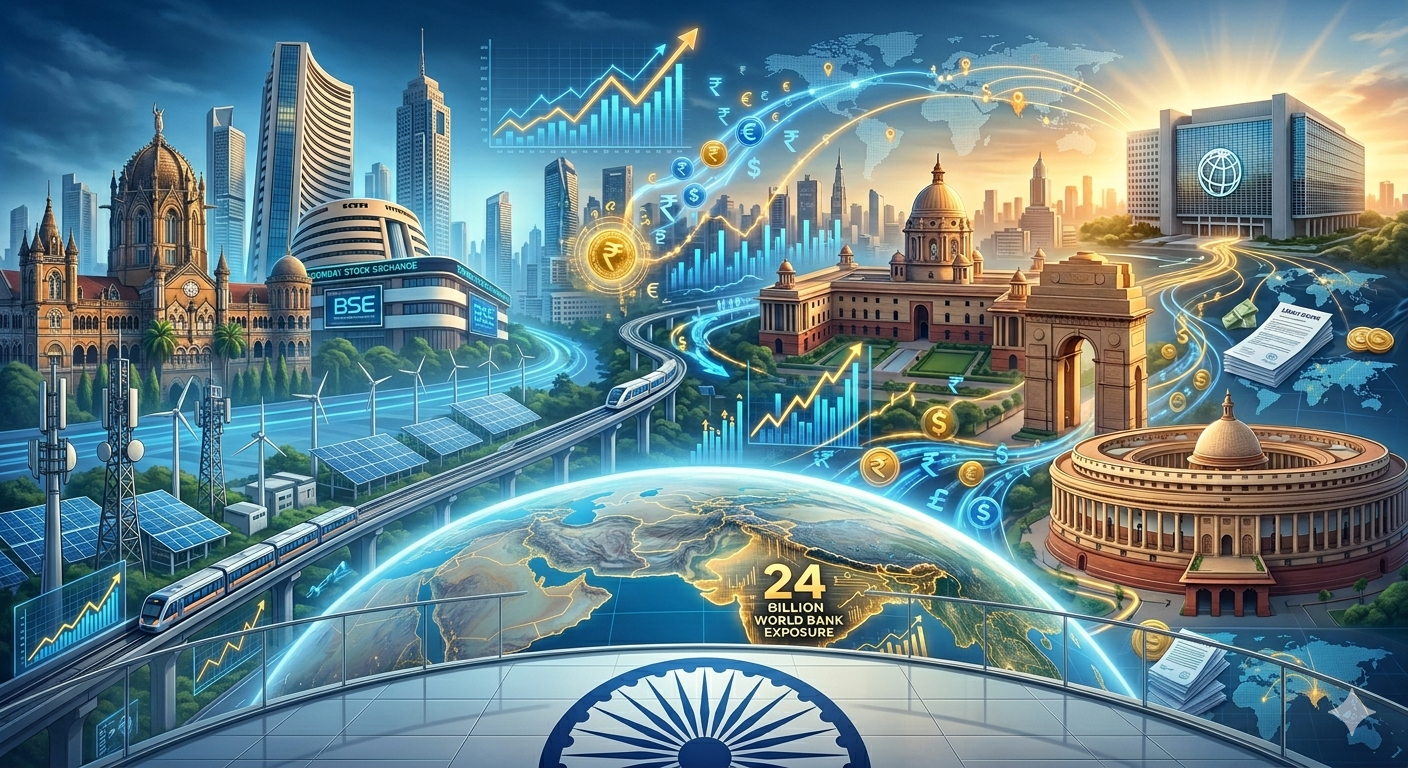
India is the largest borrower of the World Bank’s main lending arm, the International Bank for Reconstruction and Development (IBRD), with an outstanding exposure of almost $24 billion. The trend points to the rising economic aspirations of India, the rapid expansion of its infrastructure and the increasing demand for global financial backing to undertake large scale development projects. India is one of the world’s fastest-growing major economies, and therefore it continues to invest extensively in transportation, climate resilience, healthcare, urban development, renewable energy and social welfare programs.
The World Bank’s financial support to India is a reflection of both confidence in the country’s economic potential and the scope of its development needs. According to the latest numbers on the World Bank’s total debt exposure, India has overtaken Indonesia and Colombia to become the world’s largest borrower from the agency. This financial link also emphasizes the strategic relevance of India in global economic and development policy.
India’s Position as the Largest World Bank Borrower
As per the latest data, India’s total outstanding commitments from the World Bank are around $24 billion. This includes loans and credit facilities granted by different institutions of the World Bank, including the IBRD. The World Bank Group provides financial and technical assistance to help developing countries reduce poverty and promote sustainable development.
India’s large borrowing is associated with its ambitious objectives to upgrade infrastructure, improve public services and boost the economy. India has been working on projects from highways and metro systems to digital connection and climate adaption programs that demand massive amounts of money.
India is now the largest borrower at the World Bank, followed by Indonesia with about $22 billion and Colombia with about $17 billion in exposure. India’s top position shows not only the amount of its borrowing but also the scale of the ongoing development revolution in the country.
Understanding the World Bank’s Role in India
For decades, the World Bank has been a partner of India. Since India’s accession to the institution in 1945, the World Bank has financed hundreds of projects in sectors such as education, agriculture, healthcare, energy and transport.
The World Bank’s financial support to India generally is categorized into three key types. The first are IBRD commitments, which represent the lion’s share of India’s exposure. Some $20 billion has been funnelled into initiatives relating to infrastructure, climate resilience, urban development, healthcare systems and institutional reforms.
The second is the International Finance Corporation (IFC), which has committed over $16.7 billion to boost the growth of the private sector, entrepreneurship and investment prospects in India. IFC investments usually concentrate on the renewable energy, banking, industrial and technology sectors.
The third category is guarantees issued by the Multilateral Investment Guarantee Agency (MIGA). MIGA has granted over $600 million in financial guarantees to stimulate foreign investment and reduce political or economic risks.
These funding commitments underscore the overall engagement of the World Bank Group in India’s development journey.
Why India Needs Large-Scale Borrowing
India’s population of nearly 1.4 billion has an immense demand for infrastructure and public services. To keep its economy moving and enhance people’s lives, the government must keep building roads, railways, airports, renewable energy, housing, healthcare and education.
A big reason for India’s borrowing is to modernise its infrastructure. The government has initiated various major projects like high-speed rail lines, smart cities, metro rail systems and renewable energy parks. These projects require billions of dollars in funding and typically rely on assistance from international bodies such as the World Bank.
Another key driver of borrowing demands is climate change. India confronts growing threats from floods, heatwaves, droughts and rising sea levels. The World Bank has financed climate adaptation and catastrophe management projects to increase resilience in vulnerable areas.
Healthcare and social assistance programs further add to the financing requirements. India stepped up health infrastructure, vaccination rollout and public health systems after the COVID-19 epidemic. These activities were backed by funds from the World Bank.
Additionally, India’s push toward clean energy and sustainability has encouraged international financial institutions to provide support for solar, wind, and green hydrogen projects. These investments are critical for helping India achieve its long-term climate goals.
Economic Benefits of World Bank Funding
World Bank loans are often on relatively concessional terms compared with commercial borrowing. Such finance is advantageous for emerging economies because of lower interest rates, longer repayment periods and technical help.
The cash helps to speed economic development in India without immediate impact on domestic banking systems. World Bank-supported improvements in infrastructure can generate jobs, boost productivity and attract private investment.
Projects supported by the World Bank are frequently oriented towards long-term economic development. Better roads and transport networks lower the logistical costs and encourage trade connections. Investing in renewable energy reduces reliance on imported fossil fuels and supports environmental sustainability.
World Bank-funded education and health projects also can boost human capital, which is needed to sustain economic growth. The World Bank-assisted reforms that strengthen public institutions and governance systems can also enhance the efficiency and openness of public administration.
Concerns Over Rising Debt Exposure
But the higher levels of borrowing are also a worry to economists and financial analysts.” Critics say too much reliance on outside borrowing could raise long-term debt burdens and repayment commitments.
India’s economy is strong relative to many developing countries, but debt sustainability management is still critical. The borrowed monies must be used efficiently so that the projects provide economic benefits sufficient to service future obligations.
There are also disagreements over the policy impact of international financial institutions. Some experts say institutions such as the World Bank might push economic reforms that reflect global financial agendas, which don’t necessarily exactly match domestic interests.
But Indian politicians have often insisted that World Bank funding supports national development priorities and complements local investment plans.
India’s Growing Global Economic Influence
The other sign of India’s growing importance in the global economy is India being the World Bank’s biggest borrower. India is the world’s fifth largest economy and a key destination for manufacturing, technology, digital innovation and renewable energy investment.
India is seen by global institutions as a major engine of future economic growth. Its enormous consumer market, young workforce and fast digital revolution make it appealing for international investors and development agencies.
India’s leadership on issues like digital public infrastructure, financial inclusion, renewable energy expansion has boosted its standing in the world. India is viewed as an important partner by international organisations in dealing with global problems such as climate change, poverty reduction and sustainable development.
The amount of World Bank lending in spite of global uncertainty and geopolitical tensions is a sign of confidence in India’s long-term economic potential.
Impact on Infrastructure and Development Projects
Already the impact of the World Bank supported projects are obvious in India. A number of large city metro rail systems have benefited from international financing and technical support. Rural roads initiatives have enhanced connection in isolated places, with positive effects on local economy and access to basic services.
Internationally financed renewable energy programs have made India one of the world’s fastest expanding solar energy marketplaces. In many areas, water management and sanitation programs have improved standards of living.
The World Bank has also supported reforms at the state level in sectors such as education, agriculture and urban governance. These programs aim to increase efficiency, strengthen institutions and generate chances for sustainable growth.
In the future years, India is likely to continue to invest extensively in green infrastructure, electric transportation, digital services and climate adaption projects – sectors where World Bank involvement may continue to be considerable.
Future Outlook for India and the World Bank Partnership
India’s ties with the world’s leading development bank are likely to keep developing as the government pursues lofty economic goals. With urbanization, industrial growth and climate-related concerns on the rise, the need for large-scale funding will be enormous.
Looking ahead, the Bank’s future support is likely to be more focused on sustainable development, renewable energy, climate resilience and the modernization of healthcare and digital infrastructure. The institution is also intended to boost India’s efforts to combat poverty and enhance social inclusion.
As India develops towards a multi-trillion dollar economy, it would be important to ensure that growth is not at the expense of financial sustainability. The effectiveness of India’s use of borrowed money from abroad will depend on the effectiveness of implementation of the projects being funded, the transparency of government and the management of the economy.
Conclusion
The World Bank’s exposure to India, its biggest borrower with about $24 billion, is a measure of both the size of the country’s development objectives and its rising relevance in the global economy. The cash is a reflection of world confidence in India’s long-term potential but also underscores the massive investment needed to underpin infrastructure, climate resilience, health care and economic development.
Though the question of mounting debt remains, the smart use of World Bank credit can help spur growth, improve public services and improve India’s standing in the global economy. As the country continues on its path of modernization and sustainable development, the cooperation between India and the World Bank is expected to play a vital role in molding the nation’s future.