






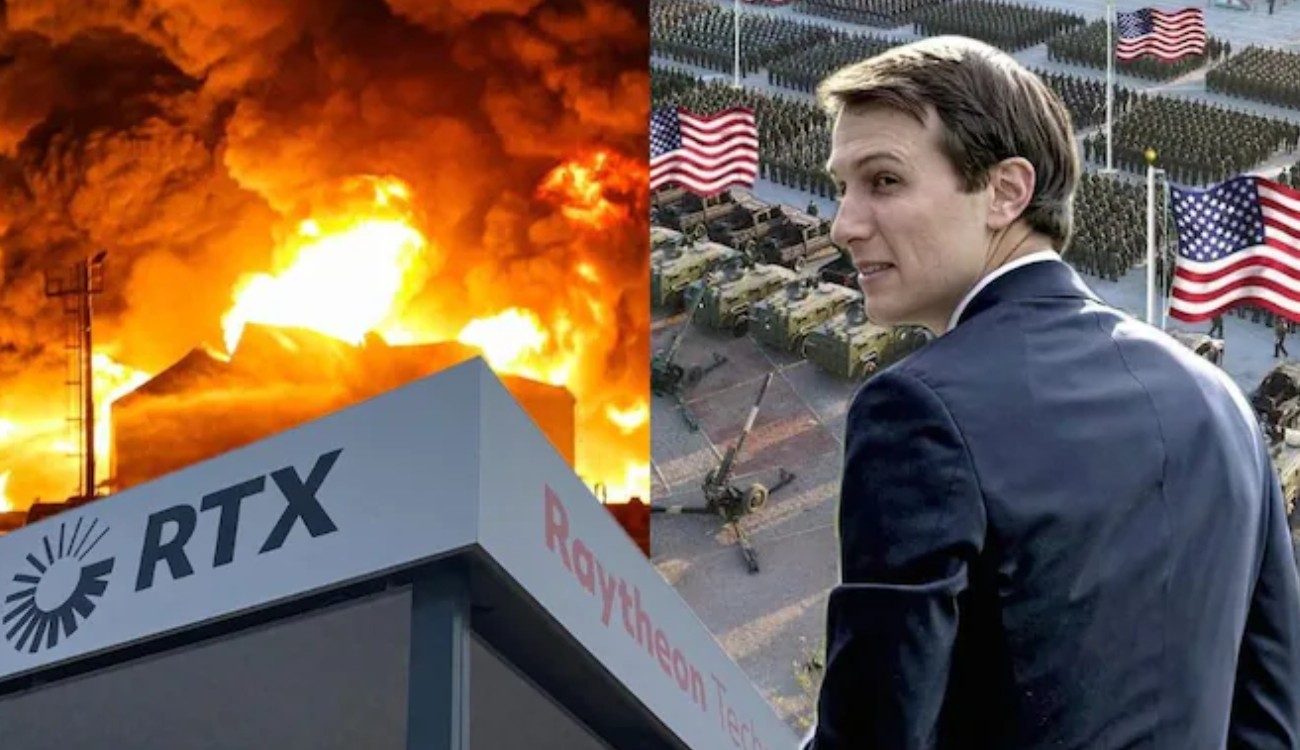
The most reliable beneficiary of the Iran war has never fired a shot, even though missiles are flying over the Gulf.
There is always a winner in war. And it’s almost never the country that started it. Iran is not the winner of the war in Iran. Its military has been greatly weakened, and its economy is under new sanctions. It is not Israel, which has made tactical gains but has not set a strategic goal. It’s not even the United States as a whole, where taxpayers are paying almost a billion dollars a day and regular people are paying 60% more for gas and groceries every time they go to the store.
A certain, well-funded, politically connected industry based in Virginia is the winner. It got richer because of Ukraine. It got more money from Iraq. It got more money from Afghanistan. And right now, in real time, it is getting more money from Iran.
The Military-Industrial Complex in the United States. And this time, the numbers are so big that they need to be said out loud.
The economy of the Tomahawk
Begin at 850. According to the Washington Post and the Center for Strategic and International Studies, that is how many Tomahawk cruise missiles the United States fired in the first month of Operation Epic Fury. It is the largest use of Tomahawks in a single conflict in American history, with more than the 802 fired during the Iraq War’s major combat phase. It costs $3.6 million to replace each one. That is 3.1 billion dollars worth of Tomahawk missiles that were used up in 30 days.
No one in Washington will answer this simple question directly. Who is responsible for paying for their replacement? The people of the United States do. According to Navy Times, the US Navy is now asking for a 1,200 percent increase in Tomahawk purchases for 2027. They want 785 missiles for 3 billion dollars. Raytheon, or RTX, gets that order. Its stock price went up 67% in the last year.
The cycle isn’t hard to understand. The war uses up the stockpile. The taxpayer pays for the replacement. The contractor keeps the difference. Do it again.
In 2025, RTX made 88.6 billion dollars, which was a 10% increase from 2024. Its Raytheon division’s profits went up 22% just because of the demand for Patriot and Tomahawk missiles. The company thinks it will make 93 billion dollars in sales in 2026. It has a confirmed order backlog of $268 billion. It has already grown its missile integration facility in Alabama by 50%.
Since the beginning of 2026, Lockheed Martin’s stock has gone up by almost 40%. In January, it signed a deal to increase THAAD interceptor production from 96 to 400 per year. The price of each THAAD interceptor is $12.77 million. During the war, there was one documented case where 11 Patriot missiles, each costing up to $4 million, were fired to stop one Iranian missile. It cost a lot less to shoot down the Iranian missile than it did to build it.
Who bought those 11 Patriot missiles? The people who pay taxes in the US. Who is putting them back in stock? Raytheon. Who made money on both sides of that deal? RTX. A Melius Research analyst told clients without shame that “defense spending was already set to rise sharply in 2026, and a long war with Iran will make the spending more necessary and less controversial.””MarketWatch was even more clear. “War can help businesses.” It is important to note that peace is the biggest threat to investors in these companies. When peace talks start, stocks in the defense industry go down. The Military Industrial Complex’s financial structure is based on the need for ongoing war.
The emergency that went around democracy
The Pentagon is now asking Congress for an extra $200 billion for the war, on top of a proposed $1.5 trillion military budget for 2027. This is a 66% increase over this year’s $901 billion defense budget. The Department of Defense is the only federal agency in the US that has never passed a financial audit. But the money keeps coming in.
Secretary of State Marco Rubio used an emergency waiver on March 19 to approve $16.5 billion in arms sales to the UAE, Kuwait, and Jordan without having to go through the normal congressional review process. The UAE got 8.4 billion dollars’ worth of drones, missiles, radar systems, and upgrades for F-16s. Kuwait got 8 billion dollars’ worth of radar systems for air defense. Jordan got $70.5 million in emergency help for its planes. The Wall Street Journal says that the UAE got another $7 billion in weapons through channels that US arms export rules don’t require to be made public. $23 billion. Accepted in 48 hours. Congress was completely left out.
At a Pentagon briefing on March 20, Defense Secretary Pete Hegseth summed up the philosophy. “Of course, it costs money to kill bad guys.” He didn’t say who consistently benefits from that money.
It is important to explain how the loop works. Iran attacked the UAE, Qatar, Bahrain, Kuwait, and Saudi Arabia because the US has military bases there. Iran’s missiles hit their infrastructure. They now need more American missiles to protect themselves from Iranian missiles. They will pay for them with their own oil money and have American defense contractors deliver them. Hegseth praised those same Gulf states for being “squarely in our orbit,” as he put it. That’s one way to talk about a group of customers.
People are already making plans for the next war.
The Wall Street Journal says that the Pentagon has talked to GM CEO Mary Barra, Ford CEO Jim Farley, GE Aerospace, and Oshkosh about turning car and industrial factories into weapons factories. Hegseth has said that this puts the US on a “wartime footing.” In 1942, the last time America told Detroit to stop making cars and start making weapons. They are not getting ready to end this war. They are getting ready for the next one.
Europe is doing exactly what the Virginia sales offices wanted. In 2024, the EU spent 343 billion euros on defense, which was a new record and a 19 percent increase. Poland is spending 4.8% of its GDP on defense in 2026, which is the highest percentage in NATO and even more than the US. The Bruegel Institute says that Poland took on $55 billion in US arms contracts in just two years. These included F-35s, Abrams tanks, and Patriot missiles, all made in the US. Friends of America are scared. The defense industry can always count on scared allies to buy from them.
The ceasefire table’s conflict of interest
Affinity Partners is a private equity firm run by Jared Kushner, Trump’s son-in-law and a member of the US delegation for the Iran ceasefire talks in Islamabad. Bloomberg said that by the end of 2025, its assets had grown by almost 30% in one year to 6.2 billion dollars. Saudi Arabia’s Public Investment Fund is the main investor, putting in $2 billion. Hundreds of millions more came from Qatar and Abu Dhabi after that. In March 2026, the House Oversight Committee sent Affinity a formal letter saying that the Saudis seemed to have “significantly increased” their promises to “curry favor” with Kushner in preparation for his father-in-law’s return to power.
This is the person who is at the ceasefire table. Running 6.2 billion dollars, almost all of which comes from the Gulf governments, who just spent 23 billion dollars on American weapons. When the talks are over, the treaties are signed, and the missiles are delivered, when does a conflict of interest become just part of doing business?
The last number
The S&P 500 hit an all-time high on April 15, the same day that Treasury Secretary Scott Bessent announced the end of Iran and Russia’s oil waivers and Putin said that his economy had shrunk by 1.8% in the first two months of 2026. The final number was 7,022.95. The Nasdaq also set a new record, rising more than 1.5 percent in just one session.
Prices for oil are still about 60% higher than they were at the start of 2026. Ordinary Americans are paying a conflict tax on everything that moves by boat, plane or truck. And Wall Street is at an all-time high.
Those two things happening simultaneously are not a coincidence. They are a system. A system in which war transfers wealth upward, to defence contractors, to private equity firms with Gulf backing, to the politicians who approve the budgets, while the cost travels entirely in the other direction.
850 Tomahawk missiles fired. 3.1 billion dollars in 30 days. A 1.5 trillion dollar military budget was requested for next year. Car factories being converted to weapons plants. And the S&P 500 at an all-time high.
Wars are sold as battles of principle. And in the trenches, they often are.
But from the boardroom, war is a ledger. The most profitable ledger ever written. For the same people. Every single time.