






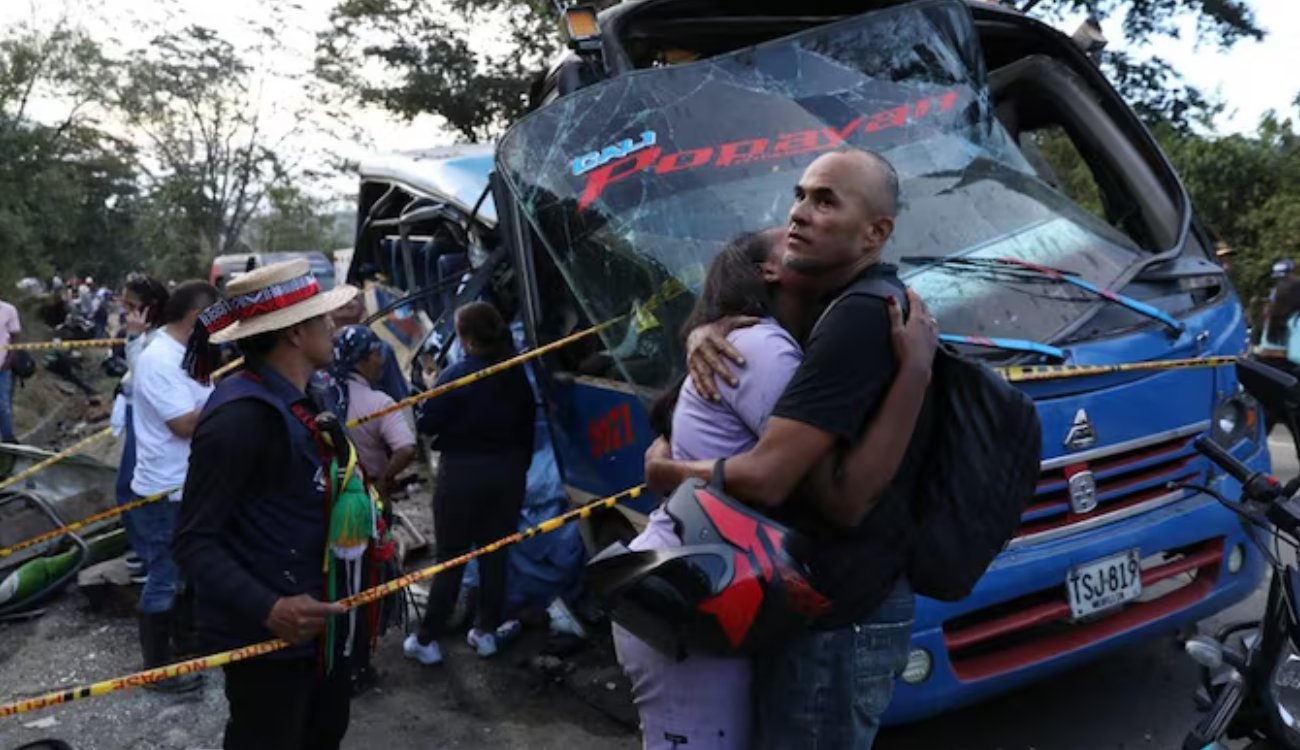
A bomb struck a bus on the Panamerican Highway in Cajibio, resulting in 13 fatalities and at least 38 injuries. This explosion occurred during a troubling rise in assaults in southwestern Colombia, raising demands for stricter security measures.
A bomb killed 13 individuals aboard a bus in southwestern Colombia on Saturday, an onslaught characterized by the country’s military leader as a “terrorist act,” which also resulted in a minimum of 38 injuries as violence associated with drug trafficking in the area intensifies.
Octavio Guzmán, the governor of Cauca, revealed on X that the bomb detonated while the bus was proceeding along the Panamerican Highway in Cajibio. Five children were amongst the injured, according to Cauca’s Health Secretary, Carolina Camargo, in a report by Noticias Caracol, a news television program.
Gen. Hugo López, head of Colombia’s Armed Forces, stated at a press conference that it was a “terrorist act” and attributed the attack to the network of a figure nicknamed “Iván Mordisco”— one of Colombia’s most sought-after individuals — along with the Jaime Martínez faction. Both groups are dissidents from the now-defunct Revolutionary Armed Forces of Colombia that operate in the vicinity.
Neither Iván Mordisco nor the Jaime Martínez faction is adhering to the peace agreement established with the state in 2016.
Colombian President Gustavo Petro denounced the attack on X.
“Those responsible for the assault that claimed seven civilians’ lives — and injured 17 others — in Cajibio, many of whom are Indigenous — are terrorists, fascists, and drug traffickers,” he expressed.
This incident is the latest in a series of bombings aimed at public infrastructures. At least 26 such events occurred in the past two days in southwestern Colombia, which López noted has predominantly affected civilians.
Incidents included a gunfire attack on a police station in rural Jamundí and an assault on a Civil Aviation radar facility in El Tambo, where authorities dismantled three drones filled with explosives earlier on Saturday. Fortunately, no injuries were reported.
On Friday, two vehicles packed with explosives were detonated near military installations in Cali and Palmira, leading to property damage.
The intensification of violence in that area — a territory contested by illegal armed factions linked to drug trafficking — triggered the assembly of high-ranking officials on Saturday. Led by Defense Minister Pedro Sánchez, the team, which includes regional governors and local leaders, was convening in Palmira at the time of the deadly explosion.
“These criminals aim to create fear, but we shall counter with resoluteness,” Sánchez declared on X.
Meanwhile, Francisca Toro, governor of Valle del Cauca, has urged the national authorities for “immediate support.” In a statement on X, Toro called for reinforcements of public security personnel, improved intelligence operations, and “decisive actions” against crime in the face of a “terrorist-level escalation.”
According to officials, Cauca and Valle del Cauca are pivotal hubs for illegal activities conducted by armed groups vying for control over maritime and river routes leading to the port of Buenaventura — a crucial conduit for drug trafficking to Central America and Europe.
The government has also announced a reward exceeding 1 million dollars for information that leads to the capture of “Marlon,” who is recognized as the leader of the region’s dissident faction. Additionally, local authorities offered over $14,000 for information that assists in identifying and locating those responsible for the attacks in Cali and Palmira.